
Ceramic vs. Carbon Window Tint: Which Is Right for Your Car?
The best window tint for Florida heat isn’t automatically the best fit for every driver. In the ceramic vs carbon window tint decision, compare the specific film’s performance data, shade, and appearance rather than relying on its category name. Your driving habits and priorities matter, too: a car parked outside for much of the day may call for a different balance of heat management and visibility than one used mainly for short trips.
If manufacturer performance claims have been hard to compare, start by separating the measurements. A film’s shade tells you how much visible light passes through, while infrared rejection and total solar energy rejection describe different aspects of performance. This guide explains what those specifications mean, how to compare them fairly, and how time in the Florida sun can shape your choice.
You’ll also learn what to consider about shade, visibility, and installation. PFM Performance Auto Group provides automotive window tinting in Hillsborough County, including Black Pearl Nano Ceramic Window Tint by Madico. Use the steps below to compare films against your needs and choose an option suited to your vehicle.
Key Takeaways
- Ceramic vs carbon window tint is a comparison of specific products, not a contest with one universal winner. Weigh heat-management figures, appearance, and your priorities.
- A darker-looking tint isn’t necessarily stronger at reducing heat. Compare documented performance at similar visible light transmission levels.
- Use a simple decision process: identify your driving needs, compare the same specifications, consider the shade, then select a film.
- For Tampa-area driving, consider how often your car sits or travels in direct sun, along with your visibility needs.
- PFM Performance Auto Group provides automotive tinting in Hillsborough County, including Black Pearl Nano Ceramic Window Tint by Madico.
Ceramic vs. Carbon Window Tint: What Is the Difference?
Neither ceramic nor carbon window tint is automatically best for every driver. They are different film categories, and the practical choice depends on the performance you want, the appearance you prefer, and the specifications of the individual film. A category name is a starting point, not a full description of how a particular product will perform.
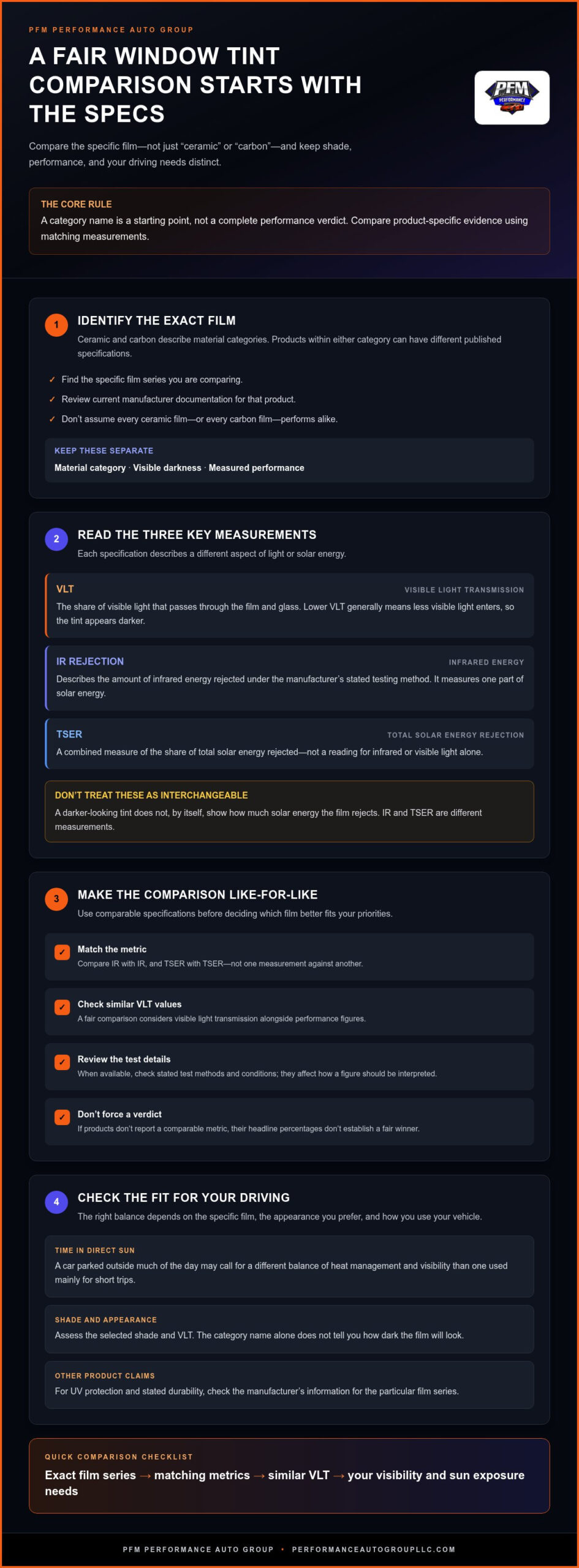
Keep three things separate when comparing films: material category, visible darkness, and measured performance. Material describes the tint category. Visible light transmission describes how much visible light passes through. The product’s specifications provide information about its tested performance.
What makes ceramic and carbon window films different?
Ceramic tint is a category of window film identified by ceramic-based material technology. Carbon tint is identified by carbon-based material technology. Those labels distinguish the types, but they don’t mean every product in a category uses the same materials, manufacturing methods, or performance targets. Manufacturers may offer different film series with different published specifications.
So a broad claim such as “ceramic always blocks more heat” shouldn’t take the place of a product-to-product comparison. The category offers context, but it doesn’t provide a complete performance verdict. For a general overview of window film technology, including common types and their properties, you can also review the broader subject beyond automotive tint.
For a useful comparison, identify the exact film series and review its current manufacturer documentation. Don’t assume one carbon film performs like every other carbon film, or that all ceramic products share the same results. In the ceramic vs carbon window tint decision, product-specific evidence is more useful than the category label alone.
What does window tint performance mean?
Film specifications describe different aspects of light and solar energy. Three terms are especially useful when comparing products:
- Visible light transmission (VLT): The share of visible light that passes through the film and glass. A lower VLT generally means less visible light enters, so the tint appears darker.
- Infrared (IR) rejection: The amount of infrared energy rejected under the manufacturer’s stated testing method. IR figures describe one part of solar energy, not the film’s overall performance.
- Total solar energy rejection (TSER): The share of total solar energy rejected, expressed as a combined measure rather than a reading for infrared or visible light alone.
These measurements aren’t interchangeable. VLT helps describe how dark the film looks, but darkness alone doesn’t establish how much solar energy it rejects. An IR figure and a TSER figure also refer to different measurements, so comparing them directly can lead to the wrong conclusion.
Compare like with like: use the same metric, similar VLT values, and current manufacturer documentation for each specific product. Check the stated test details when available, since measurement methods and conditions affect how a figure should be interpreted. If two products don’t report a comparable metric, don’t use their headline percentages to declare a winner.
How Ceramic and Carbon Tint Differ in Heat, UV, and Daily Comfort
A ceramic-versus-carbon comparison is most useful when it looks beyond the film category. Heat rejection, ultraviolet protection, appearance, and stated durability can differ between products, including films within the same category. Check the specifications for the particular film rather than assuming a ceramic or carbon label predicts the result.
Use this table to identify what to compare, not as a promise that every ceramic or carbon film performs alike:
| Comparison point | Ceramic film | Carbon film |
|---|---|---|
| Heat metrics | Compare the specific film’s infrared rejection and TSER figures. | Compare its infrared rejection and TSER figures using the same measurement basis. |
| UV claims | Check the manufacturer’s stated UV protection for that film. | Check the manufacturer’s stated UV protection for that film. |
| Appearance | Assess the selected shade and VLT; the category alone doesn’t tell you how dark it will look. | Assess the selected shade and VLT; don’t assume carbon automatically means darker. |
| Stated durability | Review the manufacturer’s durability information for the specific film series. | Review the manufacturer’s durability information for the specific film series. |
Compare matching performance metrics. IR and TSER measure different things, so putting unlike numbers side by side can make one film seem better without a fair basis.
How should drivers compare heat-rejection claims?
Infrared rejection describes a film’s performance against infrared energy under the manufacturer’s stated test conditions. Total solar energy rejection (TSER) describes rejection across a broader portion of solar energy. Neither figure, by itself, guarantees a particular cabin temperature or tells you exactly how cool a vehicle will feel. The vehicle, its glass, sunlight, and other conditions all affect comfort.
Compare IR with IR and TSER with TSER, ideally at similar VLT levels and with compatible test methods. If the documentation doesn’t make its test basis clear, treat the figures as not directly comparable instead of choosing whichever percentage is larger. Use current manufacturer documentation for the specific films you’re evaluating.
Do ceramic or carbon films affect UV protection and visibility?
Don’t infer UV protection from a category name. Look for the individual film’s published UV specification, and keep that claim separate from visible darkness and heat performance. VLT indicates how much visible light passes through; it doesn’t establish UV protection or total heat rejection.
Consider visibility alongside appearance, especially if you drive at night or rely on a clear view through side or rear windows. A darker shade may change what you see, even if it doesn’t indicate stronger heat rejection. Tint regulations also vary by vehicle and location. The FMCSA discussion of commercial-vehicle light transmission concerns commercial motor vehicles, so it shouldn’t be treated as a guide to rules for every passenger car.
Once you’ve narrowed your priorities and compared the relevant specifications, you can book professional tint installation as the next step in choosing a film for your vehicle.
Is Ceramic Tint Worth Choosing Over Carbon Tint?
Whether ceramic is worthwhile depends on what you want the film to do. If managing solar heat is high on your list, ceramic is an option to consider, but its category name alone can’t establish how it performs. Carbon isn’t automatically a poor choice, either. Compare the actual specifications and decide which benefits matter for your vehicle and routine.
A common misconception is that the darkest-looking tint must be the best at reducing heat. Darkness describes appearance and visible light transmission, not heat rejection. Two films that look similarly dark can have different performance figures, while a lighter-looking option may have specifications that better match your priorities. Choose by comparable product data, not shade alone.
When might ceramic tint suit your priorities?
Ceramic may suit drivers who put heat-management performance near the top of their decision. For example, if your vehicle spends long periods parked in the sun or you regularly drive during bright, warm parts of the day, give the film’s published heat specifications particular attention. Those circumstances help define what to compare, but they don’t guarantee a particular cabin temperature.
Review the current manufacturer data for the specific product, including the measurement type and test conditions. Compare equivalent figures instead of treating “ceramic” as proof of a set performance level. The vehicle’s glass, selected shade, weather, and use all affect what you experience. Specifications are a comparison tool, not a promise of a precise comfort result.
When might carbon tint be a reasonable fit?
Carbon can be a reasonable option if its appearance and documented performance suit your everyday needs. You may prefer a particular shade or want to balance appearance and performance without making heat rejection the only deciding factor. That doesn’t make carbon inferior by default. The decision should reflect the exact film’s characteristics and how they align with your priorities.
Review a carbon film’s specifications as carefully as you would for ceramic. Look for comparable heat measurements, stated UV protection, and durability information, then consider those details alongside how the shade looks from inside and outside the car. Don’t assume every carbon product shares the same performance or appearance.
Before comparing films, write down your priorities. This keeps the decision focused on what matters in daily use:
- Heat focus: Give more weight to relevant, comparable heat-management specifications.
- Appearance: Decide on a shade without treating darkness as a substitute for performance data.
- Daily use: Consider driving times, where the vehicle is usually parked, and how visibility factors into your routine.
- Product evidence: Compare current manufacturer documentation for the exact film series, not general claims about a material category.
In the ceramic vs carbon window tint decision, value means finding the combination of appearance and documented performance that fits your needs. Neither material wins for everyone. A careful comparison helps you set realistic expectations and choose based on the film’s published details and your driving conditions.
Choosing Window Tint for Tampa Driving: A Practical Comparison
A useful tint choice starts with your actual routine, not a generic claim about which film is best. Drivers in Tampa and Hillsborough County may spend time in bright sun while commuting, running errands, or parking outdoors, but those habits vary. Let your routine guide which features matter, then compare the specific film’s specifications and appearance. This makes the ceramic vs carbon window tint comparison practical without assuming every driver needs the same result.
Which factors matter most for your driving routine?
Think about where you usually park, when you tend to drive, and what cabin comfort means to you. If your car is parked outside for much of the day, you may want to prioritize documented heat-management performance. If you regularly drive at night, visibility and shade may deserve equal attention. Consider these needs together: no category label can account for your vehicle’s glass or your preferences.
How do you make a confident final choice?
Start with the two or three benefits that matter most, such as heat-management data, a particular appearance, or visibility. Check the exact film’s current manufacturer specifications against that short list. Compare matching metrics and note the shade you’re considering. This keeps your decision grounded in information about the film you’d actually select, rather than assumptions about ceramic or carbon as broad categories.
- Identify your priorities. Note parking exposure, typical driving hours, comfort goals, appearance, and visibility needs.
- Compare specifications. Review current manufacturer documentation for each film, matching metrics and comparable VLT values where possible.
- Consider appearance. Think about how the selected shade looks and how much visible light you want passing through the windows.
- Select with both needs in mind. Choose the film whose documented specifications and appearance best fit your vehicle and routine.
Keep Florida legality separate from performance. A film’s heat or UV specifications don’t establish whether a particular shade complies with rules for your vehicle. For details, refer to the Florida tint law guide and consider the requirements relevant to your vehicle before selecting a shade.
If you’d like more context on professional installation in the area, the Tampa car tinting guide offers a broader local perspective. A suitable film and professional application can help give your vehicle a neat, finished appearance.
Ready to take the next step?
Explore Ceramic and Carbon Tint Installation at PFM in Hillsborough County
Choosing between ceramic and carbon film is only part of the decision. The film’s specifications, shade, and fit with your driving priorities matter, and careful professional application contributes to the finished look. PFM Performance Auto Group provides automotive window tinting in Hillsborough County.
PFM offers automotive window tinting and Black Pearl Nano Ceramic Window Tint by Madico as a ceramic option. If you’re weighing ceramic against carbon, first identify which specifications matter most, what appearance you prefer, and what visibility you need for daily driving. Then compare the exact products using matching measurements.
What can drivers expect from a professional tinting service?
A considered tint choice begins with a clear understanding of the selected film and your goals for the vehicle. Heat-management priorities, appearance, and visibility can all shape the choice. Product documentation provides a basis for comparing performance; the category name alone doesn’t settle the question.
Careful application matters, too. Window tint is a visible part of a vehicle, so attention to fit and finish affects its overall presentation. Professional automotive tinting at PFM includes application of window film to vehicles. Set expectations using the specific film’s documentation and your vehicle’s conditions, rather than assuming any material guarantees a particular cabin temperature or outcome.
Keep your comparison practical as you prepare to choose:
- Metrics: Compare the same heat and UV measurements from current manufacturer documentation.
- Priorities: Decide whether heat management, appearance, visibility, or a balance of features matters most to you.
- Shade and legality: Choose an appearance that suits your needs while accounting for applicable Florida requirements.
How can you take the next step with PFM?
Once you’ve narrowed your preferences, PFM’s automotive tinting service provides Hillsborough County drivers with professional film application. Black Pearl Nano Ceramic Window Tint by Madico is one ceramic option offered by PFM. Compare the specific film details with your priorities, and make sure the shade you select aligns with the requirements that apply to your vehicle.
A careful decision doesn’t mean choosing a category just because it sounds more advanced. Compare the film’s documented metrics, consider the look you want, and select an option that fits how you use your car. PFM Performance Auto Group provides automotive tinting in Hillsborough County, with attentive application focused on your vehicle and chosen film.
Make Your Tint Choice With Confidence
Turn your priorities into a clear film choice. Keep the specifications that matter most in view, decide which shade suits your visibility needs, and account for applicable requirements. That gives you a practical basis for the ceramic vs carbon window tint decision, rather than relying on appearance or category labels alone.
PFM Performance Auto Group provides professional automotive tinting in Hillsborough County. If you’re considering ceramic, PFM offers Black Pearl Nano Ceramic Window Tint by Madico. Compare the film’s specifications with your needs, then choose a shade that fits your daily driving and applicable requirements.
Book your automotive tinting appointment with PFM Performance Auto Group to take the next step toward a film choice that suits your car and routine.
Frequently Asked Questions
Is ceramic tint better than carbon tint for Florida heat?
Ceramic may be a better fit if heat management is your leading priority, but the specific film’s documented performance matters more than its category label. For the ceramic vs carbon window tint decision, compare equivalent heat-rejection measurements for the exact films you’re considering. A driver whose car sits outside through the afternoon may weigh those figures differently from someone who mainly wants a particular look for shorter trips.
Does carbon window tint block heat as well as ceramic tint?
Some carbon films may offer useful heat rejection, but you can’t assume they match a particular ceramic film without comparing specifications. Check infrared rejection and total solar energy rejection separately, and make sure the figures use comparable test methods. For example, if one product lists an infrared figure and the other only a total solar energy figure, those numbers don’t establish which film rejects more heat overall.
Can ceramic window tint be light in color and still reduce heat?
Yes, a lighter shade can still have heat-management properties, depending on the exact film. Shade relates to visible light transmission, while heat performance is assessed through separate product measurements. If you prefer a lighter appearance for outward visibility, compare the manufacturer’s heat specifications for lighter-shade options instead of choosing a darker film based on looks alone. Confirm the shade also suits your vehicle and applicable requirements.
How can I compare ceramic and carbon tint heat-rejection percentages?
Compare the same metric at a similar visible light transmission level, using current manufacturer data for each film. Infrared rejection and total solar energy rejection describe different measurements, so don’t compare one film’s infrared percentage directly with another’s total rejection figure. Check the stated testing basis, too. If it’s unclear or differs between products, treat the figures as incomparable until you have matching information.
Does ceramic window tint interfere with cell phone or GPS signals?
Ceramic window tint is non-metallic, so it generally doesn’t interfere with cell phone or GPS signals. Signal issues are more commonly associated with metallic films, which can affect radio-frequency transmission. If reliable reception is important for navigation, test your usual devices after installation in the vehicle’s normal driving areas. Signal strength can also vary for reasons unrelated to tint, such as coverage, terrain, or the device itself.
Is ceramic or carbon tint better for nighttime visibility?
Neither material category guarantees better night visibility. The selected shade and its visible light transmission are more directly relevant, along with your eyesight, the vehicle’s windows, and how much you drive after dark. A shade that looks subtle outside may still feel different from the driver’s seat at night. Consider nighttime visibility before settling on a darker appearance, especially for windows you rely on when reversing or changing lanes.
What should Tampa drivers consider before choosing ceramic or carbon tint?
Tampa and Hillsborough County drivers should consider where they park, how often they drive in direct sun, and whether heat management, appearance, or nighttime visibility matters most. Then compare the exact films’ specifications using matching measurements and choose a shade that fits your routine. Florida tint requirements are a separate part of the decision, so review current rules for your vehicle before selecting a film or shade.