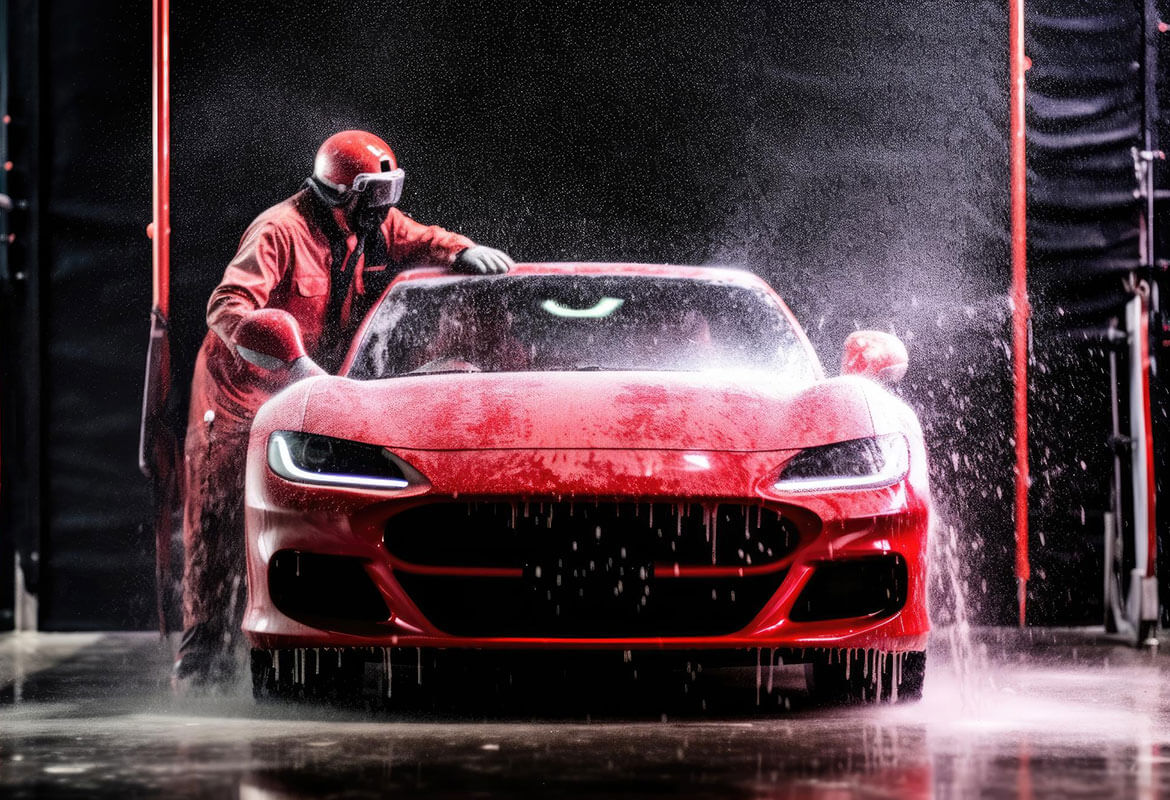

Windshield Heat Rejection Film: The 2026 Guide to Cooler Florida Driving
Imagine climbing into your car after a long afternoon in the Tampa sun, only to find the steering wheel too hot to touch and the leather dashboard radiating a punishing, dry heat. It’s a familiar, exhausting ritual for every Florida driver. We understand that your vehicle is a significant investment, and the brutal ultraviolet rays that bake our coastal roads don’t just cause discomfort; they actively degrade your interior. You deserve a cabin that remains a sanctuary, even when the thermometer hits triple digits. High-performance windshield heat rejection film offers the ultimate solution by blocking up to 87% of infrared heat before it ever passes through the glass.
You likely agree that standard glass simply isn’t enough to combat the blinding glare on I-275 or the rising cabin temperatures of a Florida summer. We’re here to show you that modern nano-ceramic technology provides crystal-clear visibility while meeting strict state legal standards. This 2026 guide explores how you can achieve a significant reduction in AC load and protect your dashboard from cracking. We’ll break down the science of solar energy, explain the legal nuances of the AS-1 line, and help you choose a shield that keeps you cool without compromising your view of the road.
Key Takeaways
- Understand why the windshield is your vehicle’s largest thermal entry point and how blocking infrared radiation preserves your interior sanctuary.
- Discover how nano-ceramic windshield heat rejection film filters out punishing heat while maintaining the crystal-clear visibility required for safe nighttime driving.
- Learn the difference between privacy tinting and performance films to choose the right balance of heat protection and factory aesthetics for your car.
- Navigate Florida’s 2026 legal landscape, including the AS-1 line restrictions and the requirements for non-reflective films on front glass.
- Identify why a meticulous, master craftsman installation is critical for protecting modern windshield sensors and ensuring a clean, distraction-free view.
The Science of Solar Heat Gain: Why Your Windshield is a Heat Magnet
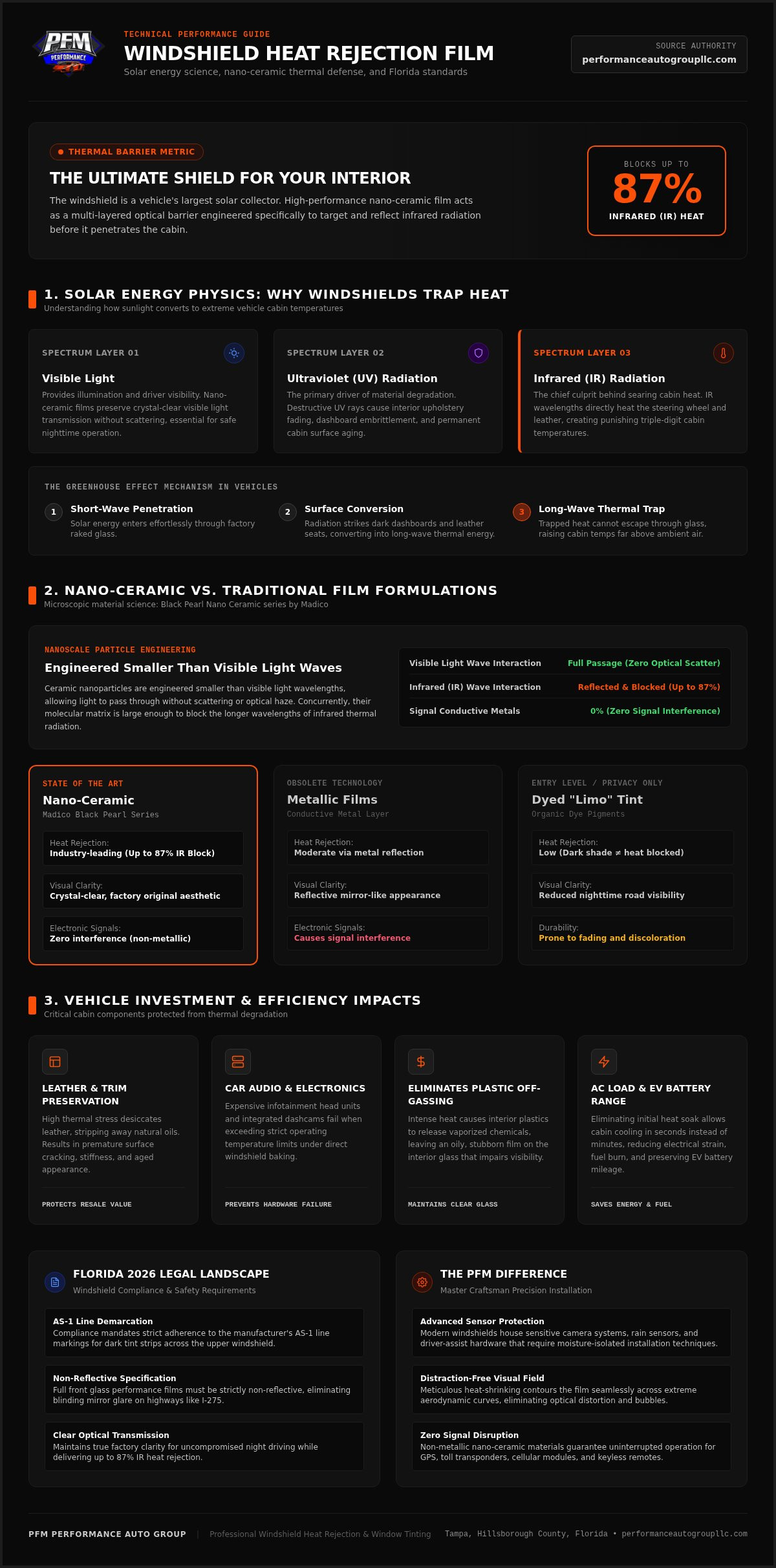
Your windshield is essentially a massive solar collector. Because it is the largest piece of glass on your vehicle and often sits at a raked, aerodynamic angle, it invites a staggering amount of energy into your cabin. Solar energy hits your car in three distinct forms: visible light, ultraviolet (UV) radiation, and infrared (IR) radiation. While UV rays are responsible for fading your upholstery, infrared radiation is the primary culprit behind the searing heat that makes your steering wheel untouchable. When evaluating the construction of automotive window film, it’s vital to understand how these layers interact with different wavelengths of light to provide protection.
The real danger lies in the greenhouse effect. Short-wave radiation from the sun passes through your factory glass with ease. Once this energy strikes your dashboard or seats, it converts into long-wave thermal energy. This trapped heat cannot escape back through the glass, causing interior temperatures to climb far beyond the ambient air temperature outside. We define windshield heat rejection film as a multi-layered optical barrier engineered specifically to target and reflect the IR spectrum while maintaining total visual clarity. It acts as a guardian for your vehicle, ensuring that the energy that enters doesn’t become the heat that stays.
Protecting Your Interior Investment
Excessive heat is the silent enemy of a well-maintained interior. Over time, high temperatures cause leather to desiccate and lose its natural oils, leading to unsightly cracks and a stiff, aged feel. This thermal stress also affects your car audio and electronics, including expensive head units and integrated dashcams that can fail if they exceed their operating temperature limits. High heat also triggers off-gassing, a process where interior plastics release chemicals that create a stubborn, oily film on the inside of your glass. By installing a high-quality film, you’re not just buying comfort; you’re preserving the financial value of your property.
AC Efficiency and Fuel Economy
Reducing the initial heat soak is the fastest way to improve your driving experience. When your car sits in the Hillsborough sun, every component absorbs heat. This forces your air conditioning system to work at maximum capacity for several minutes just to reach a tolerable level. This constant strain on your vehicle’s electrical system consumes fuel and, for EV owners, directly impacts battery range. Preserving that range is a top priority during Florida summers, and a ceramic shield is the most effective tool for the job. It’s a meticulous upgrade that pays dividends in both comfort and efficiency every time you start the engine.
Nano Ceramic Technology: The Gold Standard for Heat Rejection
The secret to modern heat management lies in the microscopic world of nanotechnology. In the past, blocking heat meant using heavy dyes or reflective metals, but nano-ceramic technology has changed the rules. These films contain ceramic nanoparticles that are specifically engineered to be smaller than the wavelengths of visible light. This allows light to pass through without scattering, which ensures your view remains sharp and clear. However, these same particles are large enough to act as a barrier against the longer wavelengths of infrared radiation. This scientific precision allows a windshield heat rejection film to perform like a heavy-duty shield without looking like one.
We exclusively utilize the Black Pearl Nano Ceramic series by Madico because it represents the pinnacle of this technology. It offers a sophisticated, neutral color that complements any vehicle aesthetic while providing industry-leading clarity. Many drivers mistakenly believe that a film must be dark to be effective. In reality, the “limo tint” of the past often rejected less heat than a modern, nearly clear ceramic film. By focusing on the material science rather than just the shade, we can provide a solution that looks factory-original but performs at an elite level.
Why Ceramic Outperforms Metallic and Dyed Films
Choosing ceramic is a decision rooted in both performance and longevity. Unlike metallic films, ceramic contains no conductive materials, meaning it offers zero signal interference. This is essential for the seamless operation of your GPS, cell signals, and Tire Pressure Monitoring Systems (TPMS). Older dyed films are notorious for their lack of color stability; they often turn purple or develop bubbles after a few seasons in the Florida sun. Ceramic films are inherently stable and will never lose their hue. Our meticulous approach ensures that you won’t experience the “haze” or “orange peel” effect that often plagues lower-quality installations, providing you with perfect visibility during difficult night drives.
Understanding TSER and IR Rejection
When comparing films, you’ll see various percentages, but Total Solar Energy Rejected (TSER) is the most accurate metric. While almost every film on the market offers 99% UV protection, TSER measures the film’s ability to block the entire solar spectrum, including visible light and infrared heat. The Skin Cancer Foundation recommends high-quality window films as a vital part of a sun-protection regimen, as they significantly reduce your exposure to harmful rays while you’re behind the wheel. Infrared rejection is the true differentiator that determines how cool your cabin actually feels. High-quality nano-ceramic films can block over 80% of infrared heat while remaining nearly invisible. If you’re ready to experience this level of protection, you can schedule a consultation to find the perfect fit for your vehicle.
Windshield Heat Rejection vs. Privacy Tint: Which Do You Need?
Many Hillsborough drivers assume that “cool” must mean “dark.” They often associate the deep charcoal shades of side windows with thermal protection. While darkness provides privacy, it isn’t the primary engine behind heat management. Privacy tinting focuses on aesthetics and security by limiting visible light. In contrast, windshield heat rejection film focuses on the invisible spectrum of solar energy. For a deeper look at the darker aesthetic options for your vehicle, see our guide on Automotive Privacy Window Tint in Tampa. We help you distinguish between the look you want and the protection you need.
The ‘Invisible’ Shield: Clear Ceramic Films
For many of our clients, maintaining the Original Equipment Manufacturer (OEM) look is a top priority. They want the protection of a high-end film without the aesthetic of a modified vehicle. This is where clear ceramic films, typically in the 70% or 80% Visible Light Transmission (VLT) range, excel. These films are virtually indistinguishable from factory glass to the naked eye. Despite their clarity, they provide massive heat relief by blocking up to 95% of infrared radiation. This makes them an ideal application for luxury vehicles with high-end interior finishes that need protection from the sun but deserve to be seen clearly. These films are also the perfect choice for drivers with vision restrictions who cannot safely navigate with darker glass. You get the comfort of a cool cabin without changing the character of your vehicle.
Glare Reduction and Driver Fatigue
Driving across the Howard Frankland Bridge into a setting sun is a grueling experience for any Tampa commuter. The intense solar glare creates immediate eye strain and physical exhaustion. A high-performance windshield heat rejection film significantly reduces this blinding light, acting like a high-end pair of polarized sunglasses for your car. This isn’t just about comfort; it’s a critical safety upgrade. Reducing glare helps you spot hazards faster and reduces the “squint factor” that leads to driver fatigue. The key is finding the right balance. We help you choose a VLT that cuts the glare during the day while ensuring your night driving remains safe and crystal-clear. It’s a precise calibration that only a master craftsman can provide. Your safety depends on your ability to see the road, and our films ensure that view is never compromised.
Florida Windshield Tint Laws and Safety Standards in 2026
Compliance is the cornerstone of a professional installation. We understand that navigating the specifics of Florida Statute § 316.2952 can feel overwhelming, but it’s essential for your safety and legal peace of mind. As your trusted advisors, we ensure that every application of windshield heat rejection film aligns with the highest industry standards. Florida law is precise: any sunscreening material applied to the front windshield must be non-reflective. Typically, darker films are restricted to a specific region at the top of the glass, leaving the primary viewing area clear for unobstructed navigation. We take the time to explain these boundaries because we value your investment as much as you do.
The AS-1 Line Explained
The AS-1 line represents the legal boundary for traditional, dark tint strips on a front windshield. You can find this small mark etched into the factory glass near the upper corners. Above this line, you’re permitted to install a non-reflective “sun strip” to block the punishing glare of the morning horizon. Below this line, the law requires the glass to remain clear to ensure the driver’s vision isn’t compromised. We take pride in our meticulous adherence to Florida window tint law, ensuring your vehicle remains a sanctuary of comfort without attracting unwanted legal attention. For those who require full-face protection due to light sensitivity, the Florida Window Tint Exemption provides a lawful pathway for medical necessities through official HSMV certification.
While the letter of the law focuses on the AS-1 line, the reality of 2026 driving often involves nearly invisible ceramic films. These 70% or 80% VLT films are designed to be optically indistinguishable from factory glass while providing massive heat relief. Because they are non-reflective and maintain factory-level clarity, they represent the “missing link” in total vehicle protection. We always recommend staying within the bounds of safety and legality to ensure your insurance coverage and factory warranties remain intact.
Safety and Night Visibility
Safety is never a secondary concern in our shop. We’ve seen the dangers of “illegal” dark windshield tints firsthand; they severely compromise peripheral vision and make nighttime navigation a genuine hazard. This is why we strictly install high-VLT, non-reflective windshield heat rejection film on the main viewing area. These advanced materials prevent the “ghosting” or “starburst” distortion often caused by oncoming headlights or streetlights on the Selmon Expressway. A professional, master craftsman installation ensures that the film bonds perfectly to the glass, eliminating the risk of bubbles or peeling that can distract a driver. We refuse to compromise your safety for a look that isn’t sustainable. Our goal is to provide a shield that protects your skin and your interior while keeping your view of the road crystal clear.
The PFM Performance Difference: Professional Windshield Tinting in Tampa
The windshield is undoubtedly the most challenging piece of glass to treat on any modern vehicle. It requires a level of patience and precision that only a seasoned Master Craftsman can provide. At PFM Performance Auto Group, we don’t just apply film; we curate a protective barrier for your most valued property. We operate within a controlled, clean-room environment to ensure that no dust specks or contaminants find their way into your line of sight. This meticulous dedication to detail is what sets us apart in the Tampa market. We treat every car that enters our shop as if it were our own, ensuring the final result is nothing short of elite.
Modern vehicles are equipped with complex Advanced Driver-Assistance Systems (ADAS) and integrated dashcams located right behind the rearview mirror. Attempting a DIY installation or choosing a high-volume, low-cost shop often leads to sensor failure or permanent water damage. PFM Performance Auto Group possesses the specialized expertise required to work around these sensitive electronics safely. Our team understands how to navigate the tight tolerances of modern dashboards, ensuring your windshield heat rejection film is installed without compromising your vehicle’s safety features. We take the time to do it right because your peace of mind is our primary objective.
Our Meticulous Installation Process
Our process begins with precision heat-shrinking on the exterior of the glass to perfectly match the complex, multi-dimensional curves of your windshield. This step is critical for preventing “fingers” or creases that could distort your view. We utilize advanced water management techniques, using specialized absorbent ropes and covers to protect your dashboard electronics from moisture during the application. Finally, every vehicle undergoes a rigorous multi-point inspection to guarantee optical perfection and edge-to-edge coverage. It’s a slow, intentional process designed to exceed your expectations and ensure a lifetime of performance.
Ready for a Cooler Drive?
The transformation of your vehicle is immediate and profound. You’ll enjoy a significantly cooler cabin, an interior protected from the long-term damage of UV rays, and a dramatic reduction in the blinding glare of the Florida sun. We invite you to experience the premium reassurance that comes with a professional consultation and a master-level installation of high-quality windshield heat rejection film. Don’t settle for “good enough” when it comes to your comfort and safety. Take the final step toward a better driving experience in Hillsborough County and see why PFM Performance Auto Group is the choice for drivers who value their investment.
Secure Your Sanctuary on the Road
Your vehicle is more than just a means of transportation; it’s a significant investment that deserves the highest level of care. We’ve explored how the windshield acts as the primary gateway for solar energy and why advanced nano-ceramic technology is the only solution that truly addresses the root of the problem. By choosing a high-performance windshield heat rejection film, you’re investing in long-term interior protection and a level of daily comfort that traditional glass simply can’t provide. You’ve learned that you don’t have to sacrifice visibility or legal compliance to achieve a cooler, safer cabin.
Since 2004, we’ve dedicated ourselves to mastering the art of automotive enhancement for the unique demands of the Hillsborough climate. As an authorized Madico Black Pearl dealer, we bring over 20 years of expertise to every installation, ensuring your vehicle receives the meticulous attention it requires. We’re proud to be your trusted advisors in this process, guiding you toward solutions that enhance both your safety and your property’s longevity. It’s time to stop enduring the heat and start enjoying the drive again.
We look forward to earning your business and showing you the difference that master craftsmanship makes. Your journey toward a cooler Florida drive begins with a single, intentional choice.
Frequently Asked Questions
Is it legal to tint the full windshield in Florida?
Yes, but with specific restrictions. Florida law allows dark tint only above the manufacturer’s AS-1 line. For the rest of the glass, most Hillsborough drivers choose a nearly clear 70% or 80% VLT ceramic film. These films are non-reflective and designed to block heat without obstructing your view. If you have a medical necessity, you can apply for an official exemption to use darker materials across the entire surface.
Does windshield heat rejection film affect night visibility?
High-quality windshield heat rejection film is engineered for maximum optical clarity. When you opt for a 70% or 80% nano-ceramic film, you won’t notice a reduction in visibility. In fact, these films often improve your night driving experience by reducing the “starburst” effect and glare from oncoming LED headlights. We prioritize your safety by ensuring the material remains indistinguishable from factory glass while providing elite thermal protection.
Will ceramic film interfere with my Toll Pass or GPS?
Ceramic technology is completely non-metallic and non-conductive. This means it won’t interfere with your SunPass, GPS, cell signals, or Tire Pressure Monitoring Systems. Unlike older metallic films that acted as a signal shield, ceramic nanoparticles allow radio waves to pass through effortlessly. You can enjoy a significantly cooler cabin in the Tampa sun without ever losing connectivity or having issues at the toll plaza on the Selmon Expressway.
How long does it take to install windshield heat rejection film?
A professional installation typically requires between 90 minutes and two hours. This timeframe allows our master craftsmen to perform a meticulous deep clean of the glass and precision heat-shrink the film to match your windshield’s complex curvature. We also take extra care to protect your dashboard electronics from moisture. We don’t believe in “fast” service; we believe in doing the job correctly so it lasts for the life of your vehicle.
Can heat rejection film be installed over a dashcam or radar detector?
We apply the film to the interior surface of your glass. If you have a dashcam or radar detector mounted with adhesive, we recommend waiting at least 72 hours for the film to fully cure before reattaching them. Our team has extensive experience working around factory-installed sensors and ADAS cameras. We ensure the film is trimmed with extreme precision so it doesn’t obstruct the vital safety electronics that protect you on the road.
What is the difference between IR rejection and TSER?
TSER is the most accurate way to measure performance. While IR rejection only tracks how much infrared heat is blocked, Total Solar Energy Rejected (TSER) accounts for the entire solar spectrum, including visible light and UV rays. A film might boast 99% IR rejection but have a lower TSER if it lets too much visible light through. We help you understand these metrics to ensure you’re getting the most effective thermal barrier available.
How do I clean my windshield once the heat rejection film is installed?
Maintenance is simple but requires the right materials. Always use a clean microfiber cloth and a glass cleaner that is specifically labeled as ammonia-free. Ammonia is a harsh chemical that can eventually break down the scratch-resistant coating and the adhesives of your windshield heat rejection film. Avoid using paper towels or abrasive sponges, as these can leave fine scratches that compromise the meticulous clarity of your master-level installation.
Does the film go on the inside or the outside of the windshield?
The film is permanently installed on the inside of your windshield. During the preparation stage, we place the film on the outside of the glass to heat-shrink it and cut it to the exact dimensions of your vehicle. However, once the film is shaped, it is moved to the interior surface for the final application. This placement protects the film from road debris, wipers, and the harsh Florida elements, ensuring its longevity.