

Reduce Energy Costs With Window Film in Hillsborough: Costs and Savings
In Hillsborough, window film can help lower cooling demand by limiting solar heat entering through glass, though reducing heat gain can also affect heating needs in cooler periods. For homeowners hoping to reduce energy costs with window film in Hillsborough, the practical question is how the right film balances solar control, natural light, and year-round comfort.
When sunny rooms feel warm and the air conditioning works harder, window film can help reduce heat entering through the glass. It can also reduce glare and help protect furnishings from sun exposure. The energy savings depend on the building, its windows, and the film selected, so results vary from home to home.
This article explains how window film affects cooling and heating costs, and how glass type and window direction influence film selection. It also covers project costs and incentives to help you assess a potential upgrade.
Key Takeaways
- Window film limits solar heat entering through glass while allowing visible light through, helping explain its effect on cooling demand.
- UV protection can slow fading of furnishings, though sunlight is only one contributor to color changes.
- Film choice depends on factors such as glass type, window direction, and the balance between heat control and natural light.
- Installation costs and available utility incentives depend on project details and program requirements, so they belong in the overall savings calculation.
- Consider both cooling benefits and possible winter heating effects when assessing whether film suits your home or building.
How Does Window Film Work?
Window film changes how sunlight passes through glass, limiting some solar energy before it heats the interior. Unlike low-E window replacement, film works with existing glass. Shades and exterior shading also manage sunlight, but can affect daylight and views.
Blocking UV and Infrared Light
Solar window film filters parts of sunlight, blocking ultraviolet light and, depending on the film, infrared light while allowing visible light through. Because sunlight entering a room can add heat and contribute to fading, reducing the infrared energy passing through a sunny window can make the room feel cooler while preserving daylight.
Different films handle light in different ways, so blocking one part of the solar spectrum doesn’t mean the glass becomes opaque. A film’s Visible Transmittance rating, expressed on a scale from 0 to 1, indicates how much visible light passes through. Higher values mean more visible light enters, which helps frame the trade-off between solar control and a bright interior.
Solar Control and Spectrally Selective Films
Solar-control films reduce the solar energy entering through glass. Spectrally selective films are designed to control certain parts of sunlight while admitting more visible light. This distinction matters when you want to manage heat and glare without making a room noticeably darker. A bright workspace, for example, may need a different balance than a room where reducing incoming solar energy is the main priority.
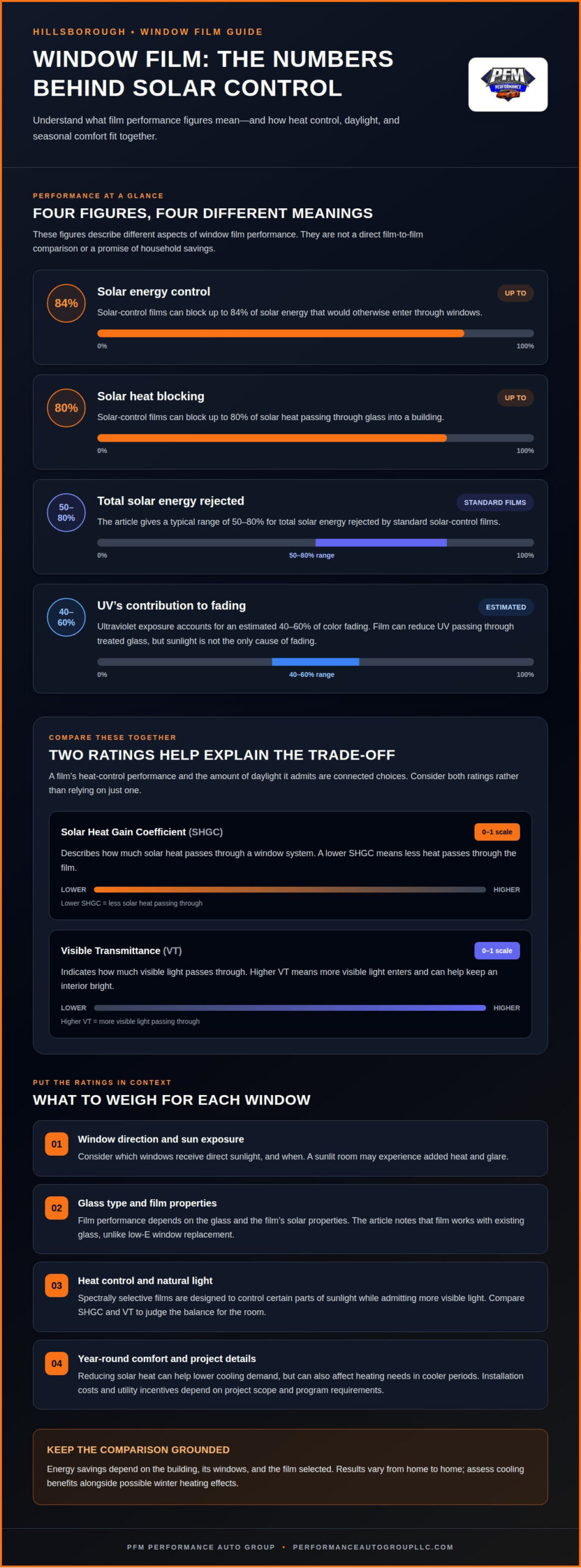
Solar-control films can block up to 84% of solar energy that would otherwise enter through windows. The exact balance depends on the film’s light transmission and solar performance, rather than the label alone. Comparing those characteristics helps explain why two films that look similar can behave differently on the same sun-exposed window.
Solar Heat Gain Coefficient
The Solar Heat Gain Coefficient, or SHGC, describes how much solar heat passes through a window system. It is expressed on a scale from 0 to 1; a lower SHGC means less heat passes through the film. This gives property owners a useful comparison point when evaluating solar control, especially for windows that receive direct sunlight.
Consider Solar Heat Gain Coefficient (SHGC) alongside Visible Transmittance, not on its own. A lower SHGC can indicate stronger heat control, while a higher Visible Transmittance means more daylight passes through. Comparing both values helps you judge whether a film suits a room where comfort and natural light both matter.
Solar Heat Blocking
Solar heat blocking limits the heat entering a building through its windows, reducing the solar load that contributes to indoor warmth. Solar-control films can block up to 80% of solar heat passing through glass into a building. That can matter most in a sunlit room where incoming heat adds to the cooling demand.
Film doesn’t remove every source of heat or replace the window itself. Its effect depends on the glass, the film’s solar properties, and the sunlight reaching that window. Total solar energy rejected by standard solar-control films typically ranges from 50-80%, illustrating why film performance is a comparison of several properties, not one universal figure.
UV protection and fading prevention
Ultraviolet exposure contributes to interior fading, so window film can help protect furnishings exposed to sunlight. This is particularly useful for fabrics, artwork, and flooring near windows that receive direct light.
UV Protection
Window film reduces the ultraviolet light passing through treated glass. That can matter in rooms where sunlight reaches valuable furnishings, such as a living room with a sofa beside a west-facing window.
UV exposure causes an estimated 40% to 60% of color fading. This makes UV control a meaningful part of protecting interior materials, although it doesn’t prevent every cause of fading. A rug near a bright window, for example, may still receive light and heat even when film reduces UV transmission.
UV protection depends on the film selected, so match its performance to the room’s needs. A space displaying artwork may call for a different balance than a family room where preserving daylight also matters. Consider how much direct sunlight reaches each area.
To assess fading concerns, note which furnishings receive the strongest sunlight and when. A dining table exposed each afternoon has a different exposure from a bookcase in a shaded corner. This helps identify the windows most relevant to protecting your belongings.
Preventing Interior Fading
Reducing fading means addressing one contributor to color change before sunlight reaches interior surfaces. This can matter when preserving textiles, artwork, wood finishes, or flooring near exposed windows.
Consider a patterned rug partly illuminated by a nearby window. If one section receives regular sun while another stays shaded, the colors may change unevenly over time. Window film can reduce UV exposure through that glass, helping limit one source of the contrast.
Film does not block every factor that contributes to fading, so placement and exposure still matter. Moving a delicate print out of direct sun changes its exposure, while film adds protection at the window. Together, these steps address the light reaching the item rather than treating fading as if it had only one cause.
For rooms with valuable furnishings, consider both the windows and the items positioned near them. A professional window-film appointment can help connect those priorities with a suitable film choice. Schedule a window-film appointment to discuss the areas you want to protect.
Utility incentives and installation costs
In Hillsborough County, Florida, installation costs and utility incentives depend on project scope and local program rules. When choosing a window-film installation, prioritize professional application, a clearly defined scope, and film suited to your windows.
Film and installation costs vary with the treated area, glass type, and project complexity. A project-specific quote accounts for the treated area, glass condition, and selected film.
Project costs and potential incentives
Window-film projects can have simple payback periods commonly between 2 and 5 years. Actual payback depends on the building’s cooling use, sun exposure, film performance, and utility rates. Treat that period as a planning measure, not a guaranteed result for every property.
Some utilities have covered up to 40% of window-film project costs through incentives. Eligibility and program terms vary by utility, so the rebate available in one service territory may not apply elsewhere. OUC offers rebates for customers whose window film has a shading coefficient of 0.5 or less, an example of a specific program threshold.
For a Hillsborough property, first find out whether its utility offers a relevant program. Compare the program’s film criteria with the proposed product and project scope. An incentive may reduce the out-of-pocket investment, but do not count on savings before confirming eligibility.
Window orientation and project scope
Window direction helps identify which glass to prioritize. East- and west-facing home windows receive the most sunlight and may benefit most from film, while south-facing windows can also receive substantial sun. A professional assessment can connect exposure to rooms where heat or glare is most disruptive.
The assessment also helps define the project scope: treating selected sun-exposed windows differs from treating every window. A west-facing living room, for example, may take priority over a shaded room. Orientation, glass, and the desired balance of daylight and solar control all shape film selection and installation planning.
Professional installation and aftercare
Professional installation helps ensure the film is applied to the intended glass according to the manufacturer’s requirements. Window-film warranties vary by manufacturer, and some require professional installation for coverage. Consider warranty terms alongside film performance and incentive eligibility when planning the project.
After installation, follow the care instructions for the selected film. Proper aftercare helps protect the finished surface during routine cleaning and use. Include product-specific care guidance in the installation handoff rather than assuming every film has the same requirements.
For a Hillsborough home or commercial property, a professional window-film project appointment can help connect window exposure, glass, and project scope with a suitable installation plan.
Professional window film selection by climate, glass type, and orientation
For Hillsborough homes, start with solar-control film suited to the glass and window exposure. A professional assessment considers Florida’s warm climate, each window’s glazing, and its direction to balance cooling benefits with daylight and winter heat.
Climate and year-round performance
Florida’s cooling-dominated climate makes solar heat control relevant, but consider the annual balance too. Film that reduces solar gain can lower cooling energy use during parts of the year, yet may increase winter heating energy. A professional considers both seasons instead of selecting film solely for its summer effect.
The balance depends on the home’s heating and cooling patterns and how much sun enters its rooms. In a space with strong afternoon sun, solar control may address a clear source of indoor heat. In a room where winter sunlight provides useful warmth, film selection should account for that seasonal contribution.
Glass type and film compatibility
Glazing affects how a window performs, so a professional identifies the glass type before recommending film. Fewer than 25% of Florida homes have double- or triple-pane window glazing. This makes the distinction between single-pane and multi-pane windows especially relevant to a home assessment.
Single-pane glass has a U-value around 1.0-1.2 BTU/hr-ft²-°F. That figure describes heat transfer through the glass, giving professionals context for the existing window. The film selection should consider the glass assembly and intended solar control together, rather than treating every pane as interchangeable.
Film properties also affect the balance between heat and daylight. A lower Solar Heat Gain Coefficient means less heat passes through the film, while Visible Transmittance describes how much visible light passes through. A bright room, for example, may need solar control that preserves the desired natural light.
Orientation and room priorities
Window direction helps identify the strongest solar exposure. Window orientation can affect sunlight exposure, so assessing it may help identify windows that could benefit from film. OUC’s sustainability supervisor recommends assessing east-, west-, and south-facing windows as useful priorities.
A professional can relate sun exposure to specific rooms. A west-facing bedroom that heats up late in the day, for example, may need a different light balance than a shaded north-facing room. Prioritizing by orientation focuses the project on windows most relevant to comfort and cooling demand.
The right selection considers climate, glass, and window direction together. In Hillsborough, solar-control film suited to exposed windows can support cooling savings while preserving preferred daylight. Choose according to the property’s glazing and seasonal needs, not a one-film-fits-all rule.
Window film’s impact on heating and cooling costs
Solar-control film limits solar heat entering through windows, which can reduce cooling demand in Florida. Professionally installed energy-saving film can deliver 10-30% HVAC savings in cooling-dominated buildings. Simple payback periods are commonly between 2 and 5 years, though the building’s conditions shape the result.
Payback compares project investment with energy savings over time. A sun-exposed home that relies heavily on air conditioning has different savings potential from a shaded property with lower cooling demand. Window area, glass type, film performance, and utility rates all affect the calculation. If you want to reduce energy costs with window film in Hillsborough, assess energy use across the year, not just summer performance.
Solar-control window film can cut cooling costs by as much as 30%. This is an upper-end possibility, not a universal outcome. Professionally installed energy-saving film can lower energy bills by 15-30% in sun-exposed buildings, while other properties may see a different effect. These figures describe different measures, so don’t treat them as guaranteed or combine them into one expected saving.
Heating matters as well. Reducing solar gain can save cooling energy during parts of the year, but may increase winter heating energy use. In a Hillsborough home, a west-facing room with strong afternoon sun may benefit differently from a room that receives useful winter sunlight. Annual performance depends on the building and climate, not summer cooling alone.
Consider potential trade-offs before choosing a film. Glass breakage is one factor, so film must be matched to the glazing and installation conditions. Warranty terms vary by manufacturer, and some require professional installation for coverage. Reduced winter solar heat is another trade-off: film that limits incoming solar gain can also reduce warmth from sunlight during cooler periods.
A useful assessment considers cooling demand, winter heating, sun exposure, and glass type together. A building with high summer cooling use and exposed windows, for example, may have more savings potential than a shaded property. To reduce energy costs with window film in Hillsborough, compare the expected annual energy effect with the project scope and the windows receiving the most direct sun. This gives a more relevant basis for deciding than relying on one bill or season.
Arrange a window-film energy assessment
PFM Performance Auto Group
PFM Performance Auto Group helps Hillsborough property owners turn window-film considerations into a practical installation plan. For a home or commercial building, the right choice depends on the glass, sun exposure, desired light levels, and priorities for comfort and solar control. These details help identify which windows to treat and which film characteristics suit the space.
PFM Performance Auto Group provides Home Window Tinting and Commercial Window Tinting, matching film to the property’s needs and applying it professionally. Black Pearl Nano Ceramic Window Tint By Madico is another available option. Window film is not a substitute for every energy upgrade, but it can target heat and glare at sun-exposed glass.
Contact PFM Performance Auto Group to discuss your window-film project.
Choose the Next Step for Your Property
To reduce energy costs with window film in Hillsborough, start by identifying the space you want to improve. Note the rooms or work areas that feel uncomfortable and consider how you want them to look and function after treatment. This makes it easier to discuss the windows and film options suited to your property.
PFM Performance Auto Group offers Auto Window Tinting, Home Window Tinting, and Commercial Window Tinting. Whether you are considering a residence, workplace, or vehicle, discuss the relevant glass and your priorities for the space. A considered plan connects the decision to how you use the property every day.
Bring your goals and the windows you are considering to PFM Performance Auto Group. A focused starting point makes it easier to discuss a suitable solution.
Contact PFM Performance Auto Group to discuss making your space more comfortable.
Frequently Asked Questions
How much can window film reduce energy costs in Hillsborough County, Florida?
There is no single savings figure for every home in Hillsborough County, Florida. Results depend on cooling demand, sun exposure, the glass, and the selected film. For a more useful estimate, consider energy use across the year and note which rooms overheat in sunny weather. A home with substantial cooling demand and exposed windows differs from a shaded property.
How much does residential window film cost per square foot in Hillsborough County, Florida?
Residential window-film pricing depends on the project. The treated glass area, glass condition, film choice, and installation requirements all affect the total. A per-square-foot figure alone may not reflect these differences, particularly when windows vary in size or condition. A project-specific quote gives homeowners a clearer basis for budgeting.
Which window films work best for Hillsborough’s climate and seasonal sun exposure?
Solar-control film is a practical option for sun-exposed windows in Hillsborough County, Florida. Select it according to the room’s sunlight and daylight needs. For a bright west-facing living room, a spectrally selective option can balance solar control with visible light. The film should also suit the existing glass and seasonal comfort priorities, rather than being chosen by appearance alone.
Can window film reduce heat gain while preserving natural light and views?
Yes. Spectrally selective films are designed to manage parts of sunlight while allowing visible light through, making them an option for rooms where daylight and views matter. A home office with a sunny window, for example, may need less heat without a heavily darkened appearance. Choose film by balancing solar control with Visible Transmittance, the measure of how much visible light passes through.
How can homeowners estimate energy savings from window film before installation?
Start with utility bills from comparable billing periods and note how much the home uses cooling. Then identify rooms that overheat and windows that receive direct sun; a west-facing room used each afternoon is a useful example. An estimate should account for film performance, glass, treated windows, and seasonal heating effects. Comparing these factors with household energy use gives a more meaningful projection than applying one savings percentage to the whole bill.
How does window film compare with low-E windows, shades, and exterior shading for energy savings?
Window film works with existing glass, while low-E windows require replacement. Shades and exterior shading also manage sunlight but can affect daylight or views. There is no direct energy-savings comparison among these options.
How should homeowners choose a window-film installer in Hillsborough County, Florida?
Prioritize professional application, a clear project scope, and film suited to your windows’ glass type and sun exposure. Request a quote based on the treated area, glass condition, and selected film, and consult trusted local specialists such as PFM Performance Auto Group for reliable service.