

Office Privacy Tinting in Brandon for Focus and Comfort
A darker window film isn’t automatically the best fit for an office. For office privacy tinting in Brandon, the right shade depends on how much privacy a space needs and how much natural light the team wants to keep. Visible light transmission, or VLT, is the percentage of light that passes through a window, making it a useful way to compare tint shades.
Privacy and comfort matter, but so does a clear, considered result that suits how each room is used. The right balance can reduce visual distractions and glare without making a workspace unnecessarily dim.
Explore how privacy film options and VLT relate to office needs, what to consider when choosing a tint shade, and how professional measurement and installation bring the plan together. This practical framework can help you decide what suits conference-room glass, street-facing windows, and other workplace glazing.
Key Takeaways
- Match privacy film to the purpose of each space, from meeting rooms to customer-facing areas.
- Consider how film may support visual privacy, glare control, and workplace comfort together.
- Understand the professional installation process, from measuring the glazing to fitting the selected film.
- Use visible light transmission to compare tint shades and balance incoming daylight with privacy needs.
- Learn what to consider when choosing commercial window tinting for a Brandon workplace.
Commercial applications in offices, healthcare, retail, and education
Commercial window film serves different purposes across Brandon workplaces, from screening meeting rooms to softening storefront glare. Placement depends on who uses each room and what the glazing faces.
Permit and building-code approval cannot be determined by one rule for every Brandon office. The key distinction is whether work changes only the film layer or alters glazing, framing, or the building.
Office privacy film is available for workplace glass in Brandon through commercial window tinting. Applications include office windows, interior glass partitions, and storefront glazing.
For office privacy tinting in Brandon, look for a commercial window-tinting service that handles workplace glazing. This can include office windows and storefronts, not just vehicle glass.
Business and Storefront Applications
Commercial window film can be applied to office buildings, retail storefronts, and other business glazing. A street-facing shop might prioritize screening its customer-service area, while a lobby may benefit from a lighter visual effect. Before choosing coverage, consider each window’s position, sightlines, and purpose. These details help create a consistent design across the building.
Office and Commercial Privacy Film
Office and commercial privacy film can address exposed conference-room glass, reception areas, and interior partitions. In a clinic, film may screen a waiting-room window; in a school, it can distinguish a meeting space from an open corridor. Privacy needs vary by room. Map where people need visual separation, then match the film design to the glass.
Healthcare, education, and retail spaces have different layouts. A clinic may have private consultation rooms beside public waiting areas, while a school may have classroom glazing facing a busy hall. A retailer may want clear display-window views but more separation around staff workspaces. Treat each window as part of its room, not as an identical surface across the property.
Commercial properties can combine window and wall solutions. For example, a glass meeting-room partition beside a solid wall creates two different sightlines. Planning film around that boundary can make the room feel intentional and preserve privacy where conversations happen. In multi-tenant buildings, this can help define individual suites without changing the basic layout.
For office privacy tinting in Brandon, start by identifying each room’s purpose and the views that matter. A reception window, private office, and storefront each call for a different balance of openness and screening. A room-by-room plan gives the installer a clear basis for discussing film placement and appearance.
Privacy film benefits for focus, comfort, glare, and heat reduction
Privacy film changes what people can see through office glass while leaving the window in place. In a conference room, it can reduce visual distractions from a busy corridor; at a workstation, solar-control film can soften glare from direct sunlight. The right option depends on whether privacy, daylight, or heat control matters most.
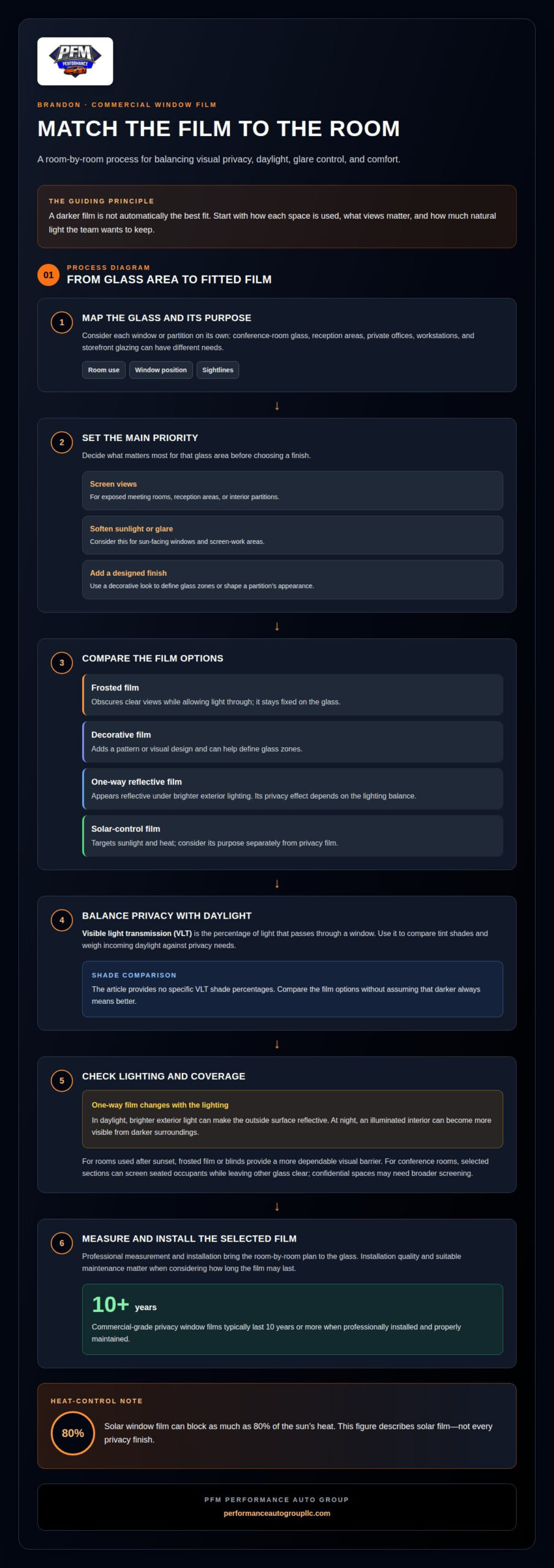
Office privacy films include frosted finishes, decorative patterns, and reflective one-way films. Frosted film obscures clear views while allowing light through; decorative film adds a visual design; one-way film appears reflective under brighter exterior lighting. Solar-control film targets sunlight and heat, so consider its purpose separately from privacy.
Conference rooms often use film on interior glass partitions, where passing coworkers can interrupt meetings or see screens. Applying a privacy finish to selected sections can screen seated occupants while leaving other glass clear. In a small meeting room, partial coverage may preserve openness; a space for confidential discussions may need broader screening.
One-way film has a key limitation: its privacy effect depends on the lighting balance. During daylight, brighter exterior light can make the outside surface reflective, but at night, illuminated interiors can become more visible from darker surroundings. For rooms used after sunset, frosted film or blinds provide a more dependable visual barrier.
Frosted film and blinds provide privacy in different ways. Frosted film stays fixed on the glass, diffusing views while leaving the window uncovered. Blinds can be opened or closed to change privacy and light, but require adjustment. Decorative film can add patterns or define glass zones, making it suitable for offices seeking a designed partition rather than a plain opaque look.
For heat, solar window film can block as much as 80% of the sun’s heat. This figure describes solar film, not every privacy finish, so match the film’s stated purpose to the room’s main concern. Reducing incoming solar heat can support a more comfortable space near sun-facing windows, while glare control can make screen work easier.
Start by listing each glass area’s primary need: screen views, soften sunlight, or add a decorative finish. Then consider the room’s daytime and nighttime use before selecting film. A focused privacy film consultation can help align the finish with the space.
Durability is another consideration when comparing options for different glass areas. Commercial-grade privacy window films typically last 10 years or more when professionally installed and properly maintained. That expected service life makes installation quality and ongoing care part of the selection, alongside privacy, daylight, and heat control. When planning coverage, consider whether the chosen finish will continue to suit the room’s use over time, and follow suitable maintenance practices to support the stated longevity.
Consultation, measurement, design, production, and installation
A professional installation starts with understanding the space and ends with fitting film to the selected glass. Each stage helps align the finish, coverage, and schedule with how the workplace operates.
Installation Process and Deposits
During consultation, the installer reviews the rooms, glazing, privacy goals, and working hours. For example, a conference room used throughout the day may need a different design from an unused reception window. The installer measures the selected panes and records their locations, then prepares a proposal describing the film, coverage, project scope, and expected schedule.
Deposit terms belong in the written agreement, alongside the remaining payment schedule and any cancellation conditions. The amount and timing depend on the project agreement, so the document should make both clear before production or installation begins. Most office privacy film installations take 1 to 2 days, while larger facilities may need more time.
Professional Installation and Warranty Coverage
Professional installation involves preparing the glass, cutting film to fit accurately, and applying it carefully around edges and frames. A multi-pane office or glass partition calls for consistent alignment across each surface. Before work begins, the installer can coordinate room access and confirm which areas need to remain available during the project.
Warranty coverage depends on the film and the written terms for the installation. Review what the document covers, the coverage period, and applicable care requirements. Keeping a written record gives the property manager a clear reference if questions arise after installation.
Make design decisions before production. Using room measurements and the selected finish, the installer can plan whether film will cover full panes or defined sections. A consistent pattern across adjacent office partitions can create a more orderly appearance, while different rooms can have distinct levels of screening.
Scheduling depends on access and the number of glass areas. A suite with several rooms, for example, may require coordination around meetings, staff movement, or customer appointments. The project plan should identify the work areas and sequence so occupants know which spaces are being addressed and when.
After installation, the installer can explain care instructions and what to expect as the film settles. The property manager should receive product and warranty documentation for the completed work. Keeping these records with the project agreement links the chosen film, covered windows, and applicable service terms.
Glare reduction and workplace comfort
Glare often follows a predictable path through an office. Sunlight through a window can reflect across a monitor, meeting table, or polished desk. Identify which seats and screens receive direct light during working hours. This helps determine which glass needs attention instead of treating every window alike.
A workstation beside bright glazing, for example, may need solar-control film to soften incoming light. A conference table may face reflected light from a neighboring building, even without direct sun. Film selection should account for both the window and the room’s use. The goal is to reduce troublesome brightness while preserving useful daylight for employees.
Comfort also varies across a floor plan. A sun-exposed perimeter office can feel warmer than an interior workspace, while a reception area may have screen glare at the counter. Window film can reduce solar heat entering through glass, which may ease the load on cooling systems. The effect on energy use depends on the building and how it operates.
- Map the glare: Note which workstations, screens, or tables receive bright reflections.
- Identify peak exposure: Observe when sunlight reaches those areas during normal work.
- Set room priorities: Separate screen comfort from privacy or appearance goals.
- Plan coverage: Match film placement to the affected glazing and room function.
These observations help an installer distinguish a localized problem from an issue affecting an entire window. Film on one exposed office window, for instance, may address a monitor reflection, while a shared meeting room may need broader coverage. The treatment should preserve comfortable light levels for reading paperwork and recognizing faces across the room.
Evaluate energy considerations alongside glare rather than assuming performance from a film’s appearance. A darker-looking window does not, by itself, show how effectively a film manages solar heat. The glass, film type, exposure, and existing cooling system all affect the result. Discuss heat patterns in the room and desired daylight before selecting a product.
Workplace comfort depends on the activities near each window. A receptionist needs a clear view of visitors; a designer may need accurate visual detail; a team using screens may prioritize fewer reflections. These needs call for different balances of light control and visibility. Note each room’s primary task, then use it to guide coverage and finish.
After installation, review the treated areas during regular work. A monitor that remains difficult to view or a meeting table still receiving harsh reflections may indicate a coverage mismatch. This walkthrough helps assess whether the film addresses the original glare path while keeping the workspace comfortable and functional.
Visible light transmission (VLT) and tint shades
Visible light transmission, or VLT, is the percentage of light that passes through a window. It gives Brandon office managers a practical way to compare tint shades. Higher VLT means more visible light passes through; lower VLT means less does. The right choice depends on the room’s daylight, privacy, and work needs.
Start with the task performed beside each window. A design team reviewing color samples may value abundant daylight, while a conference room may need more visual screening. A reception area calls for another balance: staff need to see visitors but may want to limit views into workspaces. Matching the shade to each room is more useful than choosing one tint for every pane.
VLT describes visible light, not privacy on its own. A shade that looks darker from outside does not automatically make a room private under every lighting condition. Film construction and the difference between indoor and outdoor brightness also affect visibility. For a room used after dark, consider its lighting and sightlines as well as its VLT.
Compare tint options in the context of the existing glass. Clear glazing with a selected film may look different from tinted glass with additional film. The combined appearance can affect daylight and the view through the window. A professional assessment can account for the glass, room orientation, and desired finish before you select a shade.
VLT should not be treated as a measure of energy efficiency. It measures visible light transmission, not a film’s full solar performance. For a sun-facing office, discuss heat management separately from shade and privacy. A film selected for its darker appearance may not provide the specific solar control a room needs.
A useful selection process is straightforward. First, identify each room’s primary need, such as daylight, privacy, or screen comfort. Next, compare the visual effect of possible shades with that need. Finally, consider how the film will look with the existing glazing and interior lighting. This approach avoids treating shade as the only measure of performance.
A private office used for video meetings, for example, may need a different balance from a bright shared workspace. The manager can prioritize reduced visibility in the private room while retaining more daylight in the open area. Compare the spaces individually, then choose a consistent appearance where neighboring windows need a unified finish.
Arrange a window film shade consultation
PFM Performance Auto Group: Black Pearl Nano Ceramic Window Tint By Madico
PFM Performance Auto Group provides Commercial Window Tinting and Privacy Window Tinting for workplaces seeking professional window-film installation in Hillsborough County. If conference-room glass needs screening or street-facing windows need a tailored tint, these services offer a practical next step. The business also offers Black Pearl Nano Ceramic Window Tint By Madico; the right option depends on the property’s goals and the glass being treated.
Bring your priorities into the conversation, whether they are privacy, daylight, glare, or appearance. Describing the affected rooms clearly helps focus planning for commercial tinting. Contact PFM Performance Auto Group to discuss workplace window film in Brandon.
Plan a Workplace That Supports What Comes Next
Connect your window plan with how the workplace may evolve. Consider whether rooms could change purpose, partitions might move, or customer-facing areas may need a different visual feel. These decisions can help tailor office privacy tinting in Brandon to the workplace you are building toward, not just how it operates today.
PFM Performance Auto Group provides Commercial Window Tinting for business properties in Hillsborough County, alongside Auto Window Tinting and Home Window Tinting. For an office project, the focus is commercial glass and the privacy or comfort goals you want it to support. Discuss your space with the team to turn those priorities into a considered plan.
Choose a thoughtful solution for your workspace, shaped around the people who use it every day.
Frequently Asked Questions
Does office privacy tint provide daytime and nighttime privacy?
Not consistently. One-way film provides daytime privacy when exterior light is stronger, but after sunset, interior lighting can reverse the effect and make the office more visible. For a Brandon conference room used for evening meetings, choose an opaque or frosted treatment, or pair the film with an interior privacy measure. Review the room from both sides under different lighting conditions before settling on a design.
How long does commercial window film installation take, and what is the process?
Commercial film installations commonly take 1 to 2 days; larger facilities may require longer. Work usually starts with a site review and glass measurements, followed by film selection, surface preparation, cutting, and installation. In Brandon workplaces, schedule around occupied rooms and access to each pane. Ask the installer to identify which areas will be unavailable during work, so meetings and reception can be routed elsewhere.
What warranties do Brandon office window tinting companies offer?
Warranty terms vary by selected product. PFM Performance Auto Group offers a warranty on tint material and installation, with terms varying based on the chosen product. For a commercial project in Hillsborough County, review the written warranty alongside the product description, including what materials and installation it covers and how to raise a claim. Coverage and duration can differ between products, so do not assume every film has identical terms.
Can privacy window film reduce heat, glare, and UV exposure in an office?
Selected solar-control films can help with all three, but performance varies by film. Solar window film can block as much as 80% of the sun’s heat, and some tint films block up to 99% of harmful UV rays. For a Brandon office with sun-exposed desks, choose based on the window’s exposure and the room’s main need. A privacy appearance alone doesn’t define heat or UV performance.
What are the risks or limitations of installing privacy film on office windows?
Privacy film can reduce visible daylight, and reflective one-way finishes may lose privacy after dark when office lighting is brighter than outdoors. Tint legality varies by state or country, and it is not legal everywhere, so do not assume every glazing choice is automatically permissible. Film also does not replace secure records handling or access controls. Consider how the room is used before choosing a finish or coverage plan.
Are permits or building-code approvals required for office window tinting in Brandon, Florida?
Requirements depend on whether the work changes only the film layer or alters the glazing, framing, or building.