
Best Budget Car Speakers 2026: Smart Picks for Your Sound System
The best budget car speakers 2026 aren’t necessarily the ones with the biggest power rating or the lowest price. A speaker that doesn’t fit your vehicle or work well with its factory stereo can disappoint, even when its specifications look impressive. Start with your existing system, what you want to hear differently, and the speaker locations in your car.
Specs can be difficult to compare, especially when you’re deciding whether coaxial speakers are a practical replacement or component speakers are worth the added installation work. This guide explains how to weigh those options and choose an upgrade that suits your vehicle and listening habits.
We’ll compare speaker types and use cases, explain fitment, RMS power handling, and sensitivity, and show how installation affects the finished system. PFM Performance Auto Group provides car speaker installation and car audio upgrades for drivers in Hillsborough County. Use the steps below to narrow your options, then plan an installation around your vehicle’s actual requirements.
Key Takeaways
- The best budget car speakers 2026 are value-focused choices matched to your sound goals, not simply the cheapest models.
- Compare coaxial and component designs to weigh ease of replacement against sound staging and installation needs.
- Use the shortlist to explore speaker picks organized around different listening and replacement needs.
- Check vehicle-specific dimensions, mounting depth, connectors, and audio components before settling on a speaker.
- A carefully planned installation helps address fit and system integration. Hillsborough County drivers can explore professional car speaker installation with PFM Performance Auto Group.
What makes a budget car speaker a worthwhile upgrade in 2026?
A budget speaker is a value-focused upgrade, not automatically the least expensive option available. It should fit your vehicle, work with the audio equipment already installed, and improve the parts of everyday listening that matter to you. Clear vocals and balanced sound may be more useful than a high power figure that doesn’t match your system.
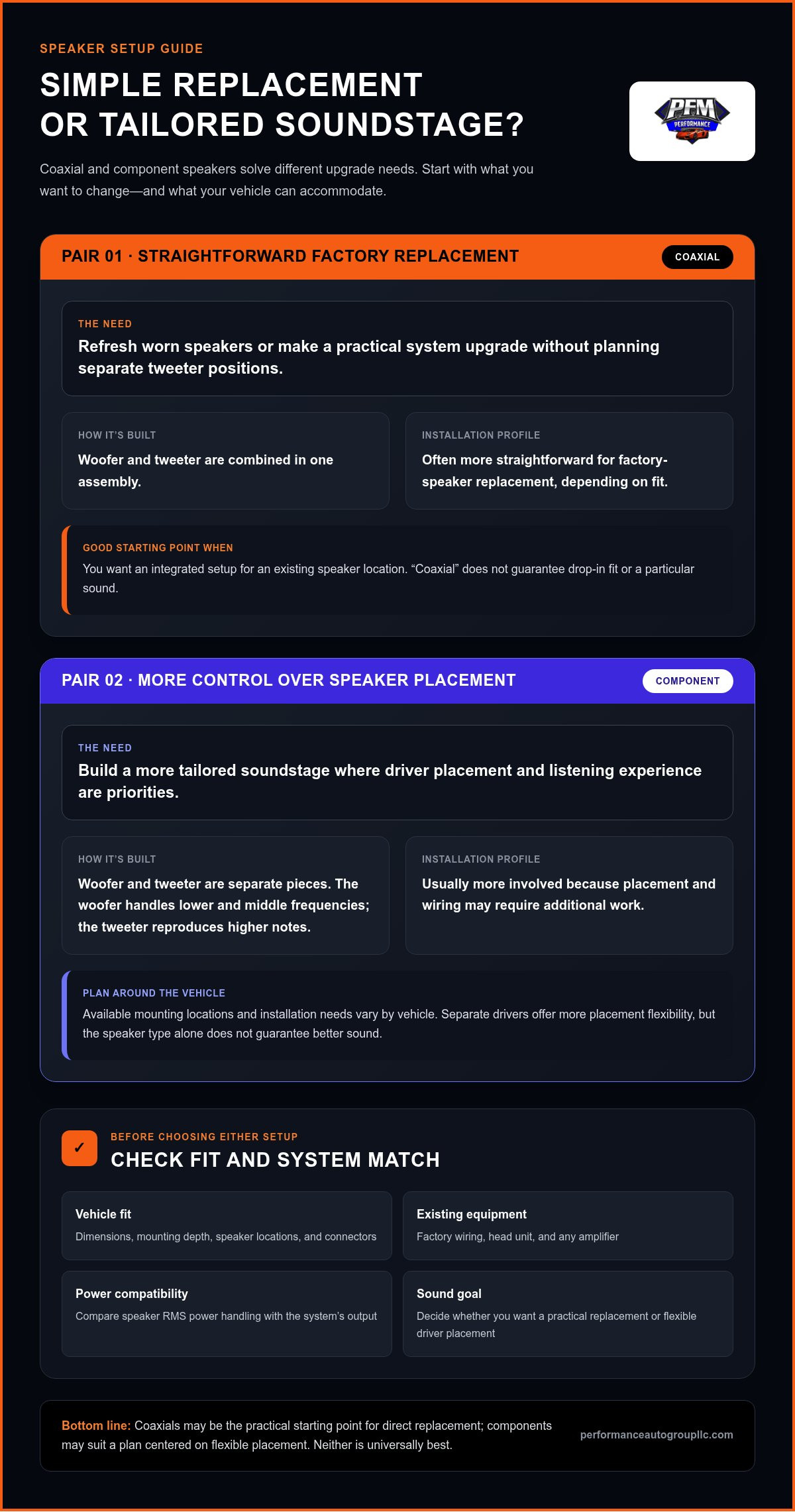
Quick definition: A coaxial speaker combines its woofer and tweeter in one unit. A component system separates those drivers into individual pieces for more flexible placement and sound staging. Either can be a sensible choice, depending on your listening goals, vehicle, and installation requirements. For an overview of how speakers fit into broader car audio systems, see the foundational components and context.
When does replacing factory car speakers make sense?
Distortion at normal listening levels, weak vocal clarity, rattling, or visible speaker damage can indicate that replacement is worth considering. If the factory speakers still work but sound flat, you might instead be looking for more detail or a more balanced presentation. Note what sounds lacking and what you want to improve before shopping.
A speaker swap has limits. The factory radio, amplifier, signal processing, and the way sound resonates in the vehicle can all affect what you hear. Replacing speakers alone may not resolve a limitation elsewhere in the system. Identify the source of the problem so you don’t expect a new speaker to fix an unrelated issue.
What does “budget” mean when comparing car speakers?
Judge value by how well a speaker matches your sound goals and system, not by price alone. Review its specifications, build details, intended use, and compatibility with your head unit or amplifier. Pay particular attention to RMS power handling and compare it with the system’s output. A high headline rating by itself doesn’t show that a speaker is a good match for your car.
Separate general category guidance from model recommendations. “A sensitive coaxial speaker can suit a straightforward factory-powered replacement” describes a type of option. Naming a specific model is a more precise recommendation, so check its current specifications and vehicle fitment. The best budget car speakers 2026 shortlist can help you explore candidates, but the final choice still depends on your vehicle.
For a replacement, prioritize compatibility and reliable operation. If your system works but needs improvement, focus on the sound change you’re seeking and whether other components may need attention. PFM Performance Auto Group provides car audio upgrades and professional speaker installation for drivers in Hillsborough County, with fit and system integration considered as part of the upgrade.
Coaxial vs. component speakers: which budget setup suits your car?
Choose based on how you want to improve your system, not on the assumption that one design is always superior. A direct replacement may call for a compact, integrated setup, while a more tailored soundstage may make separate drivers worth considering. In either case, the vehicle’s speaker locations and existing audio equipment determine what is practical.
| Setup | Configuration | Typical installation complexity | Suitable upgrade goal |
|---|---|---|---|
| Coaxial | Woofer and tweeter combined in one assembly | Often more straightforward for factory-speaker replacement, depending on fit | Refreshing worn speakers or making a practical system upgrade |
| Component | Woofer and tweeter installed separately | Usually more involved because placement and wiring may require additional work | Creating more flexibility in driver placement and pursuing a more tailored soundstage |
Are coaxial speakers the practical choice for a simple upgrade?
Coaxial speakers package multiple driver elements together. That can make them convenient when replacing a factory speaker in its existing location, particularly if you don’t want to plan separate tweeter positions. However, “coaxial” doesn’t guarantee a drop-in fit or a particular sound. Check dimensions, mounting depth, connectors, factory wiring, and compatibility with the head unit or amplifier.
When might component speakers better match your sound goals?
Component systems separate the woofer, which handles lower and middle frequencies, from the smaller tweeter that reproduces higher notes. This can give you more flexibility in driver placement, but available mounting locations and installation work vary by vehicle. Consider components when placement and listening experience are priorities, rather than assuming the speaker type alone will guarantee better sound.
Think about compatibility across the whole system. A speaker must fit its location, and its power requirements should make sense alongside the factory radio or any amplifier in the vehicle. The Car Audio Market Analysis offers broader industry context, but market trends can’t determine the right configuration for an individual car. That depends on your vehicle and the result you want.
For a direct replacement, coaxials may be the more practical starting point. For flexible driver placement, components may better suit the plan. Neither is universally best. PFM Performance Auto Group provides car audio installation with fit and system integration considered as part of a vehicle-aware upgrade. To plan the next step, schedule a car audio appointment.
Best budget car speakers in 2026: shortlist picks by upgrade goal
A useful shortlist starts with the job you want the speakers to do. The models below appear in recommendations from Redline Garage and Crutchfield. Audio Intensity listed the Image Dynamics options on September 30, 2026. These recommendations are starting points, not proof that a speaker fits every vehicle or works with every factory system.
Which picks suit a straightforward factory-speaker replacement?
- Rockford Fosgate Prime R165X3: Redline Garage recommends it as a factory replacement candidate. Investigate it for a conventional replacement, then verify the speaker dimensions, mounting depth, impedance, RMS rating, and fit for your vehicle.
- JBL Club 64: Redline Garage recommends this pick for systems using factory power. It may interest drivers keeping a factory radio, but compatibility still depends on the specific vehicle and audio equipment.
- Pioneer TS-A653FH: Redline Garage names it as its overall budget recommendation. Treat that as a review-based pick, not a universal ranking or assurance of fit.
- Kenwood KFC-1666S: Crutchfield identifies this model as a value pick. Use the recommendation to narrow your search, then review the manufacturer’s current specifications and vehicle-fitment information.
Which picks suit drivers seeking a more involved sound upgrade?
For a component setup, Audio Intensity listed the Image Dynamics ID65CS and Image Dynamics CXS64 V2 6.5-inch component set in its September 30, 2026 roundup. These models are candidates for drivers considering separate woofer and tweeter placement, where installation may involve additional mounting and wiring decisions. The listing identifies options to research, not a guaranteed sound result or fit for a particular car.
For a specific placement need, you can also investigate the Infinity Reference REF6532EX, which Redline Garage recommends as a shallow-mount option, or the Kicker CSC65, recommended for bass without a subwoofer. These recommendations describe use cases, not compatibility with every factory system.
How should readers interpret the roundup?
A speaker’s published power rating alone doesn’t guarantee compatibility. Match a candidate’s dimensions, mounting depth, impedance, and RMS power handling to the vehicle’s speaker location and existing radio or amplifier. The recommendations identify models and intended use cases, but don’t establish vehicle-specific fitment or cover every technical specification. Review current manufacturer documentation and fitment data before choosing, as specifications and availability can change.
The best budget car speakers 2026 depend on that final match. PFM Performance Auto Group provides professional car speaker installation and car audio upgrades in Hillsborough County, helping drivers account for vehicle fit and system integration. The shop installs car audio systems, while the model recommendations above come from the sources named in this roundup.
Will budget car speakers fit your car and work with its audio system?
A speaker’s size label is only a starting point. Models described as the same size can differ in mounting depth, basket shape, connector style, and clearance needs. Vehicle trim and factory audio packages can also affect what fits. Use this checklist before ordering:
- Identify the vehicle: Record its year, make, model, and trim, then note which locations you plan to upgrade, such as the front doors or rear deck.
- Check the existing system: Determine whether the vehicle uses its factory radio, an aftermarket head unit, or a separate amplifier. Factory audio configurations can vary within the same model line.
- Verify fit: Compare the replacement’s dimensions and mounting depth with the available space. Check connector type and mounting requirements, including whether adapters or brackets are needed.
- Confirm vehicle-specific fitment: Use compatibility information for the exact vehicle and audio configuration. A listing for the model name alone may not account for every trim or factory system.
Do budget speakers need an amplifier or head-unit upgrade?
Not always. A speaker-only replacement may suit a driver who wants to refresh the factory system, as long as the new speakers’ requirements work with the equipment already in place. A factory radio typically produces about 15 to 22 watts per channel, while an aftermarket head unit or amplifier may have different output. Use that as context, then check your own system’s specifications.
Power handling describes what a speaker is designed to handle; it doesn’t tell you how much power the radio or amplifier supplies. Compare the speaker’s RMS rating with the system’s output, and consider whether the factory source limits the improvement you want. Choose based on verified equipment details, not a headline wattage figure.
When is professional installation worth considering?
Installation can involve more than securing a speaker in place. Wiring, connectors, mounting adaptations, door or trim handling, and integration with factory equipment all affect the finished upgrade. PFM Performance Auto Group provides car speaker installation and broader car audio upgrades for Tampa-area drivers, serving Hillsborough County.
Before choosing from the best budget car speakers 2026 shortlist, make sure the exact model matches your vehicle and audio system. A careful fit check helps prevent a promising choice from being the wrong part for the job.
Choose your budget speaker upgrade and plan the next step
The right budget speaker is one that fits your vehicle and meets your sound goals. A simple replacement may be enough if factory speakers are worn or damaged. If you want a more substantial change, the radio, amplifier, or other audio components may also need attention. Decide what you want to hear differently before choosing how much of the system to change.
Use this checklist to turn the best budget car speakers 2026 shortlist into a practical plan:
- Set a sound goal: Identify whether you want clearer vocals, more balanced playback, or a straightforward replacement for failing speakers.
- Choose a speaker type: Consider coaxial speakers for a more direct replacement or component speakers if separate driver placement better suits your goals and installation plan.
- Verify fitment: Match the exact speaker model to your vehicle’s year, make, model, trim, speaker location, dimensions, and mounting requirements.
- Check system compatibility: Compare the speaker’s specifications with your factory radio, aftermarket head unit, or amplifier. Don’t assume a speaker’s power rating alone makes it a match.
- Plan the installation: Decide whether the project is a speaker swap or may require wiring adaptations, mounting work, or attention to other audio components.
What information should you have ready before an installation?
Gather your vehicle’s year, make, model, and trim, along with any details you know about its factory audio equipment. Be ready to describe the music you listen to, your usual listening habits, and the improvement you’re hoping for. If you’ve shortlisted models, bring their exact names and specifications after reviewing current product details and vehicle fitment. This information gives the installation plan a useful starting point.
How can Tampa drivers move from shortlist to installed upgrade?
A vehicle-specific conversation can help narrow the speaker type and installation approach around your car and listening priorities. PFM Performance Auto Group provides car audio upgrades and professional car speaker installation for Tampa-area drivers in Hillsborough County, with attention to fitment and system integration. Explore the car audio services or use the Tampa car audio shop guide to review installation considerations as you plan.
Make your next speaker upgrade a confident one
The best budget car speakers 2026 are the ones that match your listening goals and work with your vehicle’s speaker locations and audio equipment. A coaxial setup can suit a straightforward replacement, while component speakers may better fit a plan that calls for separate driver placement and a more involved installation.
Before choosing, verify the exact model’s fitment, mounting needs, and power compatibility. A strong specification on paper is useful only if the speaker integrates properly with your system. PFM Performance Auto Group provides car speaker installation and broader car audio upgrades for drivers in Hillsborough County.
Bring your vehicle details and the sound improvements you have in mind. A carefully planned upgrade can turn a shortlist into a system that suits your everyday listening.
Choose with care, then enjoy a clearer, more rewarding drive.
Frequently Asked Questions
What are the best budget car speakers in 2026?
The best choice depends on your vehicle, audio system, and listening goals. The roundup includes the Pioneer TS-A653FH as a general budget recommendation, the JBL Club 64 for factory-powered systems, and the Kicker CSC65 for drivers seeking more bass without a subwoofer, based on Redline Garage’s recommendations. These aren’t universal fits or guarantees of a particular sound. Review each model’s current specifications and vehicle fitment before choosing.
Are coaxial speakers better than component speakers?
Neither type is always better; each suits different priorities. Coaxial speakers combine the woofer and tweeter in one assembly, which can make them practical for a straightforward replacement. Component speakers separate those drivers to allow more flexibility in placement, but may involve more installation work. Consider your sound goals, available mounting locations, vehicle configuration, and existing equipment before deciding.
Will aftermarket car speakers fit my car?
Aftermarket speakers fit when their dimensions and mounting requirements match your vehicle’s speaker location. A size label alone doesn’t ensure compatibility. Mounting depth, basket shape, connectors, trim, and factory audio configuration can all affect fit. Check your vehicle’s year, make, model, and trim against exact fitment information, and confirm whether adapters or mounting hardware are required before ordering. Fitment can vary across versions of the same vehicle.
Do I need an amplifier for budget car speakers?
Not necessarily. A compatible speaker replacement may work with your factory radio, but the result depends on the radio’s output and the speaker’s sensitivity and power requirements. A factory radio typically produces about 15 to 22 watts per channel, so compare system output with the speaker’s RMS power handling. An amplifier may be relevant if your desired upgrade exceeds what the existing system can deliver, but assess the full setup first.
Can I replace factory car speakers without replacing the stereo?
Yes, you can often replace factory speakers while keeping the original stereo, provided the new speakers are compatible with its output and the vehicle’s wiring and mounting. Check speaker impedance, RMS power handling, sensitivity, dimensions, and connectors rather than relying on a general size match. A speaker swap can refresh worn or damaged drivers, though it won’t necessarily address limitations caused by the radio or other parts of the factory system.
Are cheap car speakers worth buying?
They can be worthwhile if they meet your needs and fit your system, but the lowest price alone doesn’t indicate good value. Compare build details, stated specifications, fitment, and suitability for your listening habits. A compatible, well-installed speaker may be a more sensible choice than a model with impressive headline numbers that don’t match your radio or amplifier. Treat price as one factor, not a guarantee of sound quality.
Should I install car speakers myself or use a professional?
DIY installation may suit you if you’re comfortable removing trim, handling vehicle wiring, and confirming speaker fitment. Professional installation can be practical if the job involves adapters, challenging mounting locations, delicate trim, or integration with factory audio equipment. PFM Performance Auto Group provides car speaker installation and broader car audio upgrades for Hillsborough County drivers, with attention to fit and system integration.
How do I choose car speakers for a Tampa vehicle?
Start with your Tampa vehicle’s year, make, model, trim, speaker locations, and factory audio configuration. Then define the improvement you want, such as clearer vocals or replacing a damaged speaker, and compare compatible coaxial or component options. Verify dimensions, mounting depth, connectors, and system power requirements for the exact setup. PFM Performance Auto Group is a locally owned shop serving Hillsborough County.