Tint Percentages Explained: The 2026 Guide to Choosing Your Perfect VLT
You’re navigating a heavy Tampa downpour at dusk, and suddenly, the road ahead vanishes because your windows are too dark. It’s a common realization for drivers who discover the hard way that there are significant problems with dark window tint when visibility drops and legal limits are ignored. You shouldn’t have to sacrifice your safety or your peace of mind just to achieve a refined, custom look for your vehicle. We understand that your car is a major investment; protecting it requires a meticulous balance of aesthetic appeal and functional performance.
This 2026 guide is designed to help you master the science of Visible Light Transmission (VLT) so you can choose the ideal tint level with professional confidence. You’ll learn exactly how to stay within Florida’s legal limits, which currently require 28% VLT for front side windows and 15% for the rear. We will explore how high-performance films like Black Pearl Nano Ceramic provide superior heat rejection without the visibility issues of cheaper, darker alternatives. By the end, you’ll have the clarity needed to select a film that offers elite protection and lasting durability for years to come.
Key Takeaways
- Master the math of Visible Light Transmission (VLT) to understand how lower percentages create a more private, sophisticated profile for your vehicle.
- Discover why darkness doesn’t equal cooling and how Black Pearl Nano Ceramic by Madico provides elite heat rejection regardless of the shade you choose.
- Navigate Florida’s 2026 legal requirements-28% for front windows and 15% for rear-to avoid the safety and legal problems with dark window tint.
- Learn how your car’s interior upholstery color can dramatically shift the perceived darkness of your film, affecting both style and visibility.
- Gain the confidence to select a performance-based tint that protects your investment while maintaining crystal-clear sightlines during heavy Tampa rain.
Decoding Visible Light Transmission: What Tint Percentages Really Mean
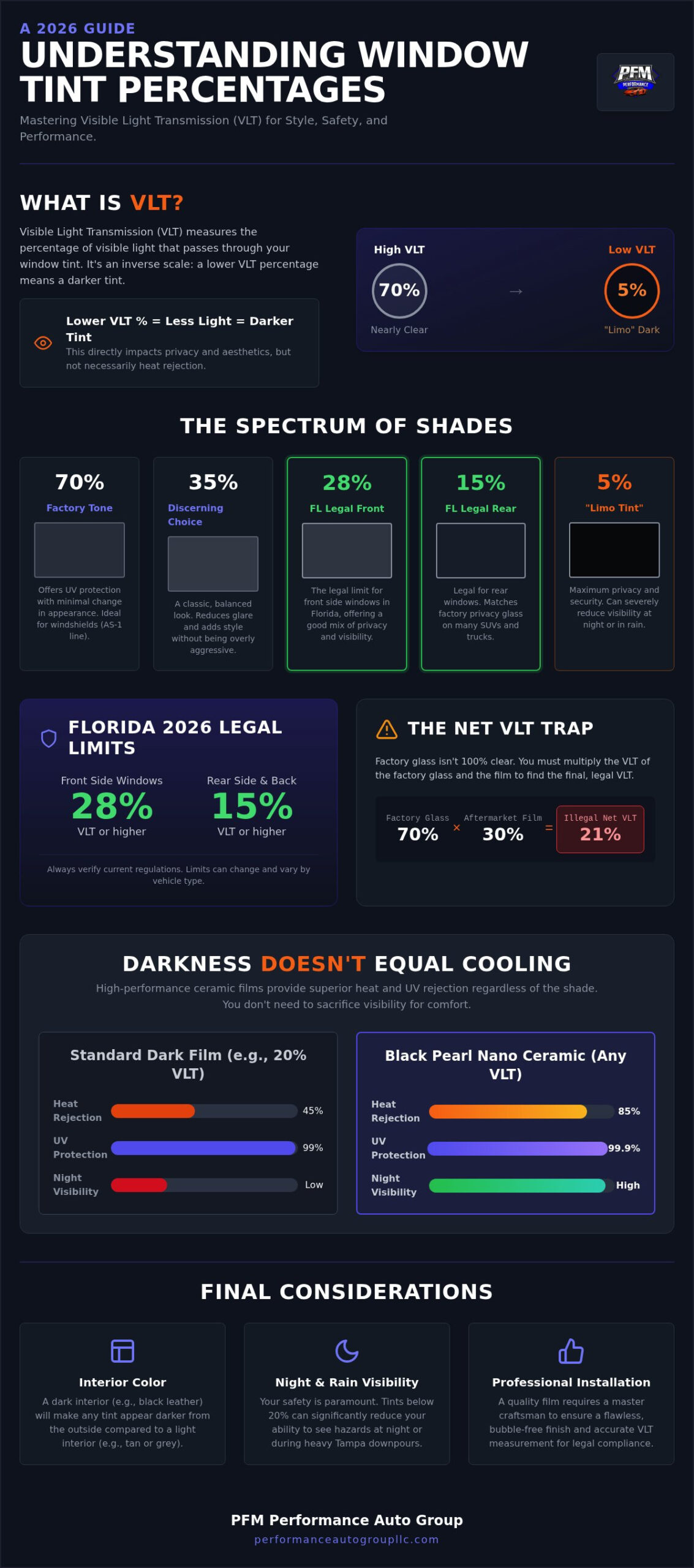
Understanding the numbers behind your window film is the first step toward a successful installation. Visible Light Transmission, or VLT, represents the exact percentage of outdoor light that can pass through your glass. It operates on an inverse scale. A film rated at 5% VLT is exceptionally dark, allowing only a tiny fraction of light through, while a 70% VLT film remains nearly transparent. Many drivers mistakenly believe that a lower percentage automatically provides better protection against the intense Florida sun. However, VLT specifically measures visible light, not the infrared heat or ultraviolet rays that cause interior fading and cabin discomfort.
One of the most frequent problems with dark window tint stems from ignoring the “Net VLT” calculation. Most vehicles leave the factory with glass that already possesses a slight tint, typically ranging between 70% and 80% VLT. When you apply an aftermarket film, these percentages multiply rather than add up. If you place a 30% film over 70% factory glass, your final output is actually 21%. This often pushes a vehicle into illegal territory without the owner even realizing it, turning a style upgrade into a potential legal liability. For a deeper look at how specific percentages translate to real-world results on Tampa roads, our guide to car privacy window tint Tampa drivers rely on breaks down exactly what 5%, 15%, and 35% VLT looks like in practice.
The Science of Light Filtration and VLT
High-quality Window film utilizes multiple layers of treated polyester to absorb or reflect specific wavelengths of light. While VLT focuses on what you can see, Visible Light Reflectance (VLR) determines how much light bounces off the surface. A higher VLR creates a mirrored look, which is strictly regulated to prevent blinding other drivers. Visible Light Transmission (VLT) is the specific percentage of visible light that successfully passes through a window and any applied treatment.
Why Percentage Accuracy Matters for Your Investment
Achieving a flawless finish requires more than just picking a shade from a display board. A Master Craftsman understands that every vehicle has a unique factory glass tone that influences the final aesthetic. At PFM Performance Auto Group, we treat every project with a meticulous eye for detail. We use precision-metered films to ensure your car remains within the 2026 Florida legal limits. This level of accuracy prevents common problems with dark window tint, such as compromised night visibility during a Tampa storm or unexpected citations. Choosing the right VLT isn’t just about looks; it’s about protecting your safety and your property with the same care we would give our own vehicles.
The Spectrum of Shades: Comparing Common Tint Levels
Choosing a tint percentage is a meticulous balancing act between the aggressive profile you want and the visibility you need. It’s a deeply personal decision. While a sleek, blacked-out window looks incredible on a luxury sedan or a rugged SUV, the utility of your vehicle changes with every drop in VLT. Modern nano-ceramic technology has revolutionized this choice. You no longer have to settle for the darkest film just to keep your cabin cool. Instead, you can select a shade based on your aesthetic preferences while relying on advanced material science to handle the heat.
Dark Tints: 5% (Limo) and 15% to 20% (Privacy)
5% VLT, commonly known as “limo tint,” is the gold standard for total privacy and security. It effectively shields your interior from prying eyes, making it an excellent choice for rear cargo areas or vehicles carrying valuable equipment. However, this extreme darkness is where the most common problems with dark window tint arise. At night or during heavy Tampa rain, your ability to see pedestrians or road hazards through side windows is severely diminished. Many drivers find they must roll their windows down just to reverse safely in low-light conditions. 15% to 20% films are the preferred choice for matching the factory privacy glass found on most modern SUVs and trucks. This creates a uniform, high-end look across the entire vehicle. Just keep in mind that Federal and State Window Tinting Laws vary significantly, and what is legal for a truck’s rear window is often prohibited on a sedan’s front doors.
Medium to Light Tints: 35% to 80% (The Discerning Choice)
35% VLT remains the classic choice for the discerning driver. It offers a balanced, professional aesthetic that works on everything from sports cars to family crossovers. This percentage provides enough shade to reduce eye strain and define the vehicle’s lines without appearing overly aggressive. If you want protection without the “tinted” look, 50% VLT provides a light smoke finish that is virtually transparent from the inside. For those focused on the highest level of performance, 70% and 80% nano-ceramic films are revolutionary. These nearly transparent layers offer exceptional car window tint UV protection by blocking 99% of harmful rays. They are frequently applied to windshields to block massive amounts of solar energy while maintaining total optical clarity. If you are unsure which shade complements your vehicle’s interior, schedule a consultation with our experts to see these films in person.
Ultimately, the “perfect” tint depends on your driving habits. A driver who frequently travels at night might favor the clarity of a 35% or 50% film, while someone focused on maximum interior preservation might lean toward a darker rear setup. By understanding the trade-offs of each level, you can ensure your vehicle looks as good as it performs.
Darkness vs. Performance: The Nano-Ceramic Advantage
A common misconception among Florida drivers is that a darker window is automatically a cooler window. This myth often leads enthusiasts to install non-compliant films, unknowingly creating the very dangers of dark window tint that compromise road safety and law enforcement interactions. At PFM Performance Auto Group, we believe you shouldn’t have to choose between a clear view and a comfortable cabin. True thermal protection comes from the quality of the film’s construction, not the depth of its pigment. By focusing on performance over simple darkness, we ensure your vehicle remains a sanctuary from the Tampa heat without falling into the trap of poor visibility.
Why 70% Ceramic Beats 5% Dyed Film
Compare the Total Solar Energy Rejection (TSER) of a basic dyed film to a premium ceramic option. A standard 5% dyed film might look like a black hole, yet it primarily absorbs heat into the glass, eventually radiating it back into your face. In contrast, a 70% Black Pearl Nano Ceramic film remains nearly transparent but blocks significantly more infrared (IR) energy. This advanced material science ensures that your modern vehicle’s sensitive electronics, including high-end car audio systems and GPS antennas, remain free from signal interference. Nano-Ceramic technology is a non-conductive and non-metallic treatment that utilizes microscopic ceramic particles to filter solar energy.
The Meticulous Choice: Black Pearl Nano Ceramic
We have spent over 20 years in Hillsborough County refining our selection of materials to find the perfect match for the discerning driver. Black Pearl Nano Ceramic by Madico stands as our gold standard for color stability and optical clarity. Cheaper films frequently succumb to the relentless Florida sun, turning a distracting shade of purple or bubbling within a few seasons. As your Trusted Advisor, we recommend ceramic because it maintains its integrity under an extreme UV index while protecting both your skin and your car’s interior. It is a meticulous choice for those who value longevity and elite performance over a quick, low-quality fix. Choosing this film effectively eliminates the visibility-related problems with dark window tint, allowing you to enjoy a cool interior without straining your eyes during a late-night drive through a summer storm.
Our commitment to craftsmanship means we don’t just apply film; we provide a shield for your investment. When you prioritize the science of the film over the darkness of the shade, you achieve a level of comfort that basic dyed products simply cannot match. It’s about providing premium reassurance that your car will stay cool, look sophisticated, and remain safe for every mile ahead.
Legal Limits and Problems with Dark Window Tint
Florida’s sun is relentless. However, the state’s legal framework is equally uncompromising. For drivers in Tampa and across the state, the 2026 VLT standards are strictly enforced: your front side windows must maintain a minimum of 28% light transmission, while rear side and back windows can go as low as 15%. These regulations exist to ensure that you can see clearly and that law enforcement can identify occupants during a traffic stop. Choosing a film that falls below these thresholds introduces significant problems with dark window tint, ranging from expensive citations to potential liability issues if an accident occurs. Your insurance company may even use non-compliant tint as a reason to complicate a claim.
Windshield regulations are even more precise. You are permitted to apply a non-reflective tint strip, but it must remain above the AS-1 line, which is typically marked on your factory glass about five inches from the top. For those with specific medical conditions that require additional UV protection, a Florida window tint exemption may allow for darker shades. Without this official documentation, you are essentially driving a vehicle that doesn’t meet safety standards, putting your investment at risk of being impounded or requiring a costly “strip and retint” service.
Visibility Hazards: Night Driving and Tampa Storms
Safety is our primary concern as Master Craftsmen. We often see drivers struggle with window tint and night driving visibility when they choose films that are too dark for their environment. In Tampa, an afternoon tropical downpour can turn a bright day into near-darkness in seconds. If your tint is too aggressive, these storms become incredibly dangerous as your peripheral vision is cut off. High-quality nano-ceramic films solve this by offering exceptional clarity. They reduce the blinding glare from modern LED headlights without the problems with dark window tint that obscure your view of the road during a heavy rainstorm.
Legal Compliance and Professional Accountability
A reputable shop acts as your Trusted Advisor. We don’t just sell film; we provide a certificate of compliance that proves your vehicle meets state requirements. This documentation is your first line of defense during an inspection. If you choose an “underground” shop that installs illegal shades, you lose that layer of professional protection. In the event of a collision, a lawyer could argue that your illegal tint contributed to the accident by obstructing your view. It’s a meticulous detail that can save you thousands of dollars in legal fees and insurance premiums over the life of your vehicle.
Choosing Your Ideal Percentage at PFM Performance Auto Group
Finalizing your selection requires a meticulous synthesis of the legal boundaries and performance metrics we have explored. One subtle detail that often catches owners by surprise is the interaction between the film and your vehicle’s interior materials. A tan or light-colored cabin reflects light back through the glass, which can make a legal 28% film appear more transparent than expected. Conversely, a black interior creates a deep shadow box effect, potentially leading to perceived problems with dark window tint if the resulting darkness appears more aggressive than the law allows. We invite you to our Tampa workshop to view physical samples against your specific upholstery, ensuring the final result matches your aesthetic vision perfectly.
Choosing the right VLT is a deeply personal decision that affects your daily comfort and your vehicle’s resale value. At PFM Performance Auto Group, we treat this choice with the gravity it deserves. We provide the “premium reassurance” that comes from seeing and feeling the product before it is applied to your glass. This hands-on approach eliminates the uncertainty that often leads to buyer’s remorse or legal complications down the road. Our goal is to ensure you leave our shop with a vehicle that looks refined and performs at the highest level.
Consulting with a Master Craftsman
Our consultation process at PFM Performance Auto Group is rooted in over 20 years of hands-on experience in Hillsborough County. We don’t just hand you a sample book; we assess your vehicle’s glass curvature and your specific driving habits. If you frequently navigate late-night rain on the Selmon Extension, we might suggest a different VLT than we would for a show car. We specialize in automotive privacy window tint in Tampa, helping you strike that elusive balance between a secure, private cabin and the optical clarity required for safety. By utilizing precision light meters before and after installation, we provide the documented reassurance that your car remains fully compliant with Florida’s 2026 regulations.
The Final Step: Protecting Your Investment
Choosing an experienced installer is the ultimate safeguard for your property. At PFM Performance Auto Group, our dedication to craftsmanship means we treat every window as a work of art. We understand the emotional and financial value you place on your vehicle, which is why we never settle for “good enough.” From the initial cleaning to the final heat-shrinking process, every step is performed with a perfectionist’s eye. This meticulous approach ensures that your Black Pearl Nano Ceramic film performs flawlessly for a lifetime. We are not just service providers; we are guardians of your investment, committed to earning your trust through every meticulous detail.
Elevate Your Driving Experience with Precision and Clarity
You now possess the clarity to navigate the world of window films with professional confidence. By mastering the science of VLT and moving beyond the myth that darkness equals heat rejection, you can avoid the safety and legal problems with dark window tint while still achieving an elite, custom aesthetic. This guide has provided the roadmap to a cooler, safer vehicle that honors Florida’s strict 2026 compliance standards.
At PFM Performance Auto Group, we take pride in being the guardians of your automotive investment. With over 20 years of meticulous service in Hillsborough County, our team provides the expert electronics integration and premium Madico films required for a flawless finish. We don’t just apply tint; we earn your business through every precise cut and careful consultation.
Your journey toward a more comfortable and secure drive begins with a single step toward quality. We look forward to welcoming you to our workshop and helping you select the high-performance film your vehicle deserves.
Common Questions About Choosing the Right Tint
What is the most popular tint percentage for cars in Florida?
The most popular combination for Florida drivers is a 28% VLT on the front side windows and a 15% VLT on the rear windows. This setup perfectly matches the legal limits set by the state while providing a uniform, high-end appearance for the vehicle. Many SUV owners also opt for a 20% film on the front doors to closely mimic the factory privacy glass installed on the back half of their vehicles.
Can I tint my windshield in Florida?
You can legally apply a non-reflective tint strip to the top of your windshield as long as it remains above the manufacturer’s AS-1 line. While full-windshield tinting is generally prohibited, many discerning drivers choose a nearly clear 70% or 80% nano-ceramic film to block heat without changing the glass’s appearance. Always ensure any application maintains total optical clarity to avoid safety hazards during sudden Tampa downpours.
What are the main visibility problems with dark window tint at night?
The primary problems with dark window tint at night include a significant reduction in peripheral vision and difficulty spotting unlit objects like pedestrians or cyclists. When VLT percentages drop below legal limits, your eyes must work much harder to process depth and movement in low-light environments. This becomes particularly dangerous during heavy rain when road markings and hazards are already obscured by water and glare.
Is ceramic tint really better than regular carbon tint for heat?
Ceramic tint is superior because it utilizes microscopic particles to block up to 99% of infrared rays, which are the main source of solar heat. Carbon films provide good UV protection and look great, but they lack the advanced thermal barrier found in nano-ceramic technology. Investing in ceramic ensures your cabin stays significantly cooler even if you choose a lighter, more transparent shade for better visibility.
What happens if I get pulled over with illegal tint percentages in Tampa?
If you’re stopped with non-compliant tint in Tampa, you typically face a non-criminal traffic infraction and a fine that varies based on the officer’s discretion. You may also receive a “fix-it” ticket requiring you to remove the illegal film and have the vehicle inspected to prove compliance. Beyond the fine, driving with illegal tint can create liability problems with dark window tint if you’re involved in an accident where visibility is questioned. To understand exactly which car privacy window tint Tampa regulations apply to your specific vehicle type — whether a sedan, SUV, or truck — reviewing the 2026 legal limits by vehicle class can help you avoid these costly situations entirely.
How does my car’s interior color affect how dark the tint looks?
Your vehicle’s interior upholstery acts as a backdrop that either reflects or absorbs light passing through the glass. A light-colored tan or grey interior reflects more light back toward the window, which makes the tint appear more transparent from the outside. Conversely, a black interior absorbs light and creates a “shadow box” effect that makes a legal 28% film look much darker and more private than it actually is.
Will a 70% tint actually block heat?
A 70% nano-ceramic film is incredibly effective at blocking heat despite being almost clear to the naked eye. Because it targets infrared energy rather than just visible light, it can reject more heat than a very dark, low-quality dyed film. This makes it a meticulous choice for drivers who want a cool, comfortable interior without sacrificing the safety of maximum visibility or the original look of their vehicle.
Does window tint help with LED headlight glare?
High-quality window films are excellent for reducing the blinding glare caused by modern LED and HID headlights. The film’s layers help to diffuse the intense light, which significantly lowers eye strain during night driving on busy Hillsborough County roads. By choosing a film with high optical clarity, you can enjoy this benefit without the visibility trade-offs associated with excessively dark or poorly manufactured products.