
Legal tint level for a front windshield in Florida
Full windshield tint isn’t strictly legal in Florida, even when the film is very light. The legal tint level for a front windshield in Florida depends on where the film sits: non-reflective tint is allowed only above the AS-1 line or within the top 5 inches of the windshield, whichever area is greater. Film with visible light transmission above 70% may be passable across the full windshield, but that doesn’t make full coverage clearly legal.
It’s easy to assume that nearly clear film is allowed everywhere. In Florida, placement matters too, so a film’s VLT percentage alone does not determine whether an installation complies.
This guide explains what Florida allows for full windshield tint, how visible light transmission fits into the rule, and where a non-reflective sun strip can go. You’ll also see why the AS-1 line matters when choosing windshield coverage, so you can weigh comfort and glare reduction against the limits on windshield placement.
Key Takeaways
- Florida’s windshield tint rules depend on both film placement and how much visible light passes through, so a film’s shade alone doesn’t determine compliance.
- Medical exemptions may allow special tint, but the exemption process has specific documentation requirements.
- Florida Legislature allows transparent sunscreening material only in a top windshield strip that does not encroach on the AS/1 direct-forward-viewing area.
- Dark full-windshield films can create legal and visibility concerns; understand the limits before choosing coverage.
- Learn how to distinguish windshield restrictions from tint rules that apply to other vehicle windows.
Is Windshield Tint Legal in Florida and What’s Allowed?
Florida restricts where windshield tint can be placed, and a medical exemption is a separate option for special tint. The distinction matters: even clear film can raise a compliance issue if it covers the wrong part of the windshield.
Medical Exemptions and Documentation
A medical exemption is an exception that may allow special window tint for a qualifying medical need. In 2026, a Florida driver seeking this exemption must have a physician’s certificate and an exemption permit on file with the Florida Department of Highway Safety and Motor Vehicles.
Have the required documentation in order before relying on an exemption to apply darker windshield tint. A glasses prescription alone does not replace the required certificate and permit. Florida also prohibits colored window tint, so an exemption should not be treated as permission to choose any color or placement.
Florida’s tint laws reference sections 316.2951 through 316.2956 of the Florida 2016 Statutes. Those statutory references provide the state context for considering an exemption, rather than assuming that a medical need automatically overrides every windshield restriction.
Rules Across Vehicle Types
Florida’s windshield placement restriction applies across vehicle types. The stated rule does not provide a separate windshield allowance for cars, SUVs, trucks, or vans. A vehicle’s body style alone does not make dark windshield film compliant.
Some rules differ for other windows. For example, the provided figures distinguish sedan side-window limits from SUV and van rear-side-window requirements, but those figures apply to side windows, not the windshield. Don’t apply a rear-window allowance to the glass directly in front of the driver.
Florida’s windshield requirements are tied to Florida law, which references sections 316.2951 through 316.2956. Use Florida’s requirements for a vehicle driven in the state instead of assuming a neighboring state’s tint allowance applies.
Allowed Tint and Clear Films
There is no general legal VLT level that makes full-windshield tint strictly legal in Florida. Full coverage remains a placement concern, while a non-reflective strip is allowed above the AS-1 line or within the top 5 inches, whichever area is greater.
Clear or transparent UV-blocking film isn’t automatically allowed across the full windshield simply because it looks clear. Florida allows transparent sunscreening material only in a top windshield strip that does not encroach on the AS/1 direct-forward-viewing area, according to the Florida Legislature.
For a specific installation, ask the installer where the film will end, whether it is non-reflective, and how its placement relates to the AS-1 line. Ask how the finished application fits Florida’s rule, rather than relying only on a film’s shade description.
The legal tint level for a front windshield in Florida is therefore not just a VLT figure: placement and any applicable medical exemption also matter. An illegal tint citation typically carries an approximate fine of $116 in Florida, so understand the placement limits before choosing windshield coverage.
Full windshield tint and visible light transmission
Visible light transmission (VLT) describes how much visible light passes through the glass and film. A higher VLT means a lighter appearance, but VLT alone does not determine whether full windshield coverage complies with Florida law.
Visible Light Transmission Requirements
VLT is the percentage of visible light that passes through the tint and the glass beneath it. The film’s labeled VLT and the installed result can differ when combined with the existing windshield glass.
Full windshield tint isn’t strictly legal in Florida. Films with VLT typically above 70% may be passable, while 70% VLT or greater is recommended for full-windshield tint using clear ceramic film. Treat that recommendation as a light-transmission target, not a guarantee that full coverage is permitted.
Terms such as 50%, 35%, 20%, and 5% VLT describe different levels of visible light transmission. For example, 5% VLT passes much less visible light than 70% VLT. A film below 30% VLT can appear blacked out even during daytime, which can substantially change the driver’s view.
Visibility and ADAS Sensors
Windshield visibility refers to the driver’s view of the road, signs, and surrounding vehicles through the glass. Low light, glare, and dark film can make it harder to see through tinted glass.
Vehicles with advanced driver-assistance systems may have cameras or sensors near the windshield. Film across a camera’s field of view can affect its view of the road. Keep that area clear and follow the vehicle manufacturer’s guidance on tint near sensors.
Compare the film’s appearance in daylight and low light before choosing full coverage. A very dark film may look different from inside the vehicle than it does from outside, so assess the driver’s view through the glass.
Measuring Windshield Tint
A VLT meter measures the visible light passing through the installed film and glass together. Testing a film sample alone does not show the combined reading on the vehicle.
To check a tinted window, place a tint meter against the glass and read its VLT result. Measure the windshield where film is applied, then compare the reading with the film’s stated VLT. The meter measures light transmission, but it cannot determine whether the film’s placement complies with Florida’s windshield rules.
Ask the installer what VLT the finished glass is expected to show, how it will be measured, and whether the film affects any windshield-mounted camera. For help choosing a suitable windshield tinting option, consider the film’s measured transmission alongside placement and visibility.
Non-reflective tint strips above the AS-1 line
Florida permits a limited windshield strip, not an unrestricted band of film across the glass. For drivers in Hillsborough County, the strip’s position matters: the AS-1 line marks the key boundary when considering a visor strip.
Florida allows transparent sunscreening material only in a top windshield strip that does not encroach on the AS/1 direct-forward-viewing area, according to the Florida Legislature. For most drivers, windshield film should not extend below the AS-1 line.
Florida allows non-reflective windshield tint above the AS-1 line or within the top 5 inches of the windshield, whichever area is greater. That describes the permitted upper area, not permission to apply reflective film or extend tint farther down the glass.
To identify the boundary, look for the AS-1 marking or line on the windshield and compare it with the proposed film edge. If the AS-1 boundary permits a taller strip than the top 5-inch area, the greater area applies; the material must still avoid the direct-forward-viewing area.
Florida does not permit colored window tint. For the windshield, the stated allowance is for non-reflective material, so a mirror-like finish does not fit the strip rule. Reflectivity limits for side windows are separate: a sedan’s front side windows may have no more than 25% reflectivity, which is not a windshield allowance.
A visor strip differs from full windshield coverage. For example, a narrow, non-reflective strip placed wholly above the AS-1 line follows the placement principle; clear film extending below that line may still be treated as non-compliant. Transparency alone doesn’t change where film is applied.
Florida’s placement rules apply statewide, including in Hillsborough County. Compliance depends on the film’s location, not just its color or how light it looks. A medical exemption permit is separate and does not change the ordinary boundary for a windshield strip.
Before application, ask the installer to identify the AS-1 line, mark the intended strip edge, and explain whether the film is non-reflective. Compare that edge with the AS-1 boundary and the top-edge allowance. This helps distinguish an allowed visor strip from film extending into the direct-forward-viewing area.
Florida front windshield tint restrictions
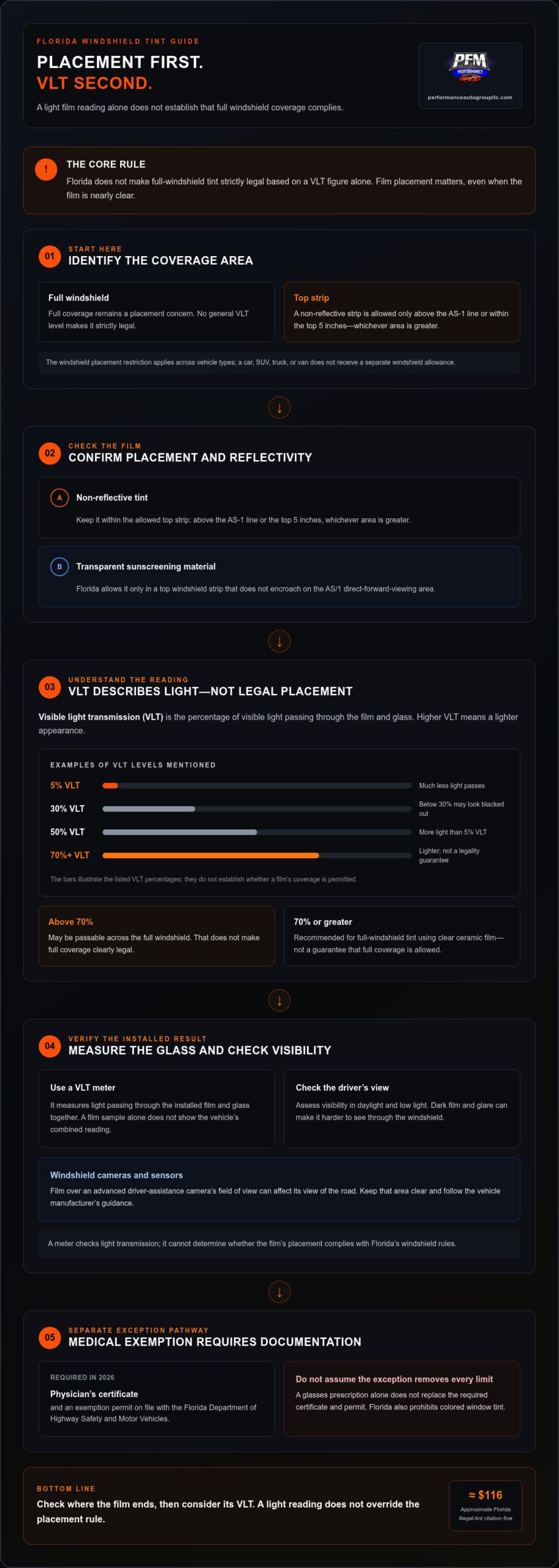
Florida’s windshield restrictions concern coverage, visible light, and film appearance. Full windshield tint is not strictly legal, so choosing a light VLT percentage does not by itself make full-glass coverage compliant.
Windshield tint legality depends on the film’s light transmission and where it is placed. A lighter windshield tint is not necessarily permitted in Florida. These figures describe the visible light that passes through the tint and glass; they shouldn’t be mistaken for a permitted full-windshield threshold.
Films below 30% VLT can appear blacked out, even during daylight. That appearance signals a substantial reduction in visible light, but the legal issue isn’t only how dark the window looks. Florida’s restrictions also concern where windshield film is placed, so a clear or lighter film does not automatically make full coverage acceptable.
A 70% VLT or greater film is recommended for full-windshield tint using clear ceramic film. Films with visible light transmission typically above 70% may be passable, but full windshield tint remains not strictly legal. Treat these VLT figures as guidance about light transmission, not as a blanket authorization for tint across the entire windshield.
Color is another restriction: Florida prohibits colored window tint. For a windshield, consider color, percentage, and placement separately. Neutral-looking film still needs to fit the windshield’s placement limits, while colored film remains prohibited under the stated rule.
Reflective tint can cause confusion because Florida has a separate reflectivity limit for sedan front side windows: no more than 25%. That side-window percentage is not a windshield allowance. Keep the two surfaces distinct when discussing window tinting, since a rule for a sedan’s side window does not establish a permissible windshield reflectivity level.
Florida’s tint law references sections 316.2951 through 316.2956 of the Florida 2016 Statutes. For a practical review, separate the proposed installation into three questions: Is the film colored? What VLT does the finished glass show? Where will the film sit on the windshield? A proposed windshield film should be assessed for both its light transmission and placement.
Before approving a darker film, compare its VLT with the restrictions above and consider the driver’s visibility. A 5% VLT film, for example, allows much less visible light through than a 70% VLT film. That comparison helps clarify the shade, but it does not replace checking whether the windshield coverage itself is allowed.
Florida front windshield tint legality
Florida’s key distinction is between a legal tint specification and full windshield coverage. Full windshield tint is not strictly legal, even though films with visible light transmission typically above 70% may be passable. The practical takeaway: a high VLT reading alone doesn’t establish that an entire tinted windshield complies.
A 50% VLT windshield tint is illegal in Florida. Windshield tint can raise compliance concerns, so choosing a lighter, clear film does not by itself ensure that full coverage is permitted. These figures don’t create a general full-windshield permission. Placement remains a separate issue, and the permitted non-reflective strip is limited to the upper windshield area.
Drivers may choose film for comfort or UV protection, but those goals do not change the legal requirements. For example, clear film intended to reduce heat may still raise a placement issue if it extends below the allowed strip. Reflective finish is a separate consideration: Florida’s windshield allowance specifies non-reflective film, so both appearance and position matter.
Compliance involves more than the film manufacturer’s label. A product description alone may not establish whether installed window film complies. A product description therefore does not replace assessing the installed glass, including its VLT and the film’s location.
Florida requires a sticker identifying legal tinting on the inside of the driver’s-side door jamb. The sticker is a practical vehicle detail, but it does not make a prohibited windshield installation compliant. Consider it alongside the film’s placement and tint reading, not as a substitute for either.
Use a clear decision sequence before approving an installation: identify whether the proposal covers the full windshield or only a strip; confirm that any windshield strip is non-reflective and placed within the permitted area; then distinguish the film’s stated VLT from the finished glass reading. For example, a 70% VLT label does not answer whether the film extends into a restricted viewing area.
When comparing window tint options, ask how the finished VLT is evaluated, where the film edge will sit, and whether the product is reflective. These details help distinguish a comfort-focused choice from a compliant installation. The manufacturer’s VLT description is useful, but placement and the finished application matter too.
PFM Performance Auto Group: Auto Window Tinting
PFM Performance Auto Group provides auto window tinting for drivers considering vehicle tint options. If windshield coverage is your priority, discuss VLT and intended placement together: a shade percentage alone does not determine whether an installation meets Florida’s limits.
Drivers considering a ceramic option can explore Black Pearl Nano Ceramic Window Tint by Madico. Start with your goals for comfort and appearance, then consider the glass and the restrictions that apply to its location. Full windshield coverage and a compliant upper strip are not interchangeable.
Explore PFM Performance Auto Group’s window tinting services, or contact PFM Performance Auto Group to discuss your vehicle’s tinting needs.
Choose a Tint Plan That Fits Your Next Drive
Understanding the legal tint level for a front windshield in Florida helps you make an informed choice. Also consider how you use your vehicle and the balance you want between appearance, comfort, and clear visibility. Discuss the installation details before moving forward.
PFM Performance Auto Group offers Auto Window Tinting, along with Commercial Window Tinting and Home Window Tinting. Whether you’re planning a vehicle project or considering tint for another property, a focused conversation can help you identify the service that fits your goals. If you’re still weighing options, that’s a useful place to begin.
Take the next step with care: choose a tint solution that suits your needs and complies with Florida’s rules.
Frequently Asked Questions
What is Front Windshield Tinting?
Front windshield tinting applies film to a vehicle’s front glass to alter its light transmission and appearance. Drivers may consider it for comfort or UV protection, but the film’s VLT and placement affect whether it complies with Florida’s rules. An upper strip is a different installation from film covering the full windshield.
2026 Window Tint Laws: What’s New for Car Owners?
Florida’s window tint laws were updated in 2025. For car owners making decisions in 2026, the practical point is to assess windshield film by its placement and visible light transmission, rather than assume a new calendar year changes the applicable limits. A side-window allowance doesn’t establish what’s permitted on the windshield, so consider each glass area separately before choosing tint.
Why You Shouldn’t Use Dark Tints in Your Windshield?
Dark windshield tints can reduce the visible light reaching the driver, and extremely dark tints might slightly reduce nighttime visibility. That can make it harder to see road details in low-light conditions. Windshield tint can raise compliance concerns depending on its light transmission and placement. A darker appearance isn’t just a style decision; it can raise both visibility and compliance concerns.
How much of the top of a Florida windshield may be tinted?
Florida allows a non-reflective tint strip above the AS-1 line or within the top 5 inches of the windshield, whichever area is greater. The strip must remain outside the direct-forward-viewing area. Florida Legislature states that transparent sunscreening material is allowed only in a top windshield strip that does not encroach on the AS/1 direct-forward-viewing area.
What visible light transmission (VLT) is required for windshield tint in Florida?
Florida doesn’t provide a VLT percentage that makes full-windshield tint strictly legal. Films with visible light transmission typically above 70% may be passable, and 70% VLT or greater is recommended for full-windshield tint using clear ceramic film. These figures describe light transmission, not permission for full coverage. The placement of the film remains relevant to whether the installation complies.
Does Florida allow medical exemptions for darker windshield tint?
Yes. Florida allows medical exemptions for special window tint. A driver seeking an exemption must have a physician’s certificate and an exemption permit on file with the Florida Department of Highway Safety and Motor Vehicles. The exemption provides an option for qualifying medical needs, but requires documentation: a medical reason alone is not a substitute for the certificate and permit.
Do Florida windshield tint laws differ from federal rules or neighboring states?
Florida allows non-reflective windshield tint only above the AS-1 line or within the top 5 inches, whichever area is greater. Do not assume a neighboring state’s tint allowance applies in Florida.