
HID vs LED Headlights: The 2026 Guide to Superior Night Visibility in Tampa
The brightest bulb on the shelf might be the most dangerous upgrade you ever make to your vehicle. We’ve all felt that moment of genuine concern during a sudden Florida summer downpour when the road ahead simply vanishes into a grey blur. You want clarity, but the HID vs LED headlights debate often feels buried under confusing technical jargon and the fear of blinding your fellow drivers with poorly calibrated equipment. It’s a common struggle for discerning owners who value both safety and a refined aesthetic.
You deserve a lighting solution that provides a high-end luxury look without the maintenance headaches of the past. This guide cuts through the noise to show you exactly how to achieve crystal clear night vision while respecting Florida’s regulations on beam patterns and colors. We’ll explore the precision of HID systems, the modern efficiency of LEDs, and why the best choice always depends on your vehicle’s specific housing optics. By the end, you’ll know exactly how to transform your night driving experience into one of absolute confidence and security.
Key Takeaways
- Understand the fundamental differences between HID plasma arc technology and LED semiconductors to identify which light source best suits your performance needs.
- Compare the impressive 20,000-hour lifespan of LEDs against the intense, wide-reaching output of HID systems for a long-term, maintenance-free upgrade.
- Navigate the HID vs LED headlights debate by learning how your vehicle’s specific housing optics dictate which bulb choice ensures superior visibility without blinding oncoming traffic.
- Ensure your vehicle remains compliant with Florida’s “white light” spectrum regulations while achieving a refined, high-end aesthetic that enhances resale value.
- Discover why meticulous professional installation is critical for secure ballast mounting and precise wiring to eliminate the flickering common in generic kits.
Beyond the Factory Glow: Why Your Headlights Matter in Tampa
Driving through Tampa after a sudden afternoon storm isn’t just a chore; it’s a test of nerves. The standard factory bulbs often leave you squinting through a wall of water on unlit stretches like the Suncoast Parkway or rural Hillsborough roads. This constant strain leads to significant driver fatigue. Your brain works overtime to process limited visual data, turning a short commute into an exhausting ordeal. Upgrading your lighting system isn’t just about utility. It’s a shift toward premium reassurance. A vehicle with crisp, high-end illumination feels safer and commands a higher resale value because it looks modern and well-maintained.
The Evolution of Automotive Illumination
The transition from traditional halogen bulbs to advanced electronics represents a massive leap in automotive care. Halogen technology relies on a delicate filament that produces a dim, yellow glow. It’s outdated. Manufacturers are rapidly phasing out these bulbs in favor of solid-state electronics found in luxury vehicles. This shift isn’t just for show. Modern tech offers a “daylight” color temperature that reduces eye strain. Understanding The Science of Light: How HID and LED Technologies Differ helps you appreciate why these components are now standard in elite performance cars. Whether you’re weighing HID vs LED headlights, you’re moving toward a more durable, sophisticated setup that reflects your high standards.
Safety First: The Real-World Impact of Dim Headlights
Visibility dictates your reaction time. At highway speeds, every second counts. Dim headlights create dangerous “dead spots” in your peripheral vision, hiding potential hazards like debris or wildlife until it’s too late. High-quality lighting increases your effective stopping distance by illuminating the road hundreds of feet further than stock halogens. Precision matters here. We view every installation as an act of meticulous craftsmanship because it protects your investment and your family.
- Identify Hazards Sooner: Spot road obstructions or pedestrians before they enter your direct path.
- Eliminate Peripheral Blindness: A wider beam pattern ensures you see what’s lurking on the shoulder during dark commutes.
- Reduce Glare: Properly calibrated HID vs LED headlights provide intense light exactly where you need it, rather than scattering it into the eyes of oncoming drivers.
Choosing the right technology is only half the battle. To truly master your night driving experience, you need a setup that integrates seamlessly with your vehicle’s existing electronics. This is where the role of a master craftsman becomes essential, ensuring that your new lights perform reliably for years to come.
The Science of Light: How HID and LED Technologies Differ
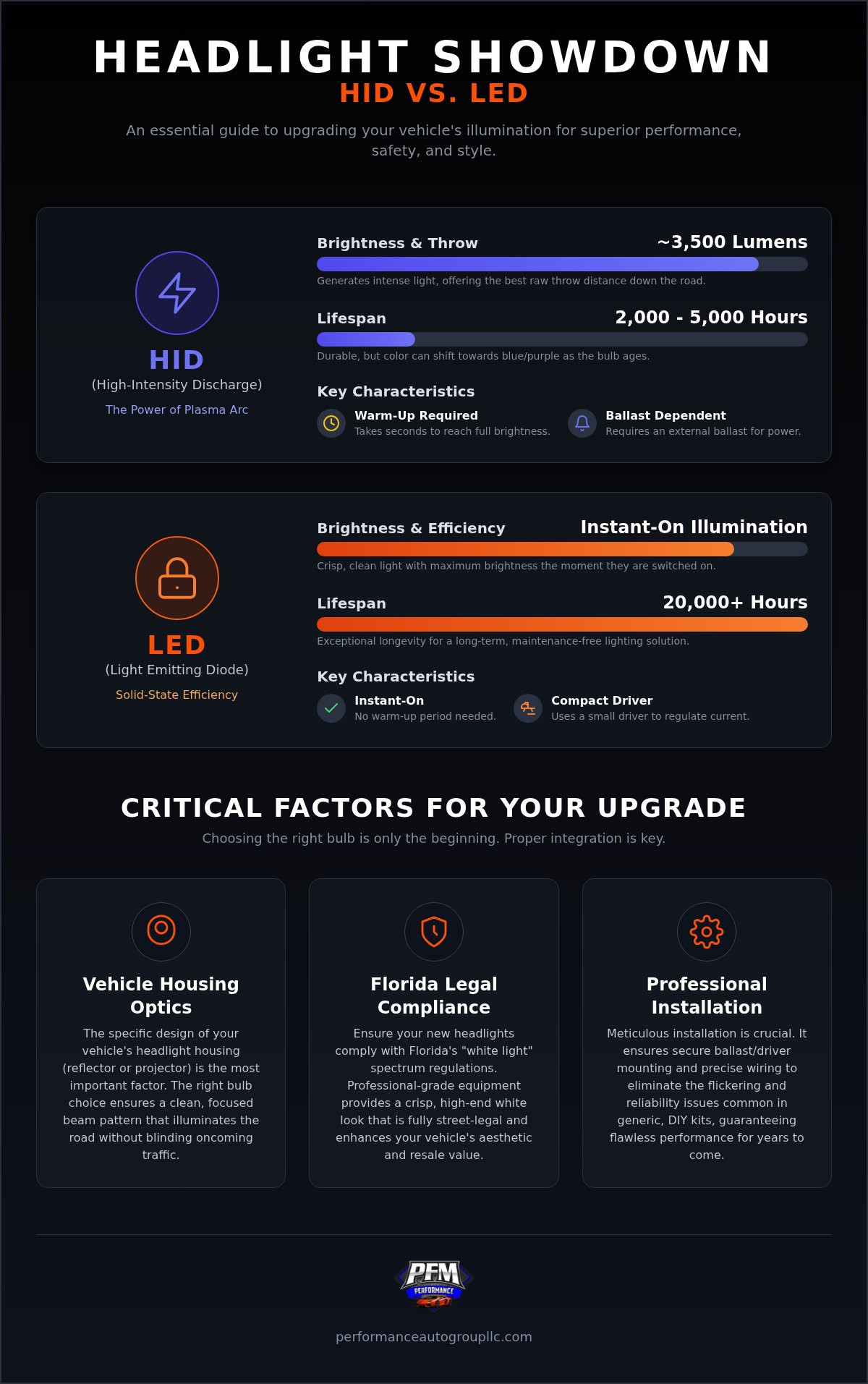
HID lighting functions by creating a high-voltage plasma arc between two electrodes housed within a quartz tube filled with xenon gas. In contrast, LEDs utilize solid-state semiconductor technology to convert electricity directly into photons through a process called electroluminescence. These two methods of light production are fundamentally different, and they require unique support systems to function reliably. While HIDs rely on a ballast to manage a massive initial surge of power, LEDs use a compact “driver” to maintain a steady current and protect the diodes from heat. When choosing between HID vs LED headlights, this internal architecture is the first step toward a superior upgrade.
High-Intensity Discharge (HID): The Arc of Power
HIDs are often called Xenon lights because of the gas that facilitates the plasma arc. This process generates approximately 3,500 lumens from a 35W system, which is roughly 3.5 times the output of a standard halogen bulb. They remain the undisputed champions of raw throw distance, casting light further down the road than almost any other consumer tech. However, they possess a unique characteristic known as “color shift.” As the bulb ages over its 2,000 to 5,000-hour lifespan, the light temperature naturally moves toward a deeper blue or purple hue. This evolution requires a meticulous eye to ensure both bulbs maintain a matching, professional appearance as they mature.
Light Emitting Diodes (LED): Solid-State Efficiency
The primary advantage of LED technology is its instant-on capability. Unlike HIDs, which require a warm-up period of several seconds to reach full intensity, LEDs provide maximum brightness the millisecond you flick the switch. This makes them the ideal choice for high-beam applications where immediate visibility is non-negotiable. Because they lack a filament or a gas arc, LEDs are incredibly durable, often lasting 20,000 hours or more. They also draw significantly less power, which reduces the overall strain on your vehicle’s alternator. Their compact nature allows for intricate, modern designs that can refresh the look of any car. The debate over HID vs LED headlights often comes down to this balance of immediate response versus long-range intensity.
Deciding which technology aligns with your driving habits requires a nuanced look at your specific vehicle. You can consult with our master craftsmen to find the perfect balance of raw power and modern efficiency for your next upgrade. Understanding these technical nuances ensures you invest in a solution that provides both elite performance and long-term peace of mind.
Head-to-Head: Comparing Performance, Longevity, and Aesthetics
Choosing the right lighting isn’t just about picking the brightest bulb. It’s about understanding how your vehicle manages power and heat over years of use. When comparing HID vs LED headlights, the most striking difference is longevity. A high-quality HID system typically offers between 2,000 and 5,000 hours of service. While this is a massive leap over halogen, it pales in comparison to LEDs, which frequently exceed 20,000 hours. This durability makes LEDs the preferred maintenance-free solution for the discerning driver. Beyond lifespan, energy efficiency plays a critical role. LEDs draw less current, which places less stress on modern vehicle computer systems that are sensitive to voltage fluctuations.
Aesthetics often drive the final decision. Most owners seek that crisp, ‘cool white’ 6000K color temperature synonymous with high-end luxury vehicles. This look provides a clean, modern edge that halogens simply cannot replicate. However, achieving this aesthetic refinement requires more than just a bulb swap; it requires a precise match between the light source and your vehicle’s optics to avoid a “cheap” or scattered appearance.
Lumens and Lux: Which Wins the Brightness Battle?
Total light output is measured in lumens, but for the driver, lux is the metric that truly matters. Lumens tell you how much light a bulb produces. Lux tells you how much of that light actually hits the asphalt where you need it. HIDs generally win the raw intensity battle for long-range driving. They project a concentrated beam that cuts deep into the darkness. Conversely, LEDs excel at providing a wider, more uniform foreground fill. This creates a smooth carpet of light directly in front of the vehicle, making it easier to see lane markings and immediate obstacles during your nightly commute.
Durability in the Florida Heat
Tampa’s climate presents a unique challenge for automotive electronics. The combination of intense heat and high humidity can be brutal on external components. For HID systems, the ballast must be meticulously mounted in a location that balances weather protection with airflow. If moisture penetrates the casing, the system fails. LEDs face a different struggle. Because they generate heat at the base of the diode, they require active cooling via heat sinks or integrated fans. In our experience, ‘cheap’ LED bulbs often fail prematurely in the Florida sun because their cooling systems are insufficient. A Master Craftsman understands that protecting your investment means selecting hardware designed to withstand our specific environmental demands.
- HID Lifespan: 2,000 to 5,000 hours of intense output.
- LED Lifespan: 20,000+ hours of reliable service.
- Color Temperature: Both can achieve the elite 6000K white light look.
- Heat Management: LEDs require active cooling; HIDs require protected ballast placement.
Making the Choice: Compatibility and Legal Considerations
Your vehicle’s headlight housing is the ultimate authority in the HID vs LED headlights debate. It doesn’t matter how premium the bulb is if the optics can’t control the beam. This is the “Master Craftsman” rule. We often see drivers buy expensive kits only to find their night vision is actually worse because the light is scattered. Precision matters. A mismatched setup doesn’t just look “cheap”; it’s a safety hazard for everyone on the road. Truly elite results require a deep understanding of how your car was engineered to project light.
Reflector vs. Projector Housings
Most older vehicles use reflector housings. These rely on the bulb’s light bouncing off a mirrored surface to project forward. Installing HIDs in these housings is a mistake. The intense plasma arc creates massive glare that blinds oncoming traffic because the reflector cannot contain the raw power. Projector housings, however, use a dedicated lens to focus the light. They’re the ideal environment for HIDs. If you’re leaning toward LEDs, chip placement is the critical factor. The diodes must perfectly mimic the position of a traditional halogen filament. This ensures the beam hits the road with maximum coverage rather than bleeding into the sky.
Navigating Florida Lighting Regulations
Florida law is clear. Headlights must emit white light. While some drivers crave the 8000K or 10000K “exotic blue” look, these bulbs are actually less effective. The human eye processes white light much more efficiently, especially in the rain. Staying within the DOT-compliant spectrum ensures you avoid moving violations while maintaining superior clarity. Just as you should understand the Florida Window Tint Law for your glass, you must respect beam cut-off lines for your lights. A sharp cut-off prevents light from bleeding upward into other drivers’ eyes. It’s about being a responsible, discerning owner who values craftsmanship over flash.
Modern vehicle computers, known as CANBUS systems, are incredibly vigilant. They monitor voltage levels constantly. If you install a low-draw LED without the proper resistors, your dashboard will likely trigger a “bulb out” warning or cause the lights to flicker. We treat these electronics with the respect they deserve. Every integration we perform uses precision components to ensure your vehicle’s computer remains silent and your lights stay steady. Choosing the right tech is a philosophical decision about how you value your property and your safety.
Professional Installation: The PFM Performance Difference
The marketing for DIY kits often promises a ten-minute “plug-and-play” experience, but this rarely accounts for the complexities of modern automotive electronics. In the HID vs LED headlights landscape, an improper installation is the fastest way to compromise your vehicle’s safety and electrical integrity. We frequently see DIY attempts that result in persistent flickering or annoying radio interference. These issues usually stem from a lack of proper grounding and shielding. At PFM Performance Auto Group, we approach every lighting project with the meticulousness of a master craftsman. Our process involves custom-routed wiring looms and secure, vibration-resistant ballast mounting. We ensure that every component is protected from the elements and integrated seamlessly with your car’s factory systems.
Precision Calibration for Maximum Road Coverage
A headlight upgrade is only functional if the light is directed where you need it most. Raw brightness means nothing if it creates a dangerous “beam scatter” that blinds other drivers. We use professional-grade aiming screens to calibrate your vertical and horizontal cut-off lines with mathematical precision. This calibration ensures that your high-intensity output stays on the road surface, providing maximum visibility without causing glare for oncoming Tampa commuters. This dedication to precision is a hallmark of our workshop, whether we are perfecting your night vision or performing a Professional Car Audio Installation. We believe that true luxury is found in the details that most people never see.
Ready to See the Road Clearly?
Navigating the choice between HID vs LED headlights doesn’t have to be confusing. As your trusted advisor, we evaluate your specific vehicle housing and driving habits to recommend the perfect balance of technology and style. A professional installation ensures that your investment is protected by proper heat management and secure electrical connections. This meticulous attention to detail is how we’ve earned our reputation in Tampa since 2004. You deserve the peace of mind that comes from knowing your vehicle was handled by experts who refuse to settle for “good enough.”
Illuminate the Road with Absolute Confidence
Night driving in Tampa shouldn’t be a source of anxiety. By understanding the critical differences in the HID vs LED headlights debate, you’ve taken the first step toward reclaiming your confidence on the road. Whether you prioritize the unmatched throw distance of a high-intensity discharge system or the maintenance-free longevity of modern semiconductors, the goal remains the same: absolute clarity and security. You now understand that your vehicle’s housing and electrical system are the true masters of your lighting performance.
Since 2004, our expert technicians have served as Hillsborough County’s trusted automotive enhancement shop by treating every vehicle with meticulous care. We don’t just swap bulbs; we provide premium electronics integration and precision beam alignment that protects your property. This ensures your vehicle looks sophisticated while remaining perfectly compliant with Florida’s white-light regulations. We take pride in earning your business through a dedicated, boutique approach to craftsmanship.
You’ve invested in your vehicle, now it’s time to protect that investment with lighting that performs as well as it looks. We look forward to welcoming you to our workshop and helping you see the road in a whole new light. Your journey toward superior night visibility starts with a single, expert integration.
Frequently Asked Questions
Are LED headlights better than HID for night driving?
LED headlights provide a wider carpet of light directly in front of your vehicle, which is excellent for spotting obstacles in residential Tampa neighborhoods. HIDs excel at distance, throwing light further down dark highways. When comparing HID vs LED headlights, the best option is the one that matches your vehicle’s optics. We act as your trusted advisor to determine which technology provides the clarity and security your specific commute requires.
Will upgrading to HID or LED headlights blind other drivers?
Upgraded lighting only blinds others when it is installed carelessly. High-intensity bulbs in standard reflector housings scatter light into the eyes of oncoming drivers. We avoid this by using professional aiming screens to set precise horizontal and vertical cut-offs. Our meticulous approach to craftsmanship ensures your upgrade is functional for you and respectful to every other driver on the roads of Hillsborough County.
Do I need a special kit to install LEDs in my older car?
Older vehicles typically require more than just a bulb swap. They often need specialized adapters or CANBUS decoders to communicate with the car’s legacy computer systems. Without these precision components, you may experience dashboard warnings or flickering. We focus on premium electronics integration to ensure your modern lighting upgrade functions reliably without compromising your vehicle’s original wiring or electrical stability.
How long do HID ballasts typically last in Florida’s climate?
In Tampa’s brutal heat and humidity, a high-quality HID ballast can last several years if it is mounted correctly. Moisture is the primary enemy of these electronics. Our workshop has specialized in these installations since 2004, and we prioritize securing ballasts in protected locations that balance weather shielding with necessary airflow. This meticulous mounting process is critical for ensuring the longevity of your vehicle’s new lighting system.
Why are my new LED headlights flickering after installation?
Flickering is a common symptom of a mismatched electrical draw. Because LEDs use significantly less power than halogen bulbs, your vehicle’s computer may think a bulb is out and pulse the power to check it. This requires the integration of precision resistors to stabilize the current. We treat these electronic challenges with a perfectionist streak, ensuring your HID vs LED headlights installation remains steady and reliable under all driving conditions.
Can I change my headlights to a blue color legally in Tampa?
Florida regulations are very specific about automotive lighting. Headlights must emit white light to remain compliant with DOT standards and local Hillsborough County enforcement. While blue or purple tints might seem aesthetically pleasing, they are illegal for road use and actually provide inferior visibility in dark or rainy conditions. We always recommend staying within the white light spectrum to ensure both your safety and your legal standing.
Is it worth the cost to have headlights professionally installed?
Professional installation provides a level of security that DIY kits cannot match. We don’t just “plug and play.” We perform a comprehensive assessment of your vehicle’s electronics, secure all wiring with vibration-resistant looms, and calibrate the beam pattern for maximum road coverage. This meticulous attention to detail prevents electrical shorts and ensures your high-end lighting solution lasts for the long term, protecting the financial value of your property.
What is the best color temperature for visibility in rain?
For the intense rain common in Florida, a color temperature between 4300K and 5000K is ideal. This range mimics natural sunlight and provides the best contrast against wet asphalt. Higher temperatures, such as 8000K, produce a blue light that reflects off raindrops and puddles, creating a wall of glare that reduces your visibility. We help you select a refined, functional temperature that keeps you safe during those sudden summer storms.