
HID Conversion Kit Installation in Brandon, FL: What to Bring
A careful HID conversion kit installation in Brandon, Florida, starts with accurate vehicle details and information about the headlights. Have the vehicle’s year, make, model, and headlight setup ready, along with the kit if you already have one. Appointment details and relevant vehicle documents can also help with intake.
Before booking, it helps to understand what the installation involves and what may affect the work. This guide covers the vehicle and headlight information to prepare, factors that influence installation time, and how to plan your appointment. Knowing the existing headlight setup can help you arrive with useful details and realistic expectations.
Key Takeaways
- Gather your vehicle’s identifying details and any information about its current headlights to help prepare for an installation appointment.
- Understand which parts of the vehicle and installation process can affect the time required and appointment planning.
- Learn why kit choice and vehicle configuration influence the total cost, without relying on a single price for every model.
- Review the legal considerations that can affect HID conversions in Florida and under federal vehicle lighting rules.
- See why compatibility with factory halogen headlights matters when weighing installation safety and lighting performance.
Documents and vehicle requirements for installation
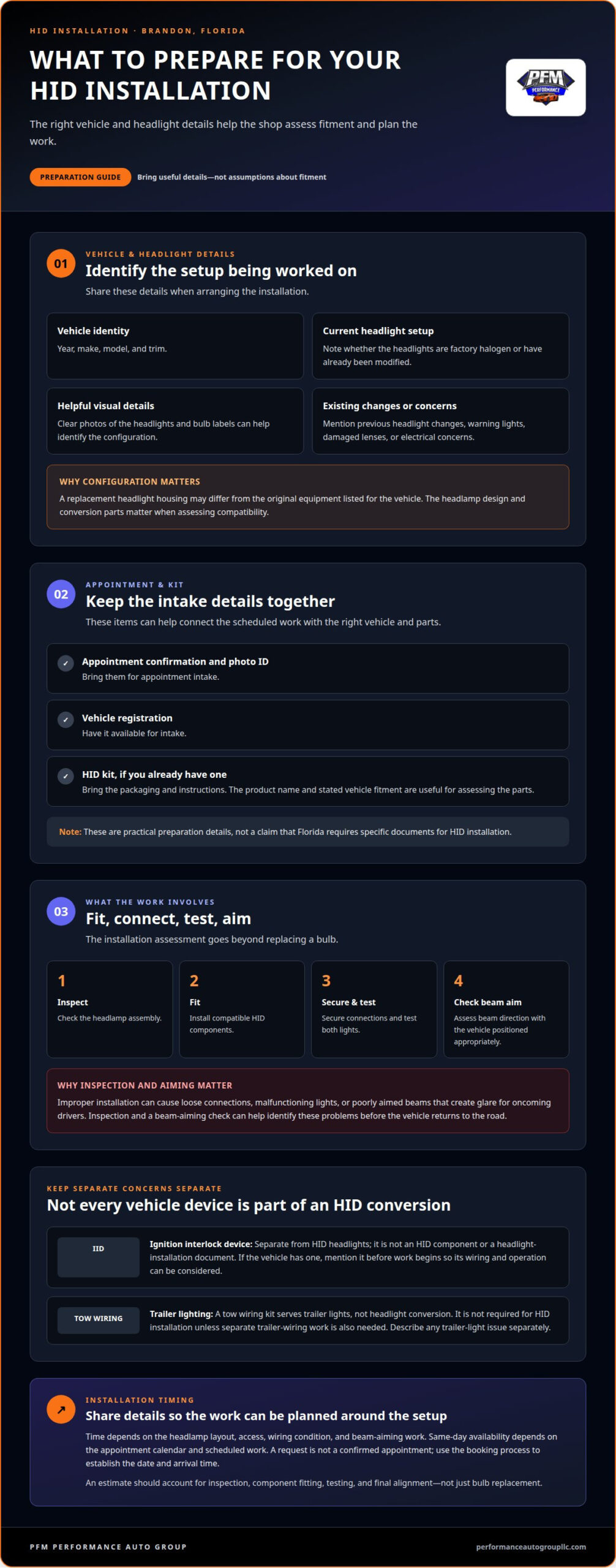
For HID conversion kit installation in Brandon, Florida, share details that identify the vehicle and its current headlight setup. Provide the year, make, model, and trim, and note whether the headlights are factory halogen or have already been modified. Clear photos of the headlights and bulb labels can help identify the configuration. If you have an HID kit, bring its packaging and instructions. The product name and stated vehicle fitment are useful details for assessing the parts.
Bring your appointment confirmation and photo ID, and have the vehicle registration available for intake. These details help connect the scheduled work with the right vehicle and customer. They are practical preparation, not a claim that Florida requires specific documents for HID installation. Mention previous headlight changes, warning lights, damaged lenses, or electrical concerns. A replacement headlight housing, for example, may differ from the original equipment listed for the vehicle.
HID bulbs produce light through an electrical arc, LEDs use light-emitting diodes, and halogen bulbs use a heated filament. Because these technologies rely on different components, the existing headlamp design and conversion parts matter when assessing compatibility.
Installation involves inspecting the headlamp assembly, fitting compatible HID components, securing connections, testing both lights, and checking beam aim. The vehicle needs to be positioned appropriately for an accurate aiming assessment, because beam direction affects what drivers see on the road.
An IID is an ignition interlock device, which is separate from HID headlights. It is not an HID component or a headlight-installation document. If the vehicle has one, mention it before work begins so its wiring and operation can be considered during installation.
A tow wiring kit serves trailer lighting, not headlight conversion. It is not required for HID installation unless the vehicle also needs separate trailer-wiring work. If you are arranging both jobs, identify the tow connector and describe any trailer-light issue separately from the headlight request.
Improper HID installation can result in loose connections, malfunctioning lights, or poorly aimed beams that cause glare for oncoming drivers. A careful inspection and beam-aiming check can help identify these problems before the vehicle returns to the road.
- Bring the vehicle details, appointment confirmation, photo ID, and any HID kit instructions.
- Describe existing modifications and electrical symptoms before installation begins.
- Keep IID or trailer-wiring concerns distinct from the headlight conversion itself.
If discussing towing separately, describe the trailer concern apart from the HID request and explain how you intend to use the vehicle. U-Haul advises considering the tow vehicle’s engine, transmission, suspension, brakes, and tires when deciding whether to tow a trailer. These systems are part of the towing decision, while a tow wiring kit addresses trailer lighting. Neither replaces the need to describe the headlight setup for HID work. If you are arranging both services, provide the relevant vehicle details and identify which concern belongs to each job. This keeps the headlight assessment focused on the lamps and the towing discussion on the vehicle and trailer combination.
Installation hours and appointment availability
Installation time depends on the headlamp layout, access, wiring condition, and beam-aiming work. A straightforward conversion may involve different work from a vehicle with modified lighting. An estimate should account for inspection, component fitting, testing, and final alignment, not just bulb replacement. When scheduling, share the vehicle’s year, make, model, and any headlight changes so the work can be planned around its setup.
Same-day availability depends on the appointment calendar and scheduled work. Submit an appointment request with the vehicle details and the HID service you need. Include whether you have a conversion kit and mention any headlight or electrical concerns. These details help the shop assess the request and plan the visit. A request is not a confirmed appointment, so use the booking process to establish the date and arrival time.
Plan around the shop’s posted hours and the time reserved for your vehicle. An appointment window allows time for inspection and testing, while arriving close to closing may limit time for a careful beam check. The schedule may also distinguish headlight conversion from other vehicle electronics work. A dashcam installation, for example, involves different parts and testing steps, even though both jobs involve vehicle wiring.
Hitch parts and HID components serve different purposes. A tow wiring kit operates trailer lights, while an HID kit serves the vehicle’s headlamps. If you need both jobs, describe them separately when submitting your request. Parts for a hitch or trailer connection do not establish that HID components are suitable for your vehicle, and the reverse is also true. Keep the two requests distinct to avoid confusion about the work and parts.
Warranty coverage and mobile installation are separate considerations. Warranty terms vary based on the chosen product, while mobile service describes where the work takes place. Review the stated warranty terms and appointment details before planning transportation or time away from work. This helps keep expectations about coverage and service location clear.
Use the appointment booking page to submit your request and select an available time. Include enough vehicle information for the appointment to match the installation, then plan to leave time for the technician’s checks. That final testing helps catch fitment or beam-direction issues before the vehicle leaves.
Installation time varies with the headlamp layout, access, wiring condition, and beam-aiming work. Ask the shop for an estimate based on your vehicle and lighting setup.
How much do HID conversion kits cost for common vehicle models?
There isn’t one reliable price for every Honda Civic, Toyota Camry, or Ford F-150. The total depends on the vehicle’s headlight configuration, the kit selected, installation access, and any wiring or aiming work required. A model name helps identify the vehicle, but trim level and previous modifications can change the parts and labor involved.
The price depends on the vehicle and the work involved. Factors include its year, make, model, trim, headlamp type, kit compatibility, and installation requirements. A stock headlight assembly and a previously modified one, for example, may require different inspection and fitting steps. Those details matter more than choosing an estimate based on the model name alone.
When reviewing an estimate, distinguish the kit from installation labor. If you already own a kit, provide its exact product details so the parts can be identified. If components are supplied for the job, ask for a clear breakdown of the kit and installation work. The scope should clarify whether fitting, electrical connections, testing, and beam aiming are included.
Use this preparation sequence for a Honda Civic, Toyota Camry, or Ford F-150:
- Provide the year, make, model, and trim.
- Describe whether the headlights are factory equipment or previously changed.
- Share the kit’s brand, product details, and instructions if you have them.
- Request a written breakdown of included parts and installation steps.
These examples don’t establish that a particular kit fits every Civic, Camry, or F-150. They show why an accurate quote starts with the exact vehicle and headlamp configuration. Two vehicles with the same model name can have different trims, assemblies, or previous changes. Those details affect fitment assessment and the work required.
For HID conversion kit installation in Brandon, Florida, compare estimates by scope, not just the headline price. Check whether the proposed work includes installation, connection checks, light testing, and beam aiming. A clear description of these steps makes it easier to compare the service offered. Ask how the scope changes if the kit does not match the vehicle or the headlamp assembly has been altered.
Before accepting an estimate, confirm which kit and installation tasks it covers. Keep the vehicle and kit details together to make the estimate more specific and clarify what the scheduled work includes.
For HID work, the estimate should reflect the specific vehicle, headlamp setup, components, and installation tasks. Comparing written scopes clarifies what the quoted amount covers.
Before scheduling, make sure the estimate reflects the kit to be installed and the condition of the vehicle’s headlights. If inspection changes the proposed work, review the revised scope and price before approving additional tasks. A clear record of vehicle details, parts, and agreed work can prevent misunderstandings and make estimates easier to compare.
Are HID conversion kits legal in Florida and under federal vehicle lighting rules?
A conversion kit’s label alone does not establish whether a vehicle’s headlights meet road-use requirements. In Florida, the completed headlamp system must be considered in relation to applicable state and federal requirements. The vehicle, original headlamp design, replacement parts, and beam pattern all matter. A kit advertised for a Honda Civic or Toyota Camry, for example, is not automatically suitable for every version of that model.
Federal vehicle-lighting requirements and Florida rules are separate considerations. A product description may identify a bulb or kit, but it does not explain by itself how an altered assembly is treated. Likewise, original vehicle equipment does not prove that a later conversion preserves the headlamp’s intended performance. Assess the complete assembly rather than relying only on packaging claims or broad compatibility statements.
Before deciding on a conversion, gather these details:
- The vehicle’s year, make, model, and trim.
- The headlamp assembly type and any previous modifications.
- The kit’s product documentation and stated vehicle fitment.
- Information about beam pattern, aiming, and any glare observed.
These details help separate a basic fitment question from a road-use compliance question. A kit may physically connect to a vehicle while changing how light leaves the original reflector or projector. A secure connection does not establish that the resulting beam is suitable. Aiming matters too: a beam directed too high can cause glare for approaching drivers.
Review the setup carefully rather than relying on color or brightness claims. First, identify the existing headlamp design. Then compare the kit documentation with that specific setup and assess the installed lights for a controlled beam and proper aim. Include any previous modifications in the assessment. These steps can surface concerns, but they do not replace an authoritative determination of applicable rules.
Keep the distinction clear: fitment, performance, and legal compliance are related, but they aren’t interchangeable. A kit fitting a Ford F-150 doesn’t by itself establish compliance for every F-150 configuration. Nor does a bright output alone demonstrate that the beam is correctly directed. In Brandon, Florida, consider the vehicle’s actual headlamp assembly and the rules that apply to its intended road use before proceeding.
If the documentation does not clearly address the vehicle and headlamp combination, do not treat a generic compatibility label as a legal conclusion. Reviewing the assembly, kit information, and beam aim provides a more responsible basis for deciding whether to proceed.
Are HID bulbs safe to install in factory halogen headlights?
HID bulbs are not automatically a safe match for factory halogen headlights. A halogen reflector or projector is designed around its intended light source. Replacing that source with an HID capsule can change where the light lands, even if the bulb base fits. A bulb that connects correctly, for example, may still create a scattered beam or glare. Physical fit alone does not establish optical compatibility.
The headlamp assembly determines how light is shaped and directed. A factory halogen reflector uses its surface geometry to control light from the filament. An HID arc sits differently, so the reflector may not focus it as intended. The result can be poor road illumination and excessive light toward oncoming traffic. Projector housings also need assessment; a lens does not make every replacement bulb suitable.
Electrical compatibility matters as well. An HID conversion generally uses additional components to operate the bulb, so installation must account for wiring, connections, and secure component placement. Loose connections or poorly routed wires can cause intermittent lighting or interfere with nearby parts. Consider the vehicle’s existing wiring and previous modifications before beginning the conversion. A careful installation includes testing both lamps after fitting.
Before proceeding, assess the assembly and proposed light source:
- Identify whether the factory housing uses a reflector or projector.
- Match the conversion parts to the vehicle and headlamp configuration.
- Inspect wiring and connectors for damage or previous changes.
- Test both beams and check their aim after installation.
Beam aim needs careful attention. Aiming too high can create glare, while a poorly controlled beam may leave dark areas on the road. A wall check can reveal obvious differences between the left and right beams, but it does not replace proper assessment of the installed system. If the pattern is scattered or sharply uneven, review the conversion before regular driving.
For some vehicles, keeping the factory halogen setup is the more suitable choice. A compatible replacement halogen bulb or vehicle-specific LED bulb may be considered, but neither is a universal fit. LED technology also needs to suit the headlamp’s optical design. The right choice depends on the housing, bulb fitment, wiring, and resulting beam, not simply the brightness claims on the packaging.
Choose a light source only after considering the complete headlamp system. A careful installation prioritizes secure connections, controlled beam output, and thorough testing, rather than treating a bulb swap as the whole job.
PFM Performance Auto Group
PFM Performance Auto Group helps drivers make informed vehicle-enhancement decisions, with attention to fit, finish, and the vehicle’s existing setup. For HID questions, use the compatibility, beam-pattern, and aiming considerations above to guide your decision. The shop also offers Auto Window Tinting, a separate upgrade that can complement a vehicle’s appearance.
For drivers considering window film alongside other vehicle enhancements, PFM Performance Auto Group offers Black Pearl Nano Ceramic Window Tint By Madico. This is separate from headlight conversion, so choose each service according to the result you want for your vehicle.
Contact PFM Performance Auto Group to discuss your vehicle enhancement plans.
Plan your next step with confidence
Choose an upgrade based on the result you want, not just the promise of a brighter bulb. For HID conversion kit installation in Brandon, FL, submit an appointment request with your vehicle details and the lighting work you are considering.
PFM Performance Auto Group also offers Auto Window Tinting, Commercial Window Tinting, and Home Window Tinting. These services suit different projects for vehicle and property owners. Identify your priorities and take the next step when you are ready to discuss your plans.
A well-planned upgrade begins with clear information and a decision suited to your vehicle. Take time to consider the details that matter before moving forward.
Frequently Asked Questions
Which auto shops in Brandon, FL install HID conversion kits?
PFM Performance Auto Group provides HID and LED lighting installations at its dedicated workshop, serving Hillsborough County. For HID conversion kit installation in Brandon, Florida, share the vehicle’s year, make, model, and headlight setup when arranging an appointment. These details help clarify the requested work and vehicle fitment. The shop also installs CarPlay and Android Auto systems, dashcams, and car speakers for drivers planning other electronics upgrades.
Do HID conversion kits require vehicle-specific parts or headlight modifications?
HID kits may require parts matched to the vehicle and headlight assembly, but modifications are not automatically necessary. Connectors or bulb fitment can differ across vehicle configurations, even within the same model line. Reflector or projector design also affects how light is focused. A fitment assessment can determine whether the chosen components suit the existing housing or whether another lighting option is more appropriate.