

Decorative Window Films for Lithia Conference Rooms: Privacy With a Professional Finish
What if the best conference-room film didn’t hide the glass, but carefully controlled what people could see through it? If meeting conversations and screens feel exposed, you may need more privacy without losing the daylight and openness of a glass-walled office. Choosing decorative window films for conference rooms Lithia businesses can use means balancing visibility, coverage, and a polished appearance.
The right choice depends on more than a pattern that looks appealing online. Consider where privacy matters most, how much natural light you want to preserve, and how the finished glass will fit the rest of your office.
This guide explains how to weigh privacy, light, and appearance, and what to assess before discussing a local installation. PFM Performance Auto Group provides commercial and privacy window tinting in Hillsborough County. Ask directly whether decorative designs are available and suitable for your project. A clear set of priorities can make that conversation more useful.
Key Takeaways
- Choose decorative window films for conference rooms Lithia offices can use by weighing privacy, daylight, and how the glass will complement your workplace.
- Check sightlines, room lighting, and coverage needs, since each affects how much privacy a film provides.
- Compare film with blinds and frosted glass based on adjustability, appearance, upkeep, and the room’s use.
- Before requesting an installation assessment, note the glass dimensions, meeting-room use, key sightlines, and desired coverage.
- PFM Performance Auto Group provides commercial and privacy window tinting in Hillsborough County. Confirm decorative options and project suitability directly.
Why Lithia Conference Rooms Need Privacy Without Losing Their Open Feel
Glass walls connect a conference room to the rest of the office, but they can also leave conversations, presentations, and screens in clear view. The challenge is to limit unwanted visibility without making the room feel closed off. Choosing decorative window films for conference rooms Lithia businesses can use starts with identifying what needs privacy and the viewpoints that matter.
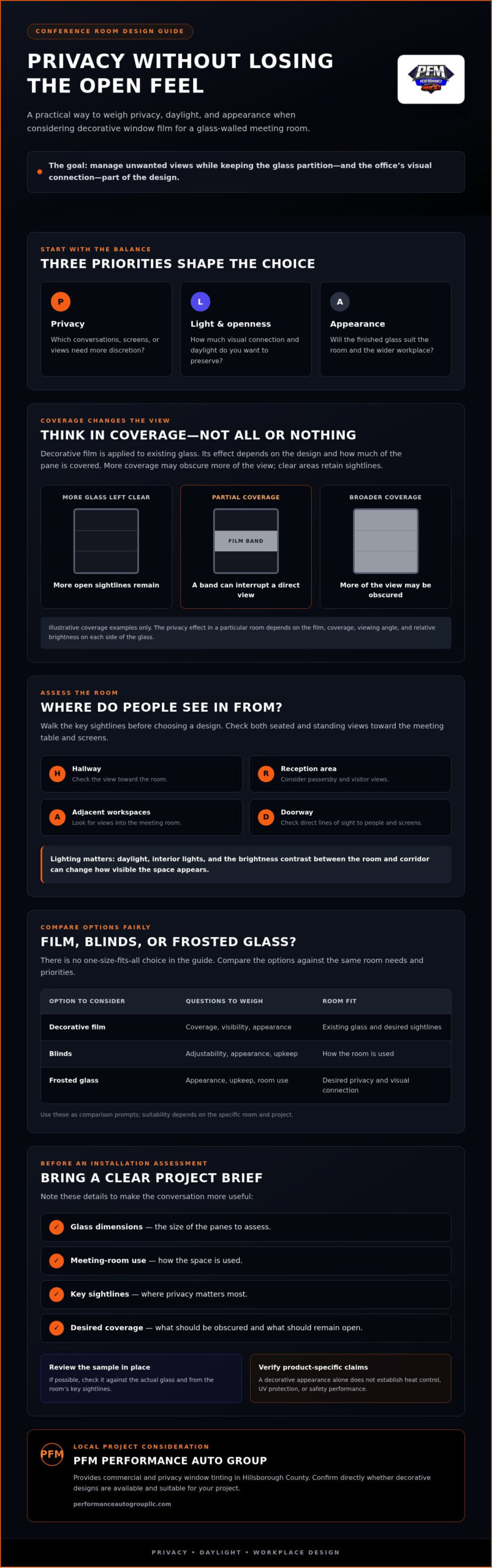
Decorative window film is applied to existing glass to change its appearance and visibility without replacing the glass or creating a physical room divider. Unlike clear glass, film can soften or obscure selected views while retaining the glass partition. The Window film overview provides background on film materials and architectural applications. The privacy effect in a particular room, however, depends on the selected film and how it is installed.
What privacy problem should the film solve?
Define the concern before choosing a design. Are people walking past the conference-room door able to see in? Is visibility from neighboring rooms an issue? Can colleagues read information on a display? Each concern may call for a different coverage layout. Film that screens a seated person’s view may still leave standing occupants or passersby able to see into the room.
Walk the room’s sightlines before selecting a treatment. Check from the hallway, reception area, adjacent workspaces, and doorway. Look toward the table and screens from each position, at both seated and standing eye levels. Privacy depends on opacity and coverage as well as viewing angle and lighting, so don’t assume one treatment will obscure every view.
How can a glass meeting room stay bright and welcoming?
Treat coverage as a design decision rather than an all-or-nothing choice. More coverage may obscure more of the room, while partial coverage can leave sections clear and maintain a stronger visual connection with the office. The right balance depends on what people need to see, what should remain private, and how the film looks alongside the rest of the workplace.
Assess the room at different times of day and under its usual lighting conditions. Daylight, interior lights, and the contrast between a bright room and a darker corridor can change how visible the space appears from outside. If possible, review a sample against the actual glass and from the room’s key sightlines before choosing a design. Don’t assume a film provides a particular level of light transmission or heat control without product-specific information.
Start with the views you need to manage, then evaluate coverage and appearance in the space itself. This helps protect meeting-room discretion while preserving the office’s open feel.
How Decorative Window Film Changes Privacy, Light, and Glass Appearance
Decorative film is applied to existing glass to change its appearance and how clearly people can see through treated areas. The effect depends on the film design and how much of the pane it covers. For example, a band across seated eye level may interrupt a direct view while leaving other portions clear. Broader coverage changes more of the room’s visual connection with the office.
Perceived privacy depends on the film’s design and coverage, the viewer’s angle, and the relative brightness on each side of the glass. A description or photograph alone cannot confirm how a particular option will look in your conference room. A decorative appearance also doesn’t establish heat control, UV protection, or safety performance. Ask for product-specific information before relying on any of those benefits. The International Window Film Association is a useful source for general window-film information. Verify project-specific claims for the film being considered.
Frosted and patterned effects: what changes visually?
A frosted-style appearance softens detail behind the treated glass while keeping the partition part of the room’s design. Bands, partial coverage, or repeated motifs can add visual definition while preserving some views through uncovered areas. More coverage may obscure more of the view; open areas retain sightlines. Before choosing, confirm which samples, patterns, and customization options are available for the project. An example online may not be offered or look the same on your glass.
What can affect visibility through filmed glass?
Lighting can change how people perceive the view from either side. A brightly lit room seen from a dimmer hallway may look different from the same room under other conditions. A physical sample on comparable glass can help you assess the effect. View it from the key positions under the room’s typical lighting.
Keep expectations precise. Window film changes visibility, not sound transmission by default, so voices may still be audible outside the room. If conversation privacy is also a concern, assess it separately rather than treating a visual treatment as soundproofing. For decorative window films for conference rooms Lithia projects, reviewing samples and asking about documented performance can help match the appearance to the room’s needs. To discuss your goals, you can request an appointment to review film options.
Decorative Film, Blinds, or Frosted Glass: Which Fits a Lithia Office?
These options address different needs. Decorative film changes the appearance of existing glass. Blinds can be adjusted as privacy needs change. Frosted glass changes the glazing itself. Consider how the room is used, what the existing glazing can accommodate, the appearance you want, and any landlord or building requirements. The Window Film Fundamentals guide provides building-focused background for evaluating film as part of a project.
| Option | Privacy | Daylight | Visual consistency | Maintenance and project disruption |
|---|---|---|---|---|
| Decorative film | Coverage and design affect visibility; generally not adjustable once applied. | Depends on the selected film and coverage. | Can create a consistent treatment across glazed areas when planned as a coordinated design. | Ask about care and installation conditions for the specific film and glass. |
| Blinds | Can be opened or closed as meeting needs change. | Adjustable, though a closed blind reduces the view through the window. | Appearance depends on the blind style and how it’s used. | Check operation, upkeep, and project requirements for the chosen system. |
| Frosted glass | Changes visibility through the glass; suitability depends on the glazing selected. | Depends on the glass specification. | Can provide a built-in appearance, subject to the glass design. | May involve a glazing project; confirm scope and disruption with the appropriate provider. |
When does film make more sense than blinds?
Film may suit a room that needs consistent visual screening and a uniform appearance across its glass. Blinds may be preferable when staff need to switch between open views and privacy for particular meetings. Consider the room’s routine: does it host confidential discussions throughout the day, or is privacy needed only at certain times? For either option, confirm maintenance needs and installation details for the specific products rather than relying on general assumptions.
When should a business consider another glass solution?
Film changes the glass surface’s appearance. It doesn’t create a solid partition or, by itself, provide sound control. If the goal is stronger physical separation, reduced sound transmission, or a structural change, discuss alternatives with a qualified building or glazing professional. Before approving work, confirm landlord permissions, building requirements, and compatibility with the existing glass.
Consider decorative window films for conference rooms Lithia offices are evaluating as one option, not as an automatic replacement for adjustable blinds, partitions, or new glazing. Match the solution to the room’s purpose and the level of control it needs.
Plan a Decorative Window Film Project for a Lithia Conference Room
A clear brief makes a project discussion more productive. Before exploring decorative window films for conference rooms Lithia businesses are considering, document what the room needs and what the building will allow. This gives a commercial film professional useful context about the glass, privacy goals, and options to assess.
Use this sequence to prepare:
- Set the privacy goal. Decide whether the priority is screening people in the corridor, protecting presentation screens, or reducing views from nearby work areas. Note the viewpoints that matter most.
- Map the glass and room. Record the number of panels and their approximate dimensions. Mark which panes need treatment and whether you’re considering full-height or partial coverage. Note seating and standing positions, walkways, doorways, and screen locations.
- Describe the desired feel. Explain how much visual connection and daylight you want to preserve, and whether the treatment should look consistent across several panels. Note how the room appears in daylight and under interior lighting.
- Gather building information. Look for glazing specifications or guidance from the building manager. Don’t guess the glass type. For a Lithia-area property, check access arrangements, preferred scheduling, and any property-management approvals needed before work can proceed.
- Review samples and scope. Ask which film appearances and coverage layouts are available for the project. Review a physical sample in comparable conditions, then clarify compatibility, surface preparation, included areas, and installation details before approving the work.
What should you assess before requesting a consultation?
Bring notes on the room’s use, glass dimensions, sightlines, nearby walkways, screen placement, and daylight conditions. Be clear about whether every panel needs treatment or only selected sections. These details help focus the discussion on practical coverage choices and flag questions that may require building or glazing information.
What should you confirm with a commercial film professional?
Ask about sample approval, glass suitability, preparation, installation scope, care instructions, and documented product limitations. Confirm what the proposed film can and cannot do rather than assuming a visual effect guarantees a particular performance. PFM Performance Auto Group offers commercial and privacy window tinting in Hillsborough County. Confirm decorative options and project suitability directly. Settle timing, access, and property approvals for the specific project.
Explore Commercial Window Film Options for Your Lithia Conference Room
Once you’ve defined the room’s privacy and design priorities, discuss them with a commercial window film professional. PFM Performance Auto Group provides commercial window tinting, including privacy window tinting, in Hillsborough County. The locally owned and operated business was founded in 2004. For a Lithia conference room, focus the conversation on the specific glass, how the room is used, and which options may suit the project.
What can a professional assessment help clarify?
A useful assessment connects your goals to the conditions in the room. Describe which views you want to limit, where occupants and passersby are positioned, and whether you’re considering coverage across the full pane or selected areas. Explain the appearance you want, such as a more uniform look or clear sections of glass.
Ask which decorative appearances and coverage layouts are currently available for your commercial glazing. Confirm whether the existing glass is suitable and what installation scope would apply. A careful discussion can distinguish what’s confirmed for your project from what still needs verification. There isn’t one standard recommendation for every office: a room with frequent presentations may have different priorities from one used mainly for small discussions.
How do you take the next step in Lithia?
Prepare a concise project brief before scheduling. Include approximate glass dimensions, the panels you’re considering, typical meeting use, screen locations, important sightlines, and how much visual openness you’d like to retain. Keep any glass specifications or property-management guidance available. These details can focus the conversation while leaving room to confirm compatibility and decorative options rather than assuming a particular film or finish is available.
For decorative window films for conference rooms Lithia businesses are evaluating, the aim is to balance privacy and appearance for the actual space. PFM’s commercial window tinting service is a relevant starting point for discussing your glazing and privacy goals. Confirm specific decorative designs, coverage choices, and project suitability directly before making a decision.
Make Your Conference Room Work Better
Start with the room’s actual needs. Identify which views need to be softened, how much openness and daylight you want to retain, and whether film, blinds, or another glazing option best fits the space. For decorative window films for conference rooms Lithia offices are considering, reviewing samples and confirming glass suitability can help turn an idea into a practical project plan.
PFM Performance Auto Group provides commercial and privacy window tinting in Hillsborough County. The locally owned and operated business was founded in 2004. Before choosing a treatment, discuss how the room is used, the glass, your preferred appearance, and which decorative options may be suitable.
To take the next step, book a consultation with PFM Performance Auto Group to discuss your conference room’s glass, privacy goals, and suitable window film options.
Frequently Asked Questions
Do decorative window films provide privacy in a conference room?
Decorative film can reduce visibility through conference-room glass, but the result depends on the film design, coverage, sightlines, and lighting. A partial band may screen seated occupants from a hallway while leaving other views open. It won’t necessarily prevent people from seeing in from every angle, and it doesn’t provide sound privacy. For decorative window films for conference rooms Lithia offices are considering, assess the room’s actual viewpoints and review samples before choosing.
Can decorative film keep a conference room bright?
It can be selected to preserve some daylight, but brightness depends on the specific film, its coverage, the glass, and lighting conditions. Partial coverage may leave clear areas, while broader coverage changes more of the glass’s appearance and view. Don’t assume a particular light-transmission level from a product description alone. Review a sample on comparable glass at different times and under typical interior lighting before approval.
What is the difference between decorative film and frosted glass?
Decorative film is applied to existing glass to change its appearance and visibility. Frosted glass has a frosted appearance as part of the glass itself, rather than from a film treatment added afterward. Both can soften views while retaining a glazed partition, but their project requirements differ. Film suitability depends on the existing glass and selected product. Replacing or changing glazing requires its own assessment and installation planning.
Can decorative window film show a company logo or custom pattern?
Some decorative film projects may incorporate logos or patterns, but don’t assume every provider offers a particular design or customization. Ask to see actual samples and confirm whether the desired artwork, coverage, and appearance can be accommodated on your commercial glass. Confirm decorative choices and project suitability directly before relying on a specific design.
Is decorative window film suitable for every conference-room glass panel?
No. Suitability depends on the glass, its condition, the selected film, and the intended coverage. Panels in the same room may have different exposure, sightlines, or glazing specifications, so don’t assume one product is appropriate throughout. Gather available glass information or building-manager guidance, then ask a commercial film professional to assess compatibility and installation scope before approving treatment.
How much does decorative window film for a conference room cost?
There isn’t enough project information to give a reliable cost for your conference room. Price depends on factors such as the glass area, selected film, coverage, design requirements, and installation scope. Provide panel dimensions and project details when requesting pricing instead of relying on a general estimate. PFM Performance Auto Group provides commercial window tinting in Hillsborough County; ask directly about options and an estimate for your project.
Can decorative window film be removed or changed later?
Removal or replacement may be possible, but the process and suitability depend on the film, adhesive, glass condition, and installation. Don’t assume removal will be simple or that every film can be changed without affecting the glass surface. Before installation, ask what removal involves, whether the specific product can be replaced, and what care or limitations apply. Confirm these details for your chosen film and glazing.