
Choose Between Nano Ceramic Tint and Other Window Films
Ceramic tint sits in the premium price tier, but its higher cost isn’t automatically worthwhile for every vehicle. In the nano ceramic tint vs. other films comparison, the key trade-off is heat filtering and a clear, low-reflective finish versus the lower cost of reflective film or the mid-range position of nano-carbon. Here in Hillsborough County, Florida, state window tint regulations govern automotive tint by VLT rather than film chemistry, which is an important factor to keep in mind. Pricing depends on the vehicle, film grade, and coverage, and is provided after a quote request.
It makes sense to weigh more than the upfront cost: heat and UV rejection, clarity, warranty terms, and possible signal interference all affect how well a film suits your priorities. When you trust PFM Performance Auto Group for your upgrade, the right choice balances those practical benefits with the look and level of comfort you want.
This guide compares common film types, explains what performance claims mean, and offers a practical way to choose. Focus on the specifications that matter for your vehicle rather than paying for features you do not need.
Key Takeaways
- Compare film technologies by their trade-offs: reflective options prioritize solar reflection, while ceramic films offer a low-reflective finish.
- Separate infrared heat rejection from UV protection when evaluating performance claims; they measure different benefits.
- Understand how nano-scale particles can support strong infrared performance while preserving optical clarity.
- Consider signal needs before choosing a metalized film, since its metallic content may affect reception.
- Choose a visible light transmission level that balances the look, brightness, and privacy you want, especially for night driving.
Price depends on the vehicle, film grade, glass area, and installation, and is given after a quote request. A nano ceramic tint vs other films comparison helps separate film technology from project scope, so judge the materials and coverage alongside the final figure.
Nano ceramic film uses particles measured in nanometers, allowing greater particle density without compromising clarity. Ceramic film filters heat with a clear, low-reflective finish and resists corrosion and oxidation. Nano-carbon film offers balanced heat absorption, a smooth, neutral appearance, and glare reduction. Film names alone do not show exactly what a particular product or installation includes, so check its specifications.
Magnetron film is made using a different process: metals such as nickel chromium, silver, or stainless steel are vacuum-deposited onto polyester layers. Reflective films use solar reflection to manage heat and glare, but have a shiny exterior. Their metal content may affect signals, and automotive tint rules apply. Construction and intended use are important comparison points.
How does nano ceramic tint compare with carbon, dyed, metallic, and hybrid window films? Nano ceramic uses dense ceramic particles and contains no metal, while carbon offers balanced heat absorption. Dyed films create a tinted appearance, metallic films contain metal, and hybrid films combine technologies. The right balance depends on the vehicle’s appearance and your priorities.
What is nano ceramic window tint and how does it work? It is a polyester window film containing nano-sized ceramic particles that filter heat while preserving clarity. Because it contains no metal, it avoids the signal interference associated with metalized films.
What are U.S. state window tint laws and legal VLT limits for cars? Tint legality varies by state or country, and tint is not legal everywhere. Visible light transmission (VLT) is a key measure. California regulates automotive tint by VLT rather than film chemistry, so the technology alone does not establish whether a shade meets applicable rules.
Interior window films typically last 7 to 10 years, depending on quality and installation; exterior films usually last 2 to 5 years, depending on climate and location. Most films go inside the glass, while special exterior applications can suit skylights. Installation quality and environmental exposure both affect durability.
| Film option | Construction | Appearance and performance | Key consideration |
|---|---|---|---|
| Nano ceramic | Nano-sized ceramic particles | Clear, low-reflective finish | Dense particles without compromising clarity |
| Nano-carbon | Carbon-based film | Neutral tone, balanced heat absorption | Mid-range positioning |
| Reflective or magnetron | Metal layers on polyester | Solar reflection and glare reduction | Signals and automotive reflectivity rules |
How should you choose and verify a nano ceramic tint installer and film specifications? Match the film to your preferred appearance, heat control, signal needs, and legal VLT. Compare written specifications for VLT, heat rejection, UV performance, and warranty. A nano ceramic tint vs. other films comparison is most useful when it focuses on the exact product grade and coverage, not the label alone.
Comparing heat rejection, UV rejection, clarity, and warranties
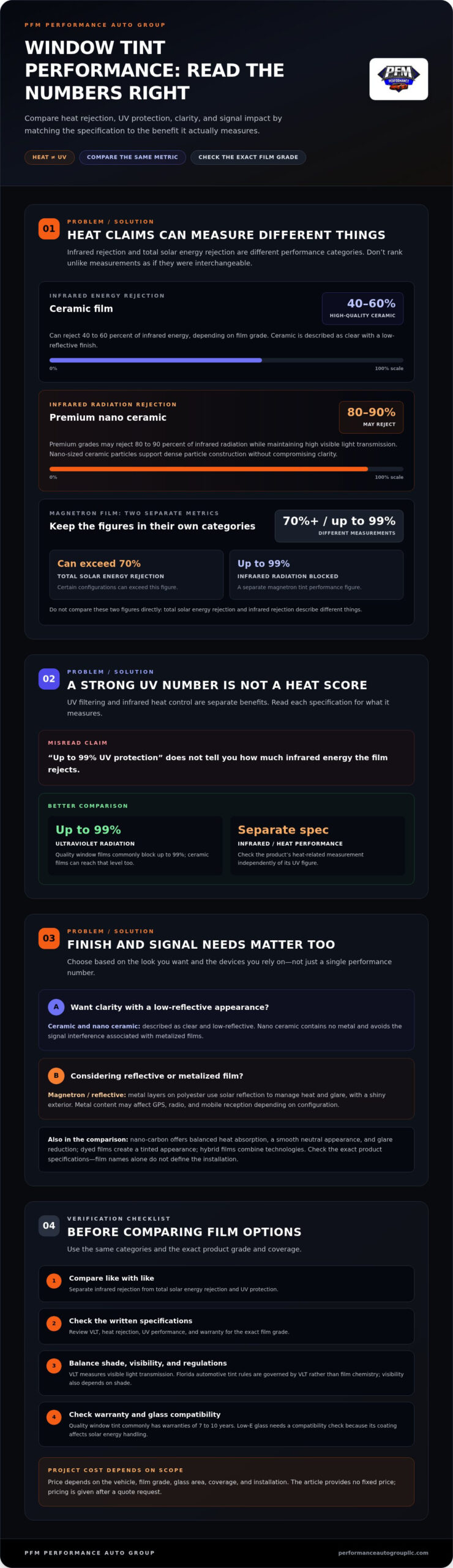
Compare the measurements carefully: infrared rejection and total solar energy rejection describe different performance categories. High-quality ceramic window film can reject 40 to 60 percent of infrared energy, depending on film grade. Premium nano ceramic films may reject 80 to 90 percent of infrared radiation while maintaining high visible light transmission.
Magnetron films show why one headline figure cannot rank every option. Certain configurations can exceed 70 percent total solar energy rejection, while magnetron tint can block up to 99 percent of infrared radiation. Those figures measure different things, so compare the same metric across product specifications rather than treating them as interchangeable.
UV protection offers a more direct comparison. Quality window films commonly block up to 99 percent of ultraviolet radiation, and ceramic films can reach that level too. Heat control and UV filtering are separate benefits: a strong UV figure alone doesn’t explain how much infrared energy a film rejects.
Clarity also matters. Ceramic film filters heat while retaining natural clarity, and its low-reflective finish differs from the shiny exterior of metalized magnetron film. Metal content may cause mild signal attenuation, depending on the configuration. Consider GPS, radio, and mobile reception alongside reflectivity, especially if you rely on connected devices in your vehicle.
Warranties are another comparison point. Quality window tint commonly comes with warranties of 7 to 10 years. Read the written terms alongside the film’s performance specifications; a long coverage period doesn’t tell you by itself which film provides the best heat rejection or clearest view.
Low-E glass needs a separate compatibility check. Its existing coating changes how the glazing handles solar energy, while added film can alter absorption and reflection. Match the film specification to the glass construction and heat-control needs instead of assuming one film suits every pane.
What are the drawbacks and risks of nano ceramic window tint, including night visibility and glass compatibility? Extremely dark tints might slightly reduce nighttime visibility, and visibility depends on shade rather than film type. With Low-E glass, compatibility depends on the glazing construction and the film’s solar properties.
- Compare infrared rejection with infrared rejection, not with total solar energy rejection.
- Review UV performance, clarity, signal compatibility, and written warranty terms together.
- Match film characteristics to the glass, especially when Low-E coatings are present.
For a vehicle-specific comparison of film options, schedule a tint appointment and discuss the performance criteria that matter most.
Nano ceramic vs ceramic tint: is there a difference?
Both use ceramic technology, but particle scale and film formulation can affect performance. Compare the stated infrared and UV figures, not the label alone.
Nano Ceramic Films
Nano ceramic window tint uses ceramic particles measured in nanometers. Their small size allows higher particle density without compromising clarity. That distinction matters because premium nano ceramic films may reject 80 to 90 percent of infrared radiation while maintaining high visible light transmission. The result is strong infrared performance without relying on a dark appearance.
Ceramic Films
Conventional ceramic films also use nonmetal ceramic materials to filter heat. High-quality ceramic window films can reject 40 to 60 percent of infrared energy, depending on film grade, and block up to 99 percent of ultraviolet radiation. Those figures describe different kinds of radiation, so a UV claim cannot substitute for an infrared specification.
Films can manage infrared energy through reflection or filtering and absorption. Reflective films send solar energy away from the glass, while ceramic films filter heat with a clear, low-reflective finish. This affects appearance: ceramic tint can preserve a natural view, while reflective film has a more mirror-like exterior.
“Nano ceramic” describes particle scale, not a universal performance guarantee. Product formulation and grade still matter. One comparison of two ceramic films reports a 19-point difference in heat rejection, illustrating why the technology name alone cannot predict the result. Compare specifications for the exact film and shade being considered.
Keep infrared and ultraviolet protection separate in your decision. Infrared rejection relates to heat control, while UV blocking describes protection from ultraviolet radiation. A film may perform differently across those categories. For example, a film’s 99 percent UV figure doesn’t tell you its infrared rejection, so read both measures independently.
Visible light transmission (VLT) also affects how clear or dark tinted glass appears. Nano ceramic particles can support greater density without compromising clarity, but shade selection still changes how much visible light passes through. Compare the VLT specification alongside infrared performance rather than assuming every nano ceramic shade looks equally clear.
Check what each figure measures: infrared rejection, UV blocking, or visible light transmission. Then compare the same measure across film grades. If comfort is the priority, focus on infrared performance; if preserving a natural view matters most, compare clarity and shade. Comparing specifications carefully makes the term “ceramic” more useful.
Signal interference and metalized films
Metal content matters when signal compatibility is a priority. Reflective window tint contains metal, which can interfere with signals; ceramic film contains no metal and avoids metal-related interference with GPS, radio, and mobile signals. When comparing connectivity and protection, film construction tells you more than shade alone.
Magnetron films use deposited metal layers, and their signal effects depend on configuration. Metallic content may cause mild signal attenuation, meaning a signal can weaken as it passes through the film. Some metallic films, such as Black Silver, may interfere with local radio frequencies. Effects vary, so the exact film construction matters.
Consider the devices you use during a typical drive. You may rely on GPS navigation, mobile reception, and radio audio in the same vehicle. Ceramic tint’s nonmetal construction avoids metal-related interference with those signal types. With a metalized option, signal attenuation can depend on film configuration and local radio frequencies.
Reflectivity is a separate consideration. Reflective film can reduce glare and provide daytime privacy with a mirror-like surface, but its metallic content may affect signals. If you prefer a bright, reflective exterior, weigh that appearance against the vehicle’s connected features. Ceramic film offers a clear, low-reflective finish without metal-related signal interference.
Use these practical checks when comparing film specifications:
- Identify construction: confirm whether the film uses metal or ceramic particles.
- List signal priorities: include GPS, mobile reception, and radio use.
- Compare reflectivity: decide whether a mirror-like finish suits the vehicle.
- Match the film: favor nonmetal ceramic construction when avoiding signal interference is a priority.
For example, a vehicle that depends on GPS and mobile connectivity has different priorities from one chosen mainly for a reflective appearance. The basic trade-off remains: metalized film can offer solar reflection, while ceramic film avoids metal-related signal interference. Choose the features that matter for everyday use.
Consider signal performance alongside heat rejection, clarity, and privacy. A high infrared figure does not describe signal compatibility, just as a reflective finish alone does not establish heat performance. Compare each specification separately, focusing on the exact film construction rather than assuming every metallic or ceramic option performs alike.
Before choosing a window tint, note which devices you use and whether a reflective appearance matters to you. Then compare the film’s metal content and stated signal characteristics with those priorities. This helps align the film’s appearance and signal effects with how you use your vehicle.
Visible light transmission and optical clarity
Visible light transmission, or VLT, describes how much visible light passes through window glass and film. The listed ceramic tint shades range from 70% to 5% VLT. A higher figure means more visible light passes through; a lower figure creates a darker appearance. Compare the same VLT value across film options before deciding.
Shade and film technology answer different questions. Ceramic describes the film’s construction, while VLT describes its light transmission. Ceramic tint can offer a natural look and moderate privacy, but selecting a darker shade changes the view through the window. Choose the light level based on your priorities, not the ceramic label alone.
Night visibility depends on shade rather than film type. A 70% tint is effectively indistinguishable from clear glass after dark, while darker options transmit less visible light. If you regularly drive at night, consider how a lower VLT may affect your view through each window before choosing the film.
Optical clarity also deserves attention. Ceramic window film has a clear, low-reflective finish, while nano-carbon film has a smooth, neutral tinted finish. Reflective film has a shiny, metallic exterior. These differences affect the glass’s appearance, even when two options have the same VLT.
Use this simple comparison process:
- Set your priority: decide whether a lighter view, darker appearance, or moderate privacy matters most.
- Compare VLT: review the available 70% to 5% shades and note how each changes light transmission.
- Consider night use: assess shade carefully because darkness, not ceramic construction, affects night visibility.
- Review finish: compare ceramic’s low-reflective look with nano-carbon’s neutral tint and reflective film’s metallic exterior.
Installation is the final part of the visual result. A carefully selected shade still needs accurate placement across the glass; consistent coverage helps create a uniform appearance from window to window. Compare the intended VLT across all windows rather than choosing each shade in isolation.
The darkest shade is not automatically the best match. A driver who values a bright cabin may prefer a higher VLT, while someone seeking a darker appearance may consider a lower one. Ceramic film’s natural look can suit drivers who want tint without a highly reflective exterior. Match the shade to visibility and style.
Before installation, note your preferred VLT, finish, and night-driving needs. Compare those priorities with the film options. This practical check helps you weigh optical clarity, privacy, and everyday visibility.
PFM Performance Auto Group: Auto Window Tinting
PFM Performance Auto Group provides auto window tinting for drivers comparing film types, shades, and performance priorities in Hillsborough County. Its Black Pearl Nano Ceramic Window Tint by Madico offers a ceramic option to consider for heat control, clarity, and signal compatibility. The right selection depends on the balance you want between visible light transmission, appearance, and film performance.
Bring your priorities into the decision: consider whether you value a lighter view, reduced glare, or ceramic construction, then compare those needs with the film specifications. PFM Performance Auto Group can help you explore its automotive tinting options.
Contact PFM Performance Auto Group or visit performanceautogroupllc.com to learn more.
Choose a film that fits your next drive
The right choice suits how you use your vehicle, not simply the film with the most impressive label. Before deciding, identify your priorities: cabin comfort, a natural view, reduced glare, or uninterrupted device signals. Then use the nano ceramic tint vs other films comparison to focus on the specifications that matter to you.
PFM Performance Auto Group offers auto window tinting, commercial window tinting, and home window tinting in Hillsborough County. For a vehicle, bring your preferred appearance and visibility needs into the decision. Knowing what matters most can make the next step more straightforward.
Contact PFM Performance Auto Group to discuss your window tinting needs.
Make a considered choice and enjoy a finish that suits your everyday drive.
Frequently Asked Questions
How much heat and infrared radiation does nano ceramic tint block compared with other films?
Nano ceramic films may reject 80 to 90 percent of infrared radiation, while high-quality ceramic films can reject 40 to 60 percent, depending on grade. Magnetron films can also perform strongly, with some configurations exceeding 70 percent total solar energy rejection. These figures measure different things, so compare infrared rejection with infrared rejection, not with total solar energy rejection. For a real-world choice, weigh the exact film grade alongside your heat-control needs.
How do visible light transmission, glare reduction, and UV protection compare among window tint types?
Listed ceramic shades range from 70% to 5% visible light transmission, so shade affects brightness and night visibility. Reflective films are very effective at reducing glare, while nano-carbon films also reduce glare with a softer, neutral appearance. Quality window films commonly block up to 99% of ultraviolet radiation. For example, a driver who often travels after dark may prefer a higher VLT, even if a darker shade offers more privacy.
How much does nano ceramic window tint cost for a car, home, or commercial building in the United States?
There isn’t one price for all three projects. The cost depends on the vehicle or building, the glass area, the chosen film, and installation requirements. For a car, coverage and vehicle glass shape affect the work; for homes and commercial spaces, window size and access matter. PFM Performance Auto Group offers tinting for vehicles, homes, and commercial properties in Hillsborough County. Pricing depends on the case and is provided after a quote request.
Does nano ceramic tint interfere with GPS, cell phone, radio, or keyless-entry signals?
Ceramic films contain no metal and avoid metal-related interference with GPS, radio, or mobile signals. Metalized films may cause mild signal attenuation, depending on their configuration, and some can affect local radio frequencies. Keyless-entry performance depends on the vehicle’s system and the film’s construction, so do not assume every metalized option behaves alike. If connectivity is a priority, nonmetal ceramic film avoids metal-related interference.
How long does nano ceramic window film last, and what warranties are typical?
High-quality window tint can last 5-10 years or more, depending on exposure and maintenance. A film exposed to harsh conditions or poorly installed may not perform like one installed carefully and maintained appropriately. Warranty coverage varies with the chosen product, so review what it covers for the film and installation, plus any exclusions and claim requirements. Those written terms are more useful than comparing warranty length alone.