
Ceramic Car Window Tint: The Ultimate Guide to Florida Heat Protection (2026)
What if you could drop your vehicle’s interior temperature by nearly 30 degrees without even touching the air conditioning dial? In Florida, the sun is a relentless adversary that turns leather seats into heating pads and slowly degrades your dashboard through constant UV exposure. You have likely felt the frustration of waiting for the cabin to cool while squinting through intense, blinding glare. We understand that your car is a significant investment, and it deserves more than a basic film that bubbles or blocks your cell signal. By choosing a premium ceramic car window tint, you are installing a sophisticated heat-management system rather than just a simple shade. This guide explores how nano-ceramic technology blocks up to 98% of infrared rays to keep your cabin remarkably cool. We will break down the 2026 Florida tint regulations, explain why ceramic film ensures crystal-clear GPS reception, and show you how to preserve your upholstery with meticulous protection. It’s time to stop enduring the heat and start enjoying a more refined, comfortable driving experience.
Key Takeaways
- Learn how nano-ceramic particles manage solar energy to provide superior heat rejection without interfering with your electronic signals.
- Discover why the intense Florida sun necessitates advanced protection to prevent interior cracking and the dangerous greenhouse effect in your vehicle.
- Compare the performance tiers of window films to understand why ceramic car window tint is the gold standard for long-term durability and cooling.
- Gain clarity on current Florida VLT regulations to ensure your vehicle remains street-legal while achieving maximum privacy and shade.
- Understand the critical importance of professional installation to avoid common defects like light gaps, bubbling, and premature peeling.
The Science of Staying Cool: What is Ceramic Car Window Tint?
A high-quality window tint is not just a cosmetic upgrade. It is a precision-engineered barrier designed to protect both the driver and the vehicle’s interior from the harsh Florida elements. To understand the effectiveness of a premium ceramic car window tint, we must look at its composition. Unlike basic films that rely on heavy dyes to darken the glass, ceramic tint utilizes a multi-layered construction. It is embedded with nano-ceramic particles that are both non-conductive and non-metallic. These particles are microscopic, meaning they remain invisible to the naked eye while performing the heavy-duty task of managing solar energy. This sophisticated approach to The Science of Window Film ensures that your vehicle stays protected without sacrificing visibility.
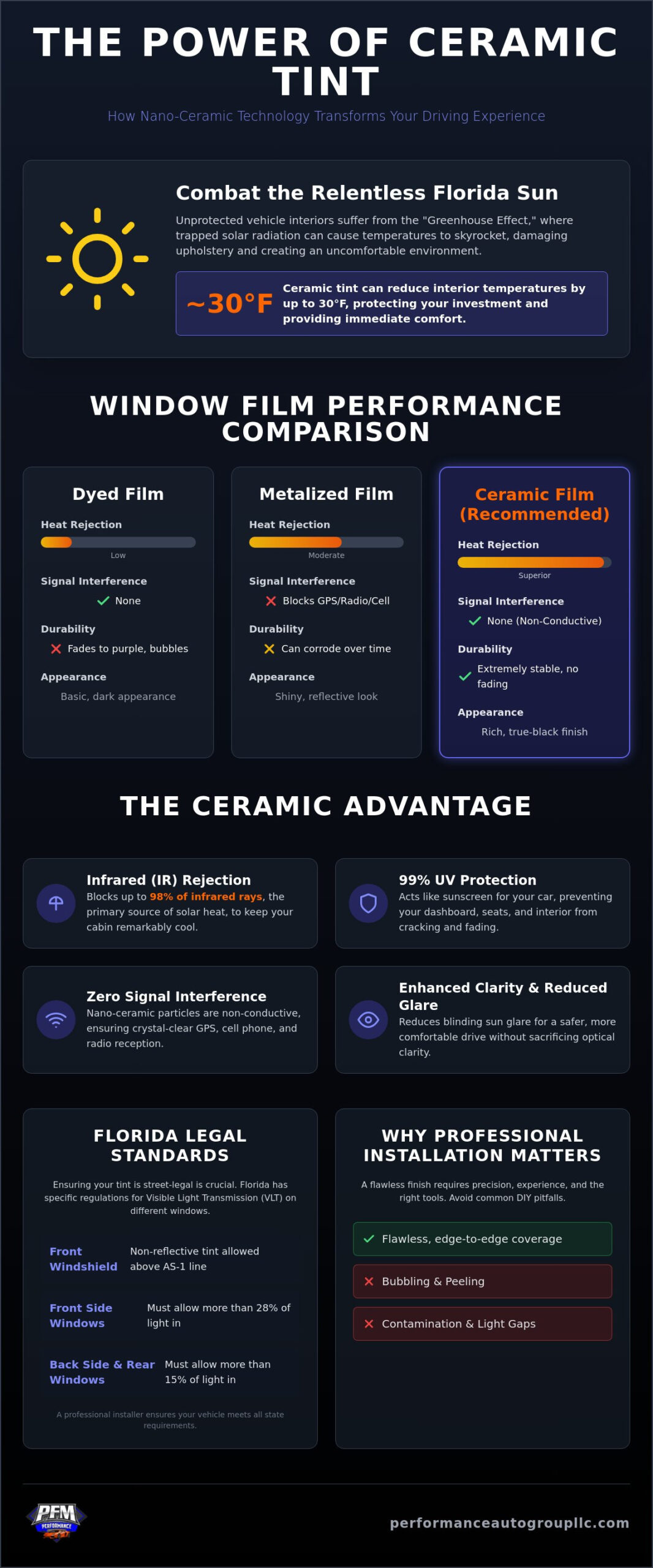
The core difference between ceramic technology and traditional options lies in how they handle heat. Standard dyed films act like a dark sponge; they absorb solar energy and eventually radiate that heat into your car’s cabin. In contrast, ceramic particles are designed to reflect and manage infrared radiation. This allows for exceptionally high heat rejection even with lighter shades of film. You don’t need “limo dark” windows to stay cool. This is a game-changer for drivers who want a sophisticated look while blocking up to 98% of the infrared rays that cause that unbearable “burning seat” sensation during a Tampa summer.
Nano-Ceramic Technology vs. Traditional Films
Traditional metalized films were once the industry standard, but they are now largely considered outdated. These films use metallic layers to reflect heat, which can lead to unsightly corrosion over time and a “shiny” look that many modern car owners find unappealing. Furthermore, dyed films are notorious for their lack of durability. Over a few years of exposure to the intense Florida sun, the dyes break down, causing the film to fade to a distracting shade of purple. Nano-ceramic particles are inherently stable. They do not fade, and they are small enough to maintain perfect optical clarity, ensuring your view of the road remains sharp and undistorted for the life of the film.
Why ‘Non-Conductive’ Matters for Your Electronics
Modern vehicles are essentially rolling computers. Between 5G cellular connectivity, satellite radio, and precision GPS, your car relies on a constant stream of electronic signals. Metallic tints act like a Faraday cage, partially blocking these signals and leading to dropped calls or lagging navigation. Because ceramic film is non-conductive, it allows these signals to pass through the glass without any degradation. This ensures that your Apple CarPlay or Android Auto connection remains stable and your internal sensors function at peak performance. For the modern driver, interference-free technology is a non-negotiable prerequisite for any luxury vehicle enhancement.
Combatting the Florida Sun: Why Tampa Drivers Need Ceramic Protection
Driving through Tampa in the height of July feels like sitting inside a pressurized oven. The sun in Hillsborough County doesn’t just shine; it radiates with a relentless intensity that can quickly degrade even the most well-maintained vehicles. When your car sits in a parking lot near Channelside or Ybor City, it falls victim to the “Greenhouse Effect.” Short-wave solar radiation passes through your glass and becomes trapped as long-wave heat, causing interior temperatures to skyrocket. Research indicates that a high-performance ceramic car window tint can reduce these internal temperatures by 25 to 30 degrees Fahrenheit. This isn’t just about comfort; it’s about protecting the financial and emotional investment you’ve made in your vehicle.
While many drivers prioritize the aesthetic of a darker window, the legal and safety implications are paramount. Adhering to Florida’s Official Window Tint Statutes ensures that your vehicle remains street-legal while still benefiting from elite heat management. We take a meticulous approach to every installation, acting as guardians of your car’s interior. By choosing a professional shop, you ensure that your film is applied with the precision required to withstand the unique humidity and heat of the Gulf Coast. It’s a matter of long-term stewardship for your property.
Infrared (IR) Rejection: The Key to Temperature Control
Infrared rays are the specific wavelengths of light responsible for that sharp, “burning” sensation on your skin during a long commute. Standard dyed films are often disappointing, rejecting only 20% to 30% of this heat. In contrast, a premium ceramic car window tint is engineered to reject upwards of 90% of infrared energy. This massive jump in performance significantly lightens the load on your car’s air conditioning system. By reducing the strain on your compressor, you may notice a slight improvement in fuel efficiency or, for EV owners, a more consistent driving range. Efficiency and luxury should always go hand in hand.
UV Defense for Your Interior and Your Skin
The damage caused by UV radiation is often invisible until it’s too late. Ceramic films act as a powerful shield, blocking 99% of harmful UVA and UVB rays. This level of protection is roughly equivalent to wearing high-SPF sunscreen every time you get behind the wheel, which is essential for long-term skin health during Florida’s peak sun hours. From an aesthetic standpoint, this UV defense is what prevents your dashboard from cracking and your leather seats from becoming brittle and discolored. Maintaining that “showroom floor” look requires more than just cleaning; it requires the elite protection that only nano-ceramic technology can provide. If you’re ready to experience this level of care for your vehicle, you can schedule a precision consultation with our master craftsmen today.
Ceramic vs. Carbon vs. Regular Tint: A Performance Comparison
Choosing the right film is a balance between initial cost and long-term protection. Most drivers categorize their options into three distinct tiers. Dyed film is the entry-level budget choice. Carbon film represents the mid-range. A premium ceramic car window tint sits at the top as the elite solution for discerning owners. While dyed films are affordable, they offer minimal heat rejection and are prone to fading. Carbon films are a significant step up, providing a matte finish and better infrared blocking, yet they still fall short of the precision standards set by nano-ceramic technology. We believe in providing solutions that respect the financial value of your vehicle. If you’re weighing your options and want to understand how much to tint a car in Tampa across different film tiers, our detailed pricing guide breaks down the real-world costs of each choice.
One of the most persistent myths in the industry is that a darker tint automatically provides better cooling. This is simply not true. A dark, low-quality dyed film might provide privacy, but it lacks the technology to block the heat-carrying infrared spectrum. In fact, a nearly clear ceramic car window tint will significantly outperform the darkest budget film on the market. This is why we focus on performance over just “the look.” According to Car and Driver’s Guide to Window Tint, the primary benefits of high-end films extend far beyond aesthetics, touching on safety and long-term vehicle health. It’s a matter of choosing technology that actually works.
The Performance Gap: Why Ceramic Wins in 2026
Imagine leaving your car in a Tampa parking lot for two hours. With a dyed film, the cabin temperature can easily reach 140 degrees. With ceramic protection, that peak is noticeably lower, and the surfaces stay cool enough to touch. Carbon films are excellent for maintaining color and provide decent heat rejection, but they cannot match the thermal management of ceramic. Additionally, ceramic particles are so refined that they offer superior optical clarity. This is vital for night driving, as it reduces the “haze” often seen with cheaper materials. You get a sharper view of the road when it matters most.
Longevity and Warranty Considerations
Cheap films often fail within two to three years. You’ve likely seen cars with purple, bubbling windows; this is the result of adhesive failure and dye breakdown. Professional-grade ceramic films are built to last the lifetime of the vehicle. We view our work as a form of care for your property, which is why we only use materials backed by robust lifetime warranties. For a deeper look at the value of these investments, read our comprehensive guide on the Best Car Window Tinting in Tampa. Precision installation ensures that your film remains flawlessly adhered, free from the peeling or bubbling that plagues mobile or DIY jobs.
Navigating Tint Percentages and Florida Legal Standards
Choosing the right shade for your vehicle is about more than just aesthetics. It’s a balance between personal privacy, driving safety, and strict legal compliance. Visible Light Transmission, or VLT, is the metric used to determine how much light passes through your window film. A lower VLT percentage indicates a darker film. For example, a 5% tint is often referred to as “limo tint” because it only allows 5% of light to enter the cabin. While the urge to go as dark as possible is common in the Sunshine State, we prioritize keeping our clients on the right side of the law. We act as your trusted advisors to ensure your ceramic car window tint meets state requirements without sacrificing the high-end look you desire.
Florida statutes are specific and strictly enforced. For passenger sedans, the front side windows must have a VLT of more than 28%. The rear side windows and the rear windshield must allow more than 15% of light to pass. If you drive a multi-purpose vehicle, such as an SUV, van, or truck, the rules for the rear sections are more lenient. While the front side windows must still meet the 28% VLT standard, the windows behind the driver can be as dark as 6% VLT. Additionally, reflectivity is regulated. Front side windows cannot be more than 25% reflective, and rear windows are capped at 35%. Adhering to these standards prevents unnecessary attention from law enforcement while maintaining clear visibility for night driving.
VLT Percentages: Finding Your Perfect Shade
Selecting a percentage often involves a trade-off. A 15% tint provides a sleek, uniform look that matches many factory-tinted rear windows, but it’s only legal for the rear of sedans. A 35% tint is a popular choice for front windows because it offers a sophisticated appearance while remaining safely above the legal 28% limit. The beauty of a premium ceramic car window tint is that you don’t need to choose the darkest shade to achieve elite heat rejection. Even a nearly clear 70% or 80% ceramic film can block more heat than a dark, low-quality dyed film. We recommend checking local Hillsborough County enforcement trends, as authorities often focus on ensuring front windows remain light enough for driver identification. When searching for an auto tint shop near me, look for a provider who can guide you through these legal nuances while delivering the heat protection your vehicle demands.
Windshield Tinting: The ‘Missing Link’ in Heat Protection
The windshield is the largest piece of glass on your vehicle and the primary entry point for solar energy. To stay legal, Florida law allows non-reflective tint only above the manufacturer’s AS-1 line, which is typically the top 5 to 6 inches of the glass. However, many discerning drivers opt for a clear ceramic film, such as “Air 80,” over the entire windshield. These films are virtually invisible and do not interfere with your view, yet they block a massive amount of infrared heat. This prevents the dreaded “hot steering wheel” syndrome and protects your dashboard from the cracking that often occurs in the Tampa sun. It’s a meticulous detail that completes your car’s thermal defense system.
The PFM Performance Difference: Why Professional Installation Matters
A high-performance ceramic car window tint is an advanced piece of technology. However, even the most sophisticated film will fail if it isn’t applied with absolute precision. At PFM Performance Auto Group, we operate under a “Master Craftsman” philosophy. We don’t just “stick” film to glass; we perform a meticulous installation that respects the financial and emotional value of your vehicle. Choosing a low-quality “parking lot” service or attempting a DIY job often leads to frustrating results. Dust specks, jagged light gaps, and premature peeling are common when the environment isn’t strictly controlled. Mobile services often struggle with the Florida wind, which carries sand and debris directly into the adhesive layer during application. Understanding what separates a true professional from a high-volume operation is essential; our detailed breakdown of what to look for in a premium auto tint shop near me can help you make the right choice for your vehicle.
We provide premium reassurance by utilizing a specialized, climate-controlled workshop in Tampa. This environment is essential for achieving a flawless, factory-like finish. By eliminating wind and airborne contaminants, we ensure that the adhesive bond is perfect from day one. Our team is proud to be an authorized dealer of Black Pearl Nano Ceramic by Madico. This specific film offers the elite durability and clarity that our discerning clients expect. It is a partnership of world-class materials and seasoned expertise. We act as your trusted advisors, guiding you toward the best solution for your specific vehicle and lifestyle needs.
Meticulous Craftsmanship: Our Multi-Step Process
- Decontamination: We start with an intensive glass preparation phase. Every microscopic particle and chemical residue is removed to prevent texture issues.
- Precision Fitting: For the complex curves of modern windshields and rear glass, we use a precision heat-shrinking technique. This ensures the film contours perfectly to the glass without tension points.
- Edge Finishing: We take pride in our “no-gap” finishing, ensuring the film looks like a natural part of the glass rather than an after-market addition.
This slow, methodical approach is what separates a professional shop from a high-volume “tint mill.” We believe that rushing a job is a disservice to the customer and the craft itself. Every vehicle that enters our bay receives the same level of focus and care as if it were our own. We are never satisfied with just “good enough” and strive to surprise every customer with our attention to detail.
Earning Your Business: The PFM Promise
We have been a part of the Tampa community since 2004. Over those two decades, we have evolved through hard work and a commitment to perfection. We don’t view our services as a simple transaction. Instead, every installation is a form of care for your property. We understand that trust is earned through consistent quality and transparency. Our history in Hillsborough County is built on the relationships we’ve formed with local drivers who value excellence. If you are ready to transform your driving experience with the best protection available, we invite you to Book Your Ceramic Tint Appointment today. Let us show you the level of detail your vehicle deserves.
Secure Your Investment with Elite Thermal Protection
Investing in a premium ceramic car window tint is about more than just surviving the Tampa heat; it is about preserving the life of your vehicle and ensuring your daily comfort. We’ve explored how nano-ceramic technology manages solar energy without blocking your essential electronic signals. By choosing a professional shop over a mobile or DIY alternative, you ensure a meticulous application that withstands the unique humidity of the Gulf Coast. Since 2004, we’ve served the Tampa community as trusted advisors, providing the precision that only a Master Craftsman can deliver. As an authorized Madico Black Pearl dealer, we combine industry-leading materials with two decades of refined expertise.
Your vehicle is a significant financial and emotional asset. Every professional ceramic installation we perform comes with a lifetime warranty, giving you the premium reassurance that your car will stay cool and clear for years to come. We look forward to earning your business and welcoming you into our community of discerning drivers who refuse to settle for anything less than perfection.
Frequently Asked Questions
Is ceramic car window tint worth the extra money?
Yes, it is a superior investment in both longevity and daily comfort. While the upfront cost is higher than dyed or carbon films, the ability of ceramic car window tint to block up to 98% of infrared rays provides immediate thermal relief that cheaper alternatives cannot match. It also lasts significantly longer, often for the life of the vehicle, whereas basic films tend to bubble or fade within a few years in the Florida sun. To better understand the full cost breakdown and what drives the price difference between film types, our 2026 Tampa car tint pricing guide offers a transparent look at what you should expect to pay for a professional ceramic installation.
Does ceramic tint interfere with GPS or cell phone signals?
No, ceramic film is entirely non-metallic and will not interfere with your electronic signals. This ensures that your 5G cellular connection, GPS navigation, and Bluetooth stay perfectly clear. Older metallic films act as a shield that can drop calls or lag your maps, but nano-ceramic particles allow signals to pass through the glass without any degradation. It’s the ideal choice for modern vehicles equipped with advanced tech.
What is the legal tint percentage in Florida for 2026?
Florida’s regulations require specific VLT (Visible Light Transmission) levels for road safety. For sedans, front side windows must allow more than 28% of light in, while rear windows must be above 15%. For SUVs and vans, front windows remain at 28%, but the rear sections can be as dark as 6%. Additionally, reflectivity is capped at 25% for front windows and 35% for the rear glass.
How long does it take to install ceramic window tint?
A professional installation typically takes between two and four hours depending on the size and complexity of the vehicle. This timeframe allows our craftsmen to perform a deep decontamination of the glass and ensure the film is perfectly heat-shrunk to the contours of your windows. We prioritize a meticulous, dust-free finish over a rushed job to ensure your investment remains flawless for the long term.
Can you tint a windshield with ceramic film legally?
Legally, you can only apply non-reflective tint above the manufacturer’s AS-1 line, which is usually the top 5 to 6 inches of the windshield. While many drivers choose nearly clear ceramic films for full-windshield heat rejection, it’s important to understand the specific statutory limits in Florida. We recommend a consultation to discuss the most effective and compliant ways to protect your front glass from solar energy.
How do I clean and maintain my ceramic window tint?
You should clean your tint using a soft microfiber towel and an ammonia-free glass cleaner. Ammonia is a harsh chemical that can break down the protective top coat of the film and eventually weaken the adhesive bond. Regular maintenance with gentle, dedicated automotive glass products will preserve the optical clarity and scratch-resistant properties of your ceramic car window tint for years to come.
Will ceramic tint prevent my dashboard from cracking?
Yes, ceramic tint is one of the most effective ways to prevent your dashboard from cracking and fading over time. By blocking 99% of harmful UVA and UVB rays, the film stops the solar radiation that dries out vinyl, leather, and plastic components. It acts as a permanent sunscreen for your interior, maintaining that showroom aesthetic even after years of intense Florida sun exposure.
What is the difference between nano-ceramic and regular ceramic tint?
Nano-ceramic technology uses microscopic particles that are much smaller than those found in standard ceramic films. This refinement results in superior optical clarity and higher heat rejection without the “haze” that can sometimes plague older ceramic products. These smaller particles also create a more durable structure, ensuring the film remains stable and effective against the elements for a much longer period.