
Darkest Legal Tint in Florida: The 2026 Guide for Tampa Drivers
Most Tampa drivers believe that a darker window film automatically means a cooler cabin, but in 2026, the secret to beating the Florida heat isn’t found in the shade of the glass; it’s found in the technology of the film. You’ve likely sat in your car on a July afternoon in Hillsborough County, feeling the steering wheel sear your palms while wondering if your current setup is actually doing anything at all. You want that sleek, charcoal look and the privacy that comes with it, yet the fear of a $116 citation often keeps you from pursuing the darkest legal tint in Florida. It’s a common frustration for those who value both their vehicle’s aesthetic and their own peace of mind.
We believe your vehicle deserves better than a compromise between style and safety. You can achieve a sophisticated, premium appearance while maintaining total legal compliance. This guide serves as your professional consultation to master the specific 2026 regulations. We’ll explore why sedans and SUVs are treated differently under the law, how to read VLT percentages like an expert, and why advanced nano-ceramic options provide superior heat rejection without the need for limo-dark shades. It’s about protecting your investment with the highest standards of craftsmanship and clarity.
Key Takeaways
- Identify the precise VLT percentages for the darkest legal tint in Florida to ensure your vehicle remains compliant while maximizing your privacy on the road.
- Distinguish between sedan and SUV regulations, specifically how rear window allowances change from 15% to 6% based on your vehicle’s classification.
- Master the rules for windshield tinting above the AS-1 line and reflectivity limits to avoid citations during enforcement sweeps in Tampa.
- Learn why advanced Black Pearl Nano Ceramic technology provides superior heat rejection and interior protection compared to traditional, darker dyed films.
- Understand the importance of professional compliance stickers and the process for securing medical exemptions to protect your health and your investment.
Understanding Florida Window Tint Laws in 2026
Florida’s sunshine is a source of pride, but for Tampa drivers, it’s also a constant challenge for vehicle preservation and personal comfort. Finding the darkest legal tint in Florida requires more than just picking the darkest roll of film on the shelf. It involves understanding a regulatory framework designed to balance driver visibility with the need for heat rejection. Since 1991, Florida has maintained specific statutes regarding window transparency, and in 2026, enforcement in Hillsborough County remains a priority for local law enforcement. For the discerning car owner, staying compliant isn’t just about avoiding a ticket; it’s about ensuring the long-term safety and integrity of your vehicle.
What is VLT and How is it Measured?
Visible Light Transmission, or VLT, is the metric that determines whether your car is a ticket magnet or a masterpiece of compliant engineering. Law enforcement officers in Tampa often carry digital tint meters; these devices slide over the glass to measure how much light successfully penetrates the surface. VLT is the percentage of light that passes through both the film and the window glass. This measurement is critical because it factors in the cumulative effect of every layer between the sun and the interior.
It’s a common mistake to assume that a 28% film applied to factory glass results in a 28% reading. Most factory glass already has a slight tint, typically around 70% to 80% VLT. When you layer high-performance automotive window film over it, the combined percentage drops. A meticulous installer accounts for this “stacking” effect to ensure the final result stays within the legal threshold. Precision is the hallmark of a master craftsman.
The Legal Risks of ‘Illegal’ Darkness
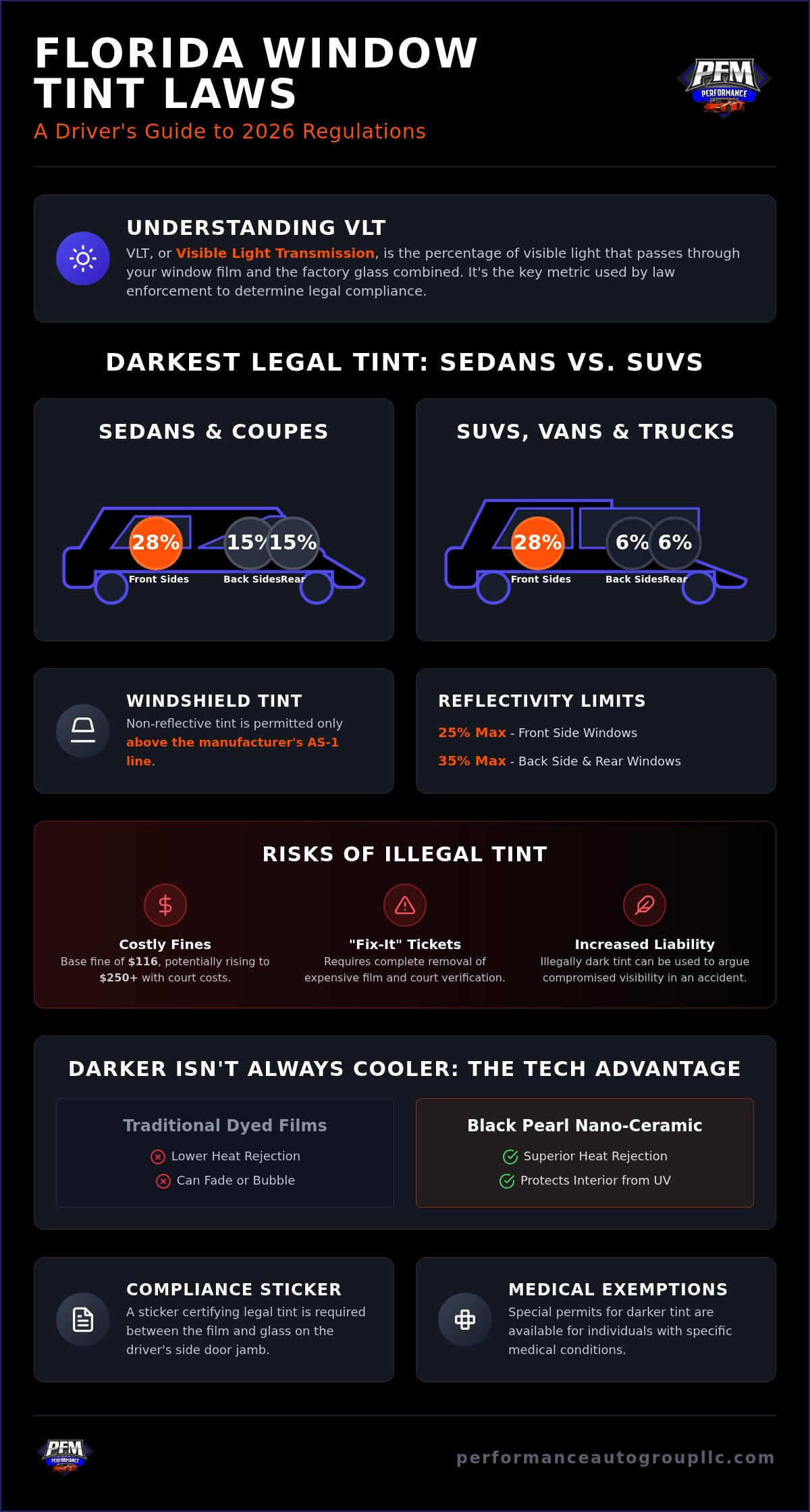
Choosing to ignore the darkest legal tint in Florida carries consequences that extend beyond a simple traffic stop. In Hillsborough County, a window tint violation is classified as a non-criminal moving infraction. While the base fine is roughly $116, court costs and local fees can quickly push that total toward $250. Often, these are issued as “fix-it” tickets, requiring you to strip the expensive film and provide proof of compliance to the court. It’s a costly and frustrating process that compromises your original investment.
Beyond the financial sting, there’s the matter of liability. If you’re involved in a nighttime accident with illegally dark windows, opposing counsel may argue that your visibility was compromised, potentially shifting the blame onto you. At PFM Performance Auto Group, we view tinting as a form of stewardship for your property. True quality isn’t about how much light you block out; it’s about the sophisticated balance of protection, longevity, and elite aesthetic refinement. Respecting the law ensures your peace of mind remains as clear as your view of the road.
Darkest Legal Tint for Sedans vs. SUVs and Vans
Identifying your vehicle’s legal classification is the first step toward a flawless installation. Florida law creates a distinct boundary between a standard passenger car and what is officially termed a “multi-purpose passenger vehicle” (MPV). This classification determines exactly how much privacy you can enjoy in the rear cabin. While many drivers desire a uniform, deep-black look across every window, the darkest legal tint in Florida is actually a tiered system. It prioritizes driver visibility in the front while allowing for significantly increased shade in the rear, provided your vehicle meets the right criteria.
Florida Legal Limits for Passenger Sedans
For a traditional four-door sedan or two-door coupe, the regulations are precise. The front side windows must allow at least 28% of light to pass through, ensuring that law enforcement can still see the driver. For the back side windows and the rear windshield, the limit drops to 15% VLT. This 15/28 split is a favorite for luxury car owners in Tampa who want to protect their high-end leather interiors without attracting unwanted scrutiny. According to the official Florida Window Tint Laws, these standards are designed to maintain safety during night driving while still offering substantial UV protection for the cabin.
Florida Legal Limits for SUVs, Vans, and Trucks
If you drive a larger vehicle, the rules for the rear of the cabin become much more lenient. While the front side windows remain at the 28% VLT minimum, the rear sections can be treated with much darker film. This includes:
- Front Side Windows: 28% VLT minimum (Same as sedans)
- Rear Side and Back Windows: 6% VLT minimum
The 6% VLT limit is often referred to as “privacy level” or “limo tint.” This level is highly sought after by Tampa families who need to keep the intense afternoon sun off children in car seats. It’s also a staple for commercial fleets protecting valuable equipment in the back of a van or truck. The logic behind this allowance is that these larger vehicles are often used for utility or transport, necessitating higher levels of privacy and heat rejection in the cargo and passenger areas.
Before you commit to a specific shade, check your driver’s side door jamb or your vehicle registration. If your vehicle is listed as an MPV or Truck, you can legally enjoy that deep 6% shade. If it’s listed as a sedan, you must stay at 15% or higher. If you aren’t sure which category your vehicle fits into, you can schedule a professional consultation to have our experts verify your specifications before we begin the meticulous application process.
Windshield Tinting and Reflection Regulations
While the conversation around the darkest legal tint in Florida often centers on side windows, the windshield represents the largest entry point for solar energy. It’s the primary reason your dashboard reaches scorching temperatures during a Tampa summer. However, the law is exceptionally strict regarding this piece of glass. You cannot simply apply a dark film across the entire surface. Instead, Florida regulations prioritize an unobstructed field of view for the driver while allowing for a strategic “brow” or visor strip to mitigate glare and heat. Understanding these boundaries is essential for any discerning vehicle owner who values both aesthetic refinement and absolute legal compliance.
Navigating the AS-1 Line for Windshield Protection
If you look closely at the upper corners of your windshield, you’ll likely find a small, etched set of characters that includes “AS-1.” This mark indicates the manufacturer’s safety line. Non-reflective tint is legally permitted only above the manufacturer’s AS-1 mark on the windshield. This strip, usually about five inches deep, serves as a vital shield against the low-hanging sun that plagues morning commutes on I-275.
At PFM Performance, we approach this installation with the precision of a master craftsman. A poorly aligned visor strip doesn’t just look unprofessional; it can actively interfere with your visibility or sensors. We ensure every cut is meticulous, following the natural contour of your glass to provide a seamless transition. This high-end approach protects your interior from UV damage without ever compromising the structural safety or legal standing of your vehicle. It’s a small detail that makes a significant difference in daily driving comfort.
The Science of Tint Reflection
Beyond the darkness of the film, Florida statutes regulate its reflectivity. This is a safety measure designed to prevent your car from becoming a reflective hazard to other motorists. The limits are specific: front side windows cannot exceed 25% reflectivity, while back side windows are capped at 35%. Many lower-quality films rely on metallic layers to bounce heat away, which often results in a “mirrored” or “shiny” appearance. In Florida, mirror-like or colored tints are strictly prohibited because they can blind other drivers under the intense midday sun.
To achieve maximum heat rejection without the illegal “mirror” look, we utilize Black Pearl Nano Ceramic technology. Instead of using reflective metals, this advanced film uses microscopic ceramic particles to absorb and dissipate heat. This allows you to maintain a sophisticated, matte-finish aesthetic that aligns with the rigorous standards of the International Window Film Association. You get the protection you need and the sleek appearance you want, all while staying well within the 25% and 35% reflection limits. It’s the ultimate solution for the car owner who refuses to settle for “good enough.”
Enforcement, Stickers, and Medical Exemptions
When you drive through Tampa, the visual appeal of your vehicle is only half the story. The other half involves staying on the right side of local enforcement. Officers in Hillsborough County are known for their meticulous attention to detail during traffic stops. They don’t just guess at your VLT levels; they use calibrated meters to verify compliance. If you’ve pushed the limits to achieve the darkest legal tint in Florida, you must have the documentation to back it up. Without the proper markers of a professional installation, even a legal tint job can lead to unnecessary delays and avoidable fines.
The Legal Compliance Sticker
Every professional installation is required by law to include a certification sticker. This small but vital label is typically placed on the driver side door jamb. It serves as an immediate signal to law enforcement that your film was applied by a legitimate business and meets state standards. The sticker must clearly state that the tinting complies with Florida statutes and include the name and location of the installation shop. At PFM Performance, we consider this sticker a badge of our commitment to your security. It provides the premium reassurance you need when facing a roadside inspection. For those who require even more protection than standard laws allow, we recommend reviewing our Florida Window Tint Exemption guide for a deeper look at medical possibilities.
Qualifying for Medical Exemptions
Some drivers have legitimate health reasons that necessitate protection beyond the standard darkest legal tint in Florida. If you suffer from medical conditions such as Lupus, autoimmune diseases, or extreme sun sensitivity, you may qualify for a medical exemption. The process involves submitting Form HSMV 83182 to the Florida Department of Highway Safety and Motor Vehicles. This application must be signed by a licensed physician. Once approved, you’ll receive a permit that allows for darker shades than the general public can use. We act as your trusted advisor during this process; we ensure that your custom installation provides the exact level of relief your condition requires while keeping your permit valid and visible.
Finally, remember that Florida law requires dual side view mirrors on any vehicle where the rear window is tinted. This ensures that your rear view visibility remains safe even if the back glass is significantly shaded. In Hillsborough County, inspections are thorough. Being prepared with the right equipment and the correct paperwork is the only way to protect your investment and maintain your peace of mind on the road.
Premium Performance: Why Legal Tint Doesn’t Mean Less Heat
The most persistent myth among Tampa drivers is that you must have a “limo” shade to achieve a truly cool interior. Many enthusiasts believe that the darkest legal tint in Florida is merely a starting point, and that pushing into illegal territory is the only way to survive a Hillsborough County summer. This is simply not true. In the world of high-performance film, darkness is a stylistic choice, not a thermal requirement. Modern technology has successfully decoupled shade from performance. You can stay perfectly legal while enjoying elite-level heat rejection that keeps your cabin comfortable even in the dead of July.
The Black Pearl Nano Ceramic Advantage
Black Pearl Nano Ceramic by Madico represents the pinnacle of this technological evolution. Traditional dyed films rely on heavy pigmentation or metallic layers to block heat, which often leads to a “shiny” look or poor visibility at night. In contrast, ceramic particles are engineered to target the infrared spectrum specifically. This means a compliant 28% VLT ceramic film can actually keep your cabin cooler than a non-ceramic 5% “limo” tint. It provides a sophisticated, matte-finish aesthetic while blocking up to 99% of harmful UV rays. This level of protection is vital for preserving the longevity of your dashboard and premium upholstery against the relentless sun. When you book your premium tinting session, you are investing in a thermal barrier that protects your property with surgical precision.
A Trusted Advisor for Tampa Car Enthusiasts
Choosing the right film is only half the battle; the other half is the application. Since 2004, we’ve served the Tampa community as a trusted advisor for car owners who demand perfection. We don’t just apply film to glass. We treat every vehicle with a master craftsman’s eye, ensuring that every edge is seamless and every micro-gap is accounted for. This meticulous approach is what prevents the bubbling, peeling, and purple-shifting often seen in lower-quality, “budget” installations. It’s about stewardship of your investment.
Our history in Hillsborough County is built on the idea of earning your business through transparency and superior results. We understand the emotional and financial value of your vehicle. To see how we maintain these standards, you can learn more about our best car window tinting in Tampa. We are not just service providers; we are guardians of your comfort and safety. We are dedicated to exceeding your expectations with a level of detail that only two decades of experience can provide.
Drive with Confidence and Clarity in 2026
Master Florida’s regulations to keep your vehicle both stunning and secure on every journey. You’ve learned that the darkest legal tint in Florida is a nuanced system; sedans and SUVs have different rules, and your windshield requires a specialized touch above the AS-1 line. Staying compliant isn’t just about avoiding a ticket in Hillsborough County. It’s about ensuring your safety and protecting your vehicle’s long-term value through meticulous craftsmanship and elite service standards.
At PFM Performance Auto Group, we’ve served the Tampa community as a trusted advisor since 2004. We specialize in high-heat rejection technology as an authorized installer of Black Pearl Nano Ceramic by Madico. This advanced film provides the sophisticated privacy you want without the legal risks of excessive darkness. We treat every car with a perfectionist’s eye, ensuring your investment is guarded by the best technology available.
Let’s transform your daily commute with the precision and care your property deserves.
Frequently Asked Questions
What is the darkest legal tint for a sedan in Florida?
The darkest legal tint in Florida for a sedan requires front side windows to allow at least 28% light transmission. For the rear side windows and back windshield, you can go as dark as 15% VLT. This specific split provides a sophisticated balance of privacy and safety. We ensure every installation adheres to these cumulative percentages, accounting for the natural tint already present in your factory glass to keep you compliant.
Can I tint my entire windshield in Florida?
No, you cannot tint your entire windshield in Florida. State law strictly limits tinting to the area above the manufacturer’s AS-1 line, which is usually the top five inches of the glass. This visor strip must be non-reflective to prevent glare for oncoming drivers. Applying film to the full windshield is illegal and can lead to significant liability issues in the event of an accident or a roadside inspection.
Is 15% tint legal on front windows in Florida?
No, 15% tint is not legal on front side windows in Florida. The law mandates a minimum of 28% VLT for the driver and front passenger windows to ensure law enforcement visibility. While 15% is perfectly legal for the rear windows of a sedan, applying it to the front will likely result in a moving infraction. It’s better to choose a high-performance ceramic film that blocks heat at the legal 28% level.
How do I get a medical exemption for darker tint in Florida?
You can obtain a medical exemption by submitting Form HSMV 83182 to the Florida Department of Highway Safety and Motor Vehicles. This application requires a signature from a licensed physician certifying that you have a condition like Lupus or extreme sun sensitivity. Once approved, you’ll receive a permit allowing for darker film. We can then apply a customized shade that meets your specific health requirements while staying within your permit’s legal bounds.
Does Florida allow colored or metallic window tints?
Florida prohibits colored, mirrored, or highly reflective window tints because they create dangerous glare for other motorists. Your front side windows cannot exceed 25% reflectivity, and rear windows are limited to 35%. Instead of using metallic films that look like mirrors, we recommend nano-ceramic technology. It provides superior heat rejection with a sleek, matte finish that respects both the aesthetic of your vehicle and the safety of the Tampa community.
What happens if my tint is too dark and I get pulled over in Tampa?
If your tint is too dark, you’ll likely receive a non-criminal moving infraction. In Hillsborough County, the base fine is approximately $116, but court costs often push the total toward $250. Most officers issue “fix-it” tickets, which require you to remove the illegal film and show proof of compliance to the court. It’s a frustrating process that effectively voids your initial investment and wastes your time.
Do I need a sticker on my car to show the tint is legal?
Yes, Florida law requires a compliance sticker to be displayed on the driver side door jamb. This label certifies that your darkest legal tint in Florida was installed by a professional and meets all state VLT and reflectivity requirements. It must include the installer’s name and location. Without this sticker, you may face additional questioning during a traffic stop, even if your windows are technically within the legal light transmission limits.
Is ceramic tint worth the extra cost for Florida drivers?
Ceramic tint is absolutely worth the investment for Florida drivers because it offers the highest heat rejection without requiring illegal darkness. While traditional dyed films just provide shade, nano-ceramic particles block up to 99% of infrared heat. This keeps your cabin significantly cooler during a Tampa summer and protects your dashboard from UV damage. It’s a premium solution that prioritizes long-term durability, clarity, and cabin comfort over simple aesthetic darkness.