
How Long Does Ceramic Tint Last? The 2026 Guide to Longevity and Protection
Why settle for a window film that has an expiration date when your vehicle is built to last a lifetime? If you’ve ever dealt with windows that turned a sickly shade of purple or peeled away in the humid Tampa heat, you know that low-quality installations are a waste of your time and money. You are likely wondering how long does ceramic tint last before the Florida sun inevitably wins the battle. In our climate, the “Florida Factor” of extreme UV exposure and humidity means that standard films often fail in just a few years; this leaves your interior vulnerable and your cabin uncomfortably hot.
We agree that you shouldn’t have to worry about your windows every few seasons. This 2026 guide explores why choosing a premium solution like Black Pearl Nano Ceramic by Madico is a permanent upgrade that protects your investment for a decade or more. You’ll discover how advanced nano-technology blocks up to 95% of infrared heat and why a professional, shop-based installation is the only way to ensure a flawless finish. We will also break down the current Florida tint laws and the simple maintenance habits that keep your view crystal clear for the long haul.
Key Takeaways
- Learn exactly how long does ceramic tint last when engineered with advanced nano-technology that outlives traditional dyed and carbon films.
- Discover how professional-grade materials withstand Tampa’s extreme UV index and high humidity without bubbling or fading.
- See why Black Pearl Nano Ceramic by Madico is the definitive choice for long-term heat rejection and vehicle resale value.
- Master the critical post-installation steps, including the proper curing window, to ensure your film bonds perfectly to the glass.
- Understand why a controlled, dust-free workshop environment is the secret to achieving a flawless finish that lasts for decades.
The Lifespan of Ceramic Window Tint: What to Expect in 2026
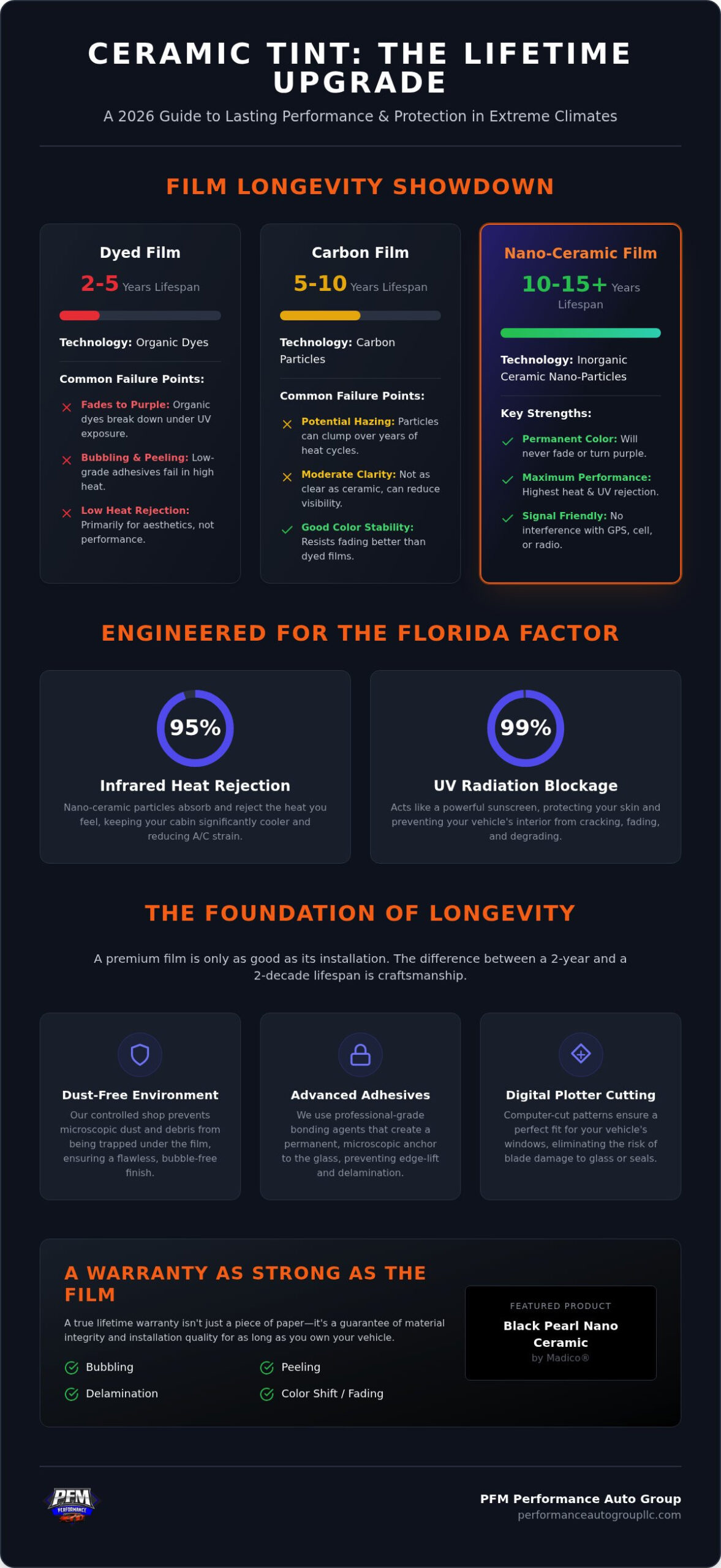
Investing in your vehicle’s protection shouldn’t be a recurring expense. When discerning drivers ask how long does ceramic tint last, they are looking for a “one and done” solution that survives the brutal Florida environment. In 2026, high-performance ceramic tint is considered a permanent structural upgrade. Unlike basic films that rely on cheap materials, professional-grade ceramic options are engineered to endure for 10 to 15 years of peak performance. This longevity is not accidental. It is the result of meticulous engineering and the use of inorganic materials that refuse to quit.
Modern window film technology has transitioned away from temporary fixes toward long-term preservation. The secret to this durability lies in the bonding process. We use professional-grade adhesives that create a microscopic anchor between the film and the glass. This prevents the common “edge-lift” and delamination that plagues DIY or mobile installations. When applied in a controlled shop environment, these bonding agents cure into a resilient shield that withstands heat cycles and humidity without flinching.
Why Ceramic Tint Doesn’t Fade or Turn Purple
The unsightly purple windows you see on the road are the result of organic dyes breaking down under ultraviolet radiation. These dyes are chemical compounds that literally “cook” in the sun. Ceramic particles are different. They are inorganic. This means they don’t possess the chemical vulnerabilities that cause organic pigments to lose their color. Nano-ceramic technology utilizes these stable particles to provide consistent shade and heat rejection for decades. Because the color is inherent to the ceramic structure rather than a surface dye, the film remains color-stable even after years of exposure to the intense Tampa UV index.
Understanding Lifetime Warranties in 2026
A warranty is only as strong as the craftsmanship behind it. In 2026, a true Manufacturer Lifetime Warranty for products like Black Pearl Nano Ceramic by Madico covers specific failure points: bubbling, peeling, delamination, and significant color shift. However, a manufacturer’s promise is half the battle. You also need a local installation guarantee. At PFM Performance Auto Group, we act as the guardians of your investment, ensuring the installation is performed in a dust-free environment to prevent the microscopic imperfections that lead to warranty claims later. In 2026, the industry standard for a premium lifetime warranty guarantees the film against all manufacturing defects for the entire duration of the original purchaser’s vehicle ownership.
Ceramic vs. Dyed and Carbon: Why Ceramic Outlasts the Rest
Choosing the right window film is a decision between a temporary fix and a permanent upgrade. While the market is flooded with budget options, they rarely survive the test of time. When you evaluate how long does ceramic tint last compared to dyed or carbon alternatives, the difference is measured in decades rather than seasons. Ceramic film is a structural enhancement for your glass that refuses to degrade, while other materials begin their decline the moment they leave the shop.
The Failure Points of Traditional Tint
Dyed window films are the most common victims of the Florida sun. These products rely on organic pigments that chemically break down when exposed to intense UV radiation. This is why you often see vehicles with purple or translucent windows; the dye has literally “cooked” out of the polyester. Typically, these films fail within two to five years. Adhesive failure is another critical issue. Cheap films use low-grade glues that gas off and lose their bond, creating those unsightly bubbles after just three Florida summers. Older metallic films pose a different problem. While they are durable, they act as a Faraday cage, interfering with your GPS, cell signals, and satellite radio. Ceramic technology solves every one of these legacy issues by using non-conductive, inorganic particles that never shift in color or block your connectivity.
Performance Retention Over Time
A premium film must do more than just stay on the glass. It must maintain its performance. Carbon films were once the standard for longevity, but they often suffer from “hazing” as the carbon particles clump together over years of heat cycles. In contrast, J.D. Power explains the benefits of ceramic tint as a superior choice for maintaining 99% UV rejection and consistent heat reduction for the life of the vehicle. Our Black Pearl Nano Ceramic by Madico keeps its Total Solar Energy Rejection (TSER) rating year after year because its heat-blocking properties are baked into the ceramic structure itself. For those seeking the Best Car Window Tinting in Tampa, the choice often comes down to the film’s ability to remain scratch-resistant and optically clear. Premium ceramic films feature advanced hard-coatings that protect against the micro-scratches caused by daily window operation, ensuring your view remains as sharp in year ten as it was on day one.
If you are ready to move away from temporary solutions and upgrade to a permanent shield for your vehicle, you can schedule your precision installation today and experience the difference of a “set it and forget it” solution.
The Florida Heat Factor: How Tampa’s Climate Affects Tint
Tampa’s environment is a relentless laboratory for window film. While manufacturers might test products in mild, controlled conditions, the real-world question of how long does ceramic tint last is truly answered in the Hillsborough County heat. Our UV index regularly climbs into the “extreme” range, which acts as a catalyst for chemical breakdown in standard dyed films. High humidity levels also present a unique challenge. In poorly installed applications, moisture can seep into the edges of the film, weakening the adhesive bond and causing premature peeling that ruins your view and your vehicle’s aesthetic.
You also have to consider the impact of thermal shock. This occurs when your vehicle sits in the 100-degree sun and you immediately blast the interior with 70-degree air conditioning. This rapid temperature shift creates significant expansion and contraction stress on the glass. Ceramic tint acts as a sophisticated thermal barrier, absorbing and dispersing this energy more efficiently than traditional materials. By stabilizing the temperature of the glass, the film reduces the mechanical stress on the adhesive, which is a major reason why premium ceramic outlasts budget alternatives. According to resources provided by the International Window Film Association, selecting a film with high heat rejection is critical for maintaining long-term structural integrity in tropical climates.
Windshield Tinting: The Front Line of Defense
Your windshield is often the largest piece of glass on your vehicle and the most direct path for solar energy. It’s the front line of defense against interior degradation. Without protection, your dashboard is subjected to constant heat, leading to brittle plastics and unsightly cracking over a 10-year period. Professional windshield tinting using Black Pearl Nano Ceramic by Madico provides a transparent shield that blocks 99% of UV rays without sacrificing visibility. If you’re concerned about staying within the legal limits while maximizing this protection, our guide on Florida Window Tint Law provides the clarity you need to stay compliant while keeping your cabin cool.
Salt Air and Chemical Resilience
Coastal drivers face an additional threat: salt air. In areas like South Tampa or Apollo Beach, the air carries microscopic salt particles that can accelerate oxidation in metallic-based tints. These metallic films can become cloudy or develop a “rust” look over time as the metal layers react with the environment. Ceramic particles are chemically inert, meaning they don’t react with salt or moisture. For coastal Florida drivers, choosing a non-metallic ceramic film is essential because it guarantees the film won’t oxidize or lose its clarity, regardless of how close you live to the Gulf. This chemical resilience is a major factor in how long does ceramic tint last when compared to older technologies that lack this level of protection.
Maximizing Your Investment: Tips to Make Your Tint Last
The transition from a fresh installation to a permanent bond is a delicate phase. While Black Pearl Nano Ceramic by Madico is incredibly durable once cured, the initial 48 hours require your absolute discipline. Do not roll down your windows. This isn’t just a suggestion. It’s a technical requirement. The adhesive needs this time to anchor to the glass without the friction of window seals pulling at the edges. When people ask how long does ceramic tint last, they often forget that the first few days set the foundation for the next fifteen years. A single mistake during this window can lead to peeling that no amount of aftercare can fix.
Living in Tampa introduces a specific variable: humidity. In dryer climates, the moisture used during installation evaporates quickly. Here, the high moisture content in the air can extend the drying process. You might notice a slight “haze” or small water pockets in the first week. This is normal. It’s part of the curing cycle. Resist the urge to press on these bubbles or clean the film prematurely. Let the sun do its job. The heat helps the moisture move through the semi-permeable film, eventually leaving you with a crystal-clear finish that is structurally sound.
The Proper Cleaning Routine
Maintaining optical clarity requires a shift in your detailing habits. The golden rule is to avoid ammonia at all costs. Ammonia is a harsh solvent that can eventually eat through the scratch-resistant coating and degrade the adhesive at the edges. Instead, use distilled water or a dedicated, ammonia-free tint cleaner. We recommend the “Two-Cloth Method” to prevent streaks and micro-scratches. Use one clean microfiber towel to apply the cleaner and a second, dry microfiber to buff the surface to a shine. Never use paper towels. Their wood-pulp fibers are abrasive enough to leave permanent swirl marks on the interior film over time.
Inspecting for Early Warning Signs
Professional craftsmanship minimizes risks, but you should still be a guardian of your vehicle. Keep an eye out for “fingering” at the bottom or side edges. These are small, vertical tunnels where the film has lifted slightly from the glass. If you catch these in the first few days, a quick visit to our shop allows us to use specialized tools to heat and re-seat the film perfectly. Understanding how long does ceramic tint last also involves recognizing the difference between normal curing haze and actual film failure. If bubbles grow larger after the first ten days, it’s time to trigger your professional reassurance guarantee.
Professional Installation in Tampa: The PFM Reassurance
The environment where your window film is applied determines the trajectory of its life. Mobile tinting services often struggle with environmental contaminants like pollen and dust, which inevitably get trapped under the film during a driveway installation. At PFM Performance Auto Group, we’ve dedicated our specialized workshop environment to ensuring a dust-free application. This meticulous attention to the installation space is directly linked to how long does ceramic tint last on your vehicle. By eliminating microscopic debris during the bonding phase, we ensure a 15-year lifespan that outshines the temporary results of a standard job.
Precision edge-trimming is another hallmark of our Master Craftsman approach. We don’t leave wide gaps at the top of your glass where moisture and oils can begin the slow process of delamination. Instead, we micro-edge the film to the glass, creating a seamless aesthetic that prevents the “lift” where peeling typically begins. We view ourselves as guardians of your investment, earning your business through a level of detail that is rarely found in high-volume shops. This dedicated focus ensures that every edge is sealed and every surface is flawless before you ever leave our facility.
The Black Pearl Nano Ceramic Advantage
We exclusively recommend Black Pearl Nano Ceramic by Madico because it represents the pinnacle of current high-performance nano-ceramic technology. It offers exceptional heat rejection, blocking significant infrared energy without requiring the “dark limo” look that can hinder visibility. In Hillsborough County, superior optical clarity is essential for safe night driving. This film provides a crisp, high-definition view of the road while maintaining its color stability for decades. You gain the ultimate peace of mind with a manufacturer-backed warranty from Madico, ensuring your vehicle remains protected as long as you own it.
Beyond Tint: Protecting Your Entire Vehicle
Our commitment to your vehicle’s performance doesn’t end with the glass. Professional window tinting is a foundational step that protects the sensitive electronics we install every day. By reducing interior temperatures, you’re also protecting the longevity of your high-end speakers and dashcam systems. Understanding how long does ceramic tint last often comes down to the synergy between the film and the vehicle’s other systems. Whether you are looking for expert Car Audio Installation Tampa or a complete privacy upgrade, we approach every project with the same perfectionist streak.
We invite you to experience a higher standard of care for your property. Our team is ready to provide a thorough consultation to help you choose the perfect shade and performance level for your lifestyle. Book your professional tint consultation today.
Secure Your Vehicle’s Future with Nano-Ceramic Protection
Choosing a window solution shouldn’t be a repetitive task. You now understand that how long does ceramic tint last is determined by the quality of the film and the precision of the installation environment. While traditional dyed films fail under the relentless Tampa sun, nano-ceramic technology offers a permanent shield that maintains its clarity and heat rejection for the life of your vehicle. This commitment to quality means you won’t have to worry about bubbling or purple windows ever again. You are making a choice for sustained comfort and preserved resale value.
As an Authorized Madico Dealer with over 20 years of experience in Tampa, we provide a specialized, dust-free, climate-controlled workshop to ensure your Black Pearl Nano Ceramic application is flawless. We don’t just apply film; we provide a high-end boutique experience that prioritizes meticulous craftsmanship over high-volume shortcuts. We act as the guardians of your property, ensuring every edge is perfect and every customer feels like a partner in the process.
We look forward to welcoming you to our shop and helping you achieve the ultimate balance of comfort, style, and long-term protection. Your vehicle deserves the highest standard of care, and we’re here to deliver exactly that.
Frequently Asked Questions
Does ceramic window tint eventually bubble?
High-quality ceramic tint does not bubble like traditional dyed films because it utilizes superior adhesive technology. Bubbling is almost always a symptom of adhesive failure caused by UV radiation breaking down organic pigments in cheaper products. Since ceramic is inorganic, it doesn’t suffer from the same level of heat-related chemical breakdown. When installed in our dust-free workshop, the bond remains stable for the life of the vehicle without the unsightly air pockets common in mobile jobs.
Can I clean my ceramic tint with Windex?
You should never use Windex or any ammonia-based cleaner on your window film. Ammonia is a harsh chemical that can strip the protective scratch-resistant coating and eventually dissolve the adhesive at the edges. To maintain the optical clarity of your investment, use a dedicated ammonia-free glass cleaner or simple distilled water with a microfiber cloth. This ensures the film remains as clear as the day it was installed for a decade or more.
Is ceramic tint worth it if I only keep my car for 3 years?
Ceramic tint is an excellent investment even for short-term owners because it significantly preserves your vehicle’s resale value. By blocking 99% of UV rays, you prevent the dashboard cracking and upholstery fading that can occur in just a few Florida summers. Additionally, the immediate heat rejection makes your daily commute far more comfortable. When it’s time to sell, having a premium, Madico-backed installation serves as a documented proof of care for the vehicle.
How long does it take for ceramic tint to fully cure in Florida?
In the high humidity of Hillsborough County, ceramic tint typically takes three to five days to cure enough for you to safely roll down your windows. However, it can take up to thirty days for every microscopic drop of moisture to fully evaporate from between the film and the glass. You might see small water pockets or a slight haze during this period. This is a normal part of the drying process in our tropical climate.
Does ceramic tint lose its heat rejection over time?
No, premium ceramic tint does not lose its heat rejection capabilities over time. Because the heat-blocking properties are derived from inorganic ceramic particles rather than organic dyes, they don’t break down or “bleach” from sun exposure. This stability is a key factor in how long does ceramic tint last compared to carbon or dyed alternatives. You can expect the same 95% infrared heat rejection in year ten as you experienced on day one.
What happens if my ceramic tint gets scratched?
If your ceramic tint suffers a deep scratch from cargo or jewelry, the damage to the interior film is permanent. While premium films like Black Pearl Nano Ceramic by Madico feature an advanced scratch-resistant hard coat to prevent micro-scratches from daily use, they aren’t invincible against sharp objects. If a scratch interferes with your vision or aesthetics, we can professionally remove the film from that specific window and replace it with a fresh, matching piece.
Will ceramic tint interfere with my GPS or cell signal?
Ceramic tint will not interfere with your GPS, cell phone, or satellite radio signals. Unlike older metallic films that contain microscopic bits of metal, ceramic is non-conductive and non-metallic. This makes it a “signal-friendly” choice for modern vehicles packed with electronics. You can enjoy maximum heat rejection without worrying about dropped calls or navigation errors. This is one reason why it’s the preferred choice for high-end vehicles with integrated tech suites.
How can I tell if my ceramic tint needs to be replaced?
You can tell your tint needs replacement if you notice a significant loss of optical clarity, peeling at the edges, or physical delamination. If you’ve asked how long does ceramic tint last, you’ll be pleased to know that a professional installation rarely needs replacement for 15 years. However, if you see the film pulling away from the glass or “fingering” at the edges, it’s time to bring it back to our workshop for a professional assessment.