
Compare LED headlight brands for beam, fit and color
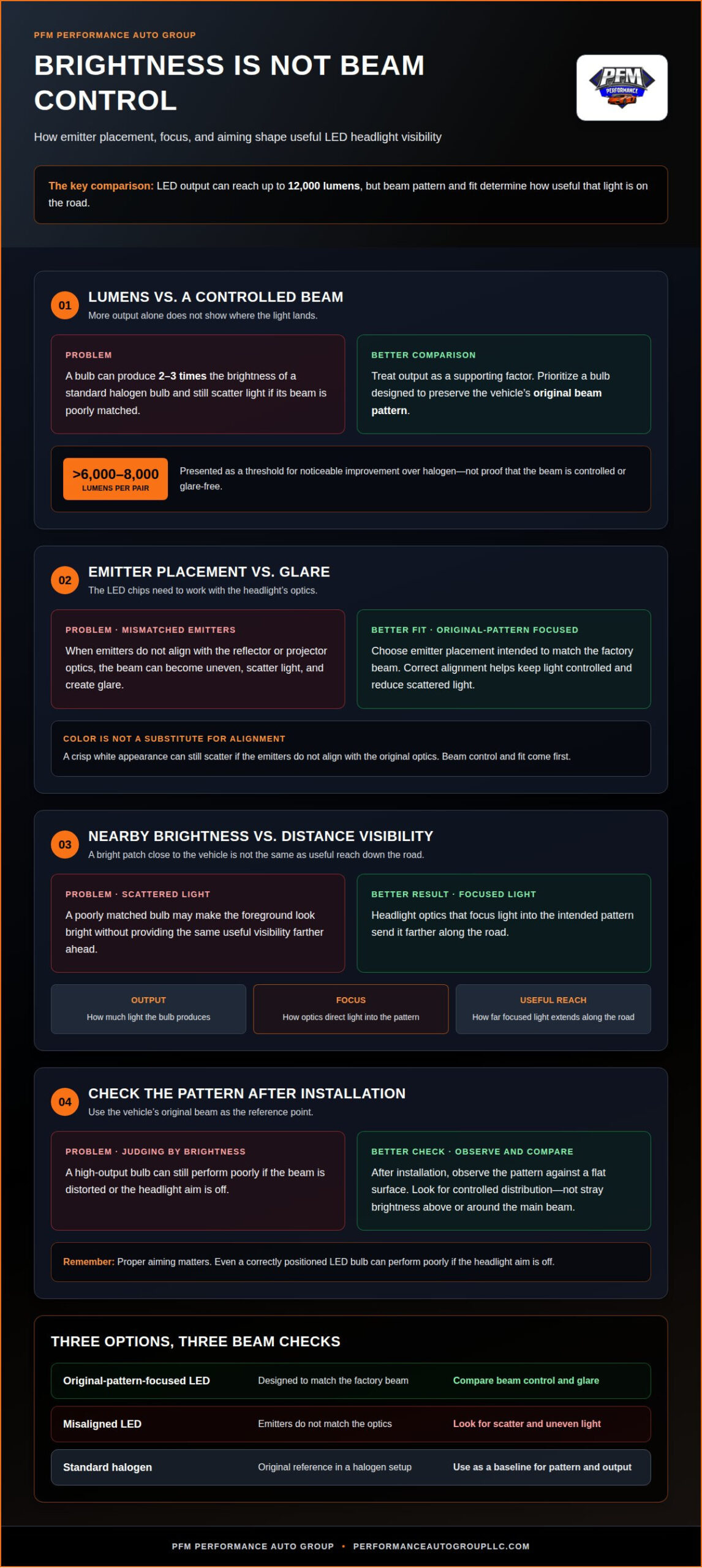
The brightest LED headlight isn’t automatically the best fit. The best LED headlight brands for 2026 are better compared by beam control, installation clearance, distance visibility, color temperature, and compatibility with your vehicle’s housing, not by a brightness claim alone. LED headlights can reach outputs of up to 12,000 lumens, but the beam pattern and fit determine how useful that light is on the road.
It makes sense to focus on brightness when you want to see farther at night. Yet an LED bulb that doesn’t align with the original beam pattern can scatter light and create glare, while a bulb that doesn’t fit the housing can complicate installation. Color matters, too: a crisp white appearance isn’t the same as comfortable visibility in every driving condition.
This comparison explains how to assess five options using details that matter in everyday driving. Compare beam control, cooling and clearance, distance visibility, color temperature, and housing compatibility to narrow your choice to a setup suited to your vehicle and driving needs.
Key Takeaways
- Prioritize a bulb that preserves the housing’s beam pattern; brightness alone doesn’t tell you whether the light is controlled or creates glare.
- Compare bulb size and cooling hardware with the space behind the headlight housing to assess installation fit.
- Judge useful distance visibility separately from bright foreground lighting, since more light close to the vehicle doesn’t necessarily mean a better view farther ahead.
- Choose color temperature for the driving conditions you encounter, not just for the appearance of a whiter or bluer beam.
- Compare reflector and projector compatibility carefully, because each housing shapes and directs light differently.
Beam pattern integrity and glare control
Beam quality depends on the position of the LED emitters and how the bulb works with the headlight optics. A controlled beam supports useful visibility while limiting stray light that can cause glare.
Emitter Placement and Beam Pattern
Emitter placement refers to how the LED chips sit on the bulb in relation to the headlight reflector or projector. A design that positions its emitters to match the vehicle’s original beam pattern is a better choice than one judged by brightness alone. Correct alignment helps reduce scattered light and glare; poor alignment can distort the beam even when the bulb produces more light than a halogen bulb.
Beam Distance and Focus
Beam distance depends on how effectively the headlight optics focus light into the intended pattern, not just on the LED bulb’s output. A focused beam sends light farther along the road; a scattered beam may create a bright patch nearby without providing the same useful reach. Compared with a bulb designed around the original pattern, a poorly matched bulb may distribute light unevenly and increase glare.
Compare beam control before treating lumen figures as a verdict. LED bulbs can produce 2-3 times the brightness of standard halogen bulbs, but extra output doesn’t establish whether the light lands in the right places. A pair rated above 6,000-8,000 lumens is presented as a threshold for noticeable improvement over halogen, yet beam pattern integrity still determines how effectively that output serves the road.
Use the vehicle’s original beam as a reference. After installation, observe the pattern against a flat surface. Look for a clear, controlled distribution rather than stray brightness above or around the main beam. This comparison can reveal whether the emitter placement and housing are working together. Proper aiming matters, too: even a correctly positioned LED bulb can perform poorly if the headlight aim is off.
Glare control depends on design and alignment, not color temperature alone. A bulb with a crisp white appearance can still scatter light if its emitters don’t align with the original optics. Compare the beam pattern and fit first, then consider brightness as a secondary factor. Cooling and installation clearance matter, but they won’t correct a mismatched beam.
| Option | Emitter and beam fit | What to compare |
|---|---|---|
| Original-pattern-focused LED bulb | Designed to match the factory beam | Beam control and glare |
| Misaligned LED bulb | Emitters don’t match the optics | Scatter and uneven light |
| Standard halogen bulb | Original reference in a halogen setup | Baseline pattern and output |
Choose a bulb whose emitter placement preserves the original beam pattern, then assess output and aiming as supporting factors.
Cooling clearance and installation
Cooling hardware and installation space affect whether an LED bulb fits behind the headlight housing. Assess the bulb, connector, and rear cover as one assembly: a compact light source can still need extra room for its cooling components.
LED bulbs manage heat with components such as heat sinks or active cooling systems. Space behind the housing matters: if a fan or heat sink sits too close to a cover or nearby component, airflow may be restricted. This can undermine consistent operation, even when the bulb’s stated output looks appealing. Compare the complete bulb assembly, not just the part that fits into the socket.
Before installation, identify the vehicle’s bulb type and inspect the space behind the housing. Compare the bulb’s overall length and cooling hardware with the available space. A plug-and-play design may simplify the electrical connection, but it still needs room to seat correctly and allow the cooling system to function.
- Socket fit: The bulb base should match the vehicle’s required bulb type.
- Rear clearance: The heat sink, fan, and connector must fit behind the housing.
- Cover fit: The housing’s rear cover should close without pressing against the bulb assembly.
- Wiring path: The connector and wires should sit without obstructing the cover or cooling components.
Plug-and-play LED bulbs typically take 20-30 minutes to install at home with basic tools. That estimate describes a straightforward installation, not every vehicle. Tight access, a difficult-to-reach rear cover, or a cooling component that prevents the cover from closing can make the job more involved. Fit and clearance should be resolved before the bulb is secured.
Active cooling and output claims need to be considered together. A label such as SV4, by itself, doesn’t explain how a bulb manages heat or whether its cooling hardware fits a particular housing. Compare the physical assembly and the stated cooling approach, then consider output in that context. A high output figure can’t answer whether the bulb will fit or whether its cooling components have adequate space.
For driving reliability, prioritize a bulb that seats securely, leaves the rear cover unobstructed, and has room for its cooling hardware. If professional fitting is the practical next step, book LED bulb installation to have the fit and installation handled with care.
Foreground lighting versus distance visibility
Compare how each LED headlight distributes light near the vehicle and farther down the road. A bulb’s output can reach 12,000 lumens, but that figure alone doesn’t show how much useful visibility reaches each zone.
For reliability and lifespan, high-quality LED headlight bulbs can last 30,000 to 50,000 hours under ideal conditions. Compare that figure alongside cooling design and consistent operation, rather than treating lifespan as a stand-alone measure of real-world performance.
Independent tests and customer reviews are most useful when they describe beam reach, foreground brightness, installation context, and operating conditions. These details make comparisons more meaningful than a general rating, although different test methods can limit direct comparisons between brands.
Foreground lighting illuminates the road close to the vehicle, including pavement edges and nearby obstacles. Distance visibility describes how clearly the beam reaches farther ahead. Focusing too much on close-range brightness can make the road immediately in front seem intense without providing balanced visibility across both zones.
GTR Lighting Ultra 3.0 is one named option readers may encounter in automotive lighting comparisons. Assess it by the same practical criteria as other bulbs: useful light distribution, beam reach, fit, and cooling requirements. A model name or headline output figure cannot independently establish performance in every vehicle’s headlight assembly.
“Made in USA” describes origin, not beam quality or lifespan. Treat it separately from optical performance: compare the product’s stated output, pattern, fit, and cooling design on their own merits. A country-of-origin label cannot substitute for details that affect visibility while driving.
Durability for off-road use is separate from useful road illumination. Assess a bulb intended for rough conditions using the durability details its maker provides, along with its fit and thermal management. These properties don’t establish how well it lights the roadway; beam distribution and distance visibility remain separate criteria.
- Foreground: Note how clearly nearby pavement and road edges appear.
- Distance: Compare how far ahead the usable beam reaches.
- Balance: Consider both zones together, not brightness alone.
- Lifespan: Read the stated operating-life figure in context.
Use this comparison to distinguish a bright foreground from genuine distance visibility. A well-balanced choice supports awareness close to the vehicle and a clear view ahead, while output, fit, cooling, and lifespan round out the evaluation.
LED headlight color temperature
Color temperature describes the appearance of light, measured in kelvins, rather than its brightness. LED headlight bulbs commonly come in 5000K to 6500K options, so choose for visibility and driving conditions, not appearance alone.
A 5000K-6000K color temperature is recommended for natural, comfortable visibility. For most driving conditions, 5500K to 6000K offers a balanced choice. At 6000K, the light appears pure white with a slight blue tone, which may suit drivers seeking a crisp white look without moving to higher temperatures.
Color temperature affects how light appears on the road, but it doesn’t describe beam focus, output, or headlight compatibility. A 6000K bulb in a projector housing still needs to match the bulb type and optics. Treat the kelvin rating as one comparison point, then weigh it alongside fit and beam performance.
For rain, fog, and snow, the guide recommends 4300K LED headlights. Bulbs above 6500K can reduce visibility in those conditions. That makes a higher Kelvin number a poor shortcut for judging real-world visibility: a bluer appearance doesn’t automatically mean a clearer view.
Warranty and customer support are separate from color temperature. A kelvin rating doesn’t indicate which brand offers better coverage or service. Before buying, compare each brand’s written warranty terms, exclusions, claim steps, and support channels.
Aftermarket LED bulbs aren’t made street legal by a particular color temperature. A 5000K, 6000K, or 6500K label alone doesn’t establish whether a bulb is suitable for a particular vehicle and headlight application.
- Choose 4300K when visibility in rain, fog, and snow is a priority.
- Consider 5000K-6000K for natural-looking, comfortable light.
- Use 5500K to 6000K as a balanced range for most driving conditions.
- Be cautious above 6500K if driving in adverse weather is common.
Before an LED headlight upgrade, match the bulb type to the vehicle and consider projector compatibility alongside color temperature. For example, an appealing 6000K color won’t compensate for a bulb that doesn’t fit the housing or produce a useful beam. Make the final comparison across appearance, conditions, and the specific headlight setup.
LED performance in reflector and projector housings
Reflector and projector housings shape light differently, so the same LED bulb can perform differently in different vehicles. Match the bulb to the headlight’s optical design, then assess fit and beam distribution before comparing lumen output.
A reflector housing uses shaped reflective surfaces to direct light from the bulb. Performance depends on how the bulb’s light source sits in relation to those surfaces. If an LED’s emitters don’t align with the reflector’s intended position, the beam can differ from the original halogen pattern. A high output figure alone won’t reveal that mismatch.
A projector housing directs light through a lens and uses a defined cutoff to shape the beam. It still requires a compatible bulb: the LED’s emitter position and orientation affect how light enters the projector optics. Don’t assume the lens will correct every mismatch. Assess the installed pattern and cutoff, not just the bulb’s advertised output.
For both housing types, compatibility means more than a matching connector. The bulb must seat correctly, fit inside the housing, and work with its optical components. A fit issue can affect positioning; an optical mismatch can change illumination. These are separate checks, and a suitable result depends on both.
- Identify the housing: Determine whether the vehicle uses a reflector or projector design.
- Match the bulb: Confirm the replacement type suits the vehicle’s headlight assembly.
- Check physical fit: Compare the bulb base and rear components with available housing space.
- Assess the beam: Look for controlled illumination and a defined pattern after installation.
Use the vehicle’s original halogen setup as a reference when assessing an LED retrofit. In a reflector, compare how light spreads across the road and whether the beam remains controlled. In a projector, observe the cutoff and distribution through the lens. This side-by-side approach reveals more than product listings alone because it considers the bulb and housing together.
Drivers should also separate lumen output from optical performance. Lumen output describes the amount of light produced, while the housing influences where that light goes. A bulb with a higher rating may not improve visibility if its emitters don’t suit the reflector or projector. For a practical comparison, prioritize housing compatibility, secure seating, and a clean beam pattern.
Choose an LED bulb that matches the vehicle’s housing and produces controlled illumination in that specific optical system. A careful fit and beam assessment matter more than choosing by output claims alone.
PFM Performance Auto Group
PFM Performance Auto Group helps Hillsborough County drivers with vehicle upgrades beyond headlight selection, including automotive window tinting. LED bulb comparisons focus on beam performance, fit, and color; window tinting is a separate enhancement and doesn’t replace careful headlight selection or installation. If you’re also considering a change to your vehicle’s windows, PFM offers Auto Window Tinting and Black Pearl Nano Ceramic Window Tint By Madico.
The next step depends on your priority. If you’re still comparing LED options, use the criteria above to assess the bulb and housing as a pair. If window tinting is also part of your plans, PFM can handle that as a separate project.
Make your next lighting choice with care
Let the vehicle’s actual headlight setup guide your decision, rather than choosing by brand recognition alone. The best LED headlight brands in 2026 are the ones that suit your priorities and application; a considered comparison is a stronger starting point than a bold product claim.
PFM Performance Auto Group also offers Auto Window Tinting, Commercial Window Tinting, and Home Window Tinting to customers in Hillsborough County. These are separate services from headlight selection, for when window tinting is part of your plans.
If you’d like to discuss your vehicle’s LED bulb needs, contact PFM Performance Auto Group.
Choose deliberately, and take the next step with confidence.
Frequently Asked Questions
Quick Comparison: Who Shines the Brightest?
No single LED bulb is brightest for every vehicle and headlight setup. A useful comparison looks beyond the strongest output claim to how each option performs in the specific housing. A bulb that appears powerful on its product label, for example, may not suit the vehicle’s optics. Compare models by intended application and practical beam performance rather than assuming one brand leads in every installation.
What Defines the “Brightest” Headlight?
The brightest headlight is the one that provides useful illumination for the driver’s needs, not simply the one with the highest lumen figure. Consider whether the light reaches the areas you need to see and works with the vehicle’s headlight assembly. An output figure can help narrow comparisons, but it doesn’t describe the result in every vehicle or show how the light is distributed.
What Separates the Best from the Rest in 2026?
A stronger choice combines clear application information with a bulb designed for a suitable fit and controlled illumination. Read the bulb-type details, cooling design, and stated color temperature together instead of treating one feature as decisive. Examine warranty terms and support procedures, too. These practical details help distinguish a product suited to your vehicle from one with an attention-grabbing specification.
What are the best LED headlight brands in 2026 in the United States?
There isn’t one brand that can be named best for every US vehicle and headlight housing. GTR Lighting Ultra 3.0 is one model mentioned in this comparison, but its inclusion doesn’t establish a universal ranking. Start with the bulb type and housing in your vehicle, then compare the intended application, beam performance, and installation fit. A brand name alone can’t resolve those vehicle-specific factors.
Which LED headlight brands offer the best brightness, beam pattern, and road visibility?
No single brand ranks highest across all three criteria for every vehicle. Compare the specific bulb model in the context of your headlight assembly, weighing brightness alongside beam control and useful road illumination. A product that performs well in one housing may produce a different result in another. Make model-level fit and application central to the decision, not brand recognition alone.
How can I check whether LED headlight bulbs fit my vehicle?
Start with the vehicle’s required bulb type and compare it with the replacement bulb’s stated fitment. H7, H11, 9005, and 9006 are examples of different bulb types, not interchangeable labels. Then consider the space behind the headlight for the bulb body, connector, and cooling components. A matching socket is only part of fit; the assembly also needs to sit correctly within the housing.
What are the risks of glare, poor beam alignment, or overheating with LED headlight upgrades?
Poor alignment can send light outside the intended beam, while a bulb that doesn’t suit the housing can create an uneven pattern. Limited space behind the housing can also interfere with cooling components. After installation, look for an unexpectedly scattered beam, light above the intended pattern, or a rear cover pressing against the bulb. These signs point to fit or alignment issues that need attention.
Which LED headlight brands are best for different budgets and vehicle types?
Choose by fit and intended use before comparing products within a budget. A vehicle with a reflector housing and one with a projector housing may need different bulb characteristics, even if both use the same bulb type. Compare the model’s application details, physical clearance, and support terms; don’t assume a single brand suits every vehicle. PFM Performance Auto Group offers car LED bulbs for drivers considering an installed lighting upgrade.