
Car Audio Upgrade Packages in Tampa for a Custom Sound System
A custom sound system isn’t just a louder version of the factory setup. Car audio upgrade packages in Tampa can combine speakers, a subwoofer enclosure, and amplifiers to suit your vehicle and listening preferences. The right combination depends on what you want to hear, how much cargo space you want to keep, and how the components work together.
You may want stronger bass without losing clear vocals, or better sound without giving up useful cargo space. A balanced upgrade considers the entire system rather than choosing components one at a time without a plan.
This article explains what audio upgrades can include, how subwoofers, enclosures, and amplifiers contribute, and what to weigh when comparing personalized packages in Tampa and Brandon. You’ll also learn how to think through system goals, installation considerations, and the next step toward a sound system that feels thoughtfully built for your vehicle.
Key Takeaways
- Define what you want to improve first, such as bass, vocal clarity, or the overall listening experience, before choosing components.
- Consider how a subwoofer enclosure affects both bass and the space available in your vehicle.
- Match the amplifier and speakers as a system so the components work together toward your sound goals.
- Compare upgrade options by how they fit your vehicle, listening preferences, and installation needs, not just by individual parts.
- Explore personalized audio packages to build an upgrade around the changes that matter most to you.
Car audio system upgrades and installations
A system can start with a stereo receiver, then add speakers, an amplifier, or a subwoofer. Choose components around the sound you want and the space your vehicle can spare.
Stereo and Receiver Installation
A receiver installation replaces or updates the controls and audio source at the center of the system. Before choosing one, consider how you use audio, which features matter, and how the receiver fits your dashboard. Professional installation connects the unit to the vehicle’s existing system. For example, a driver who wants clearer phone audio may prioritize connectivity as well as sound.
Choosing Speakers and System Components
Start with the sound you want to improve. Speakers shape the clarity of voices and instruments; a subwoofer adds low-frequency bass, while an amplifier supplies power to compatible components. A head unit, also called a receiver, provides the controls and audio source. Match components as a system rather than selecting each part in isolation. For a bass-focused setup, consider how the subwoofer and enclosure fit your available cargo space.
For car audio upgrade packages in Tampa, compare component fit, intended use, and installation needs. A professional can assess the vehicle’s existing setup and help plan upgrades that work together.
Installation Quotes and Labor Fees
A useful quote separates equipment from installation labor and identifies the work involved. Compare what each proposal includes, such as receiver fitting, speaker installation, subwoofer wiring, or system adjustment. A package deal groups selected equipment or labor, while financing and seasonal discounts are separate offer terms, not automatic inclusions. The vehicle, selected components, and complexity of the installation shape the quote. Review those details together before choosing.
Package Inclusions and Warranties
Package names alone don’t explain what’s included. Check whether the proposed scope identifies equipment, installation, wiring, and tuning, along with any applicable equipment warranty terms. A subwoofer installation, for example, may involve enclosure placement and connections beyond fitting the speaker itself. Clear inclusions help you understand the planned work and compare proposals on the same basis.
Installation time depends on the vehicle, the number of components, and the work involved. A receiver-only installation differs from a project that also adds speakers, an amplifier, and a subwoofer. The order of work matters too: installers need to fit components, connect wiring, and test the finished system. A car audio installation overview can help you understand the kinds of upgrades to consider.
Amplifiers draw power from a vehicle’s electrical system, so wiring and system load need careful planning. A warranty question depends on the warranty terms and the specific issue involved; don’t assume every audio upgrade has the same effect. For a focused discussion, bring the vehicle details and a clear list of the components you want considered.
Subwoofer enclosures and amplifiers
A subwoofer’s enclosure and amplifier shape how bass performs inside a vehicle. Choose them as connected parts: enclosure design affects the subwoofer’s response, while amplifier output must suit the equipment. A bass-focused system in a sedan, for example, has different space considerations from one in a vehicle with more cargo room. Start by deciding how much space you can dedicate to the enclosure.
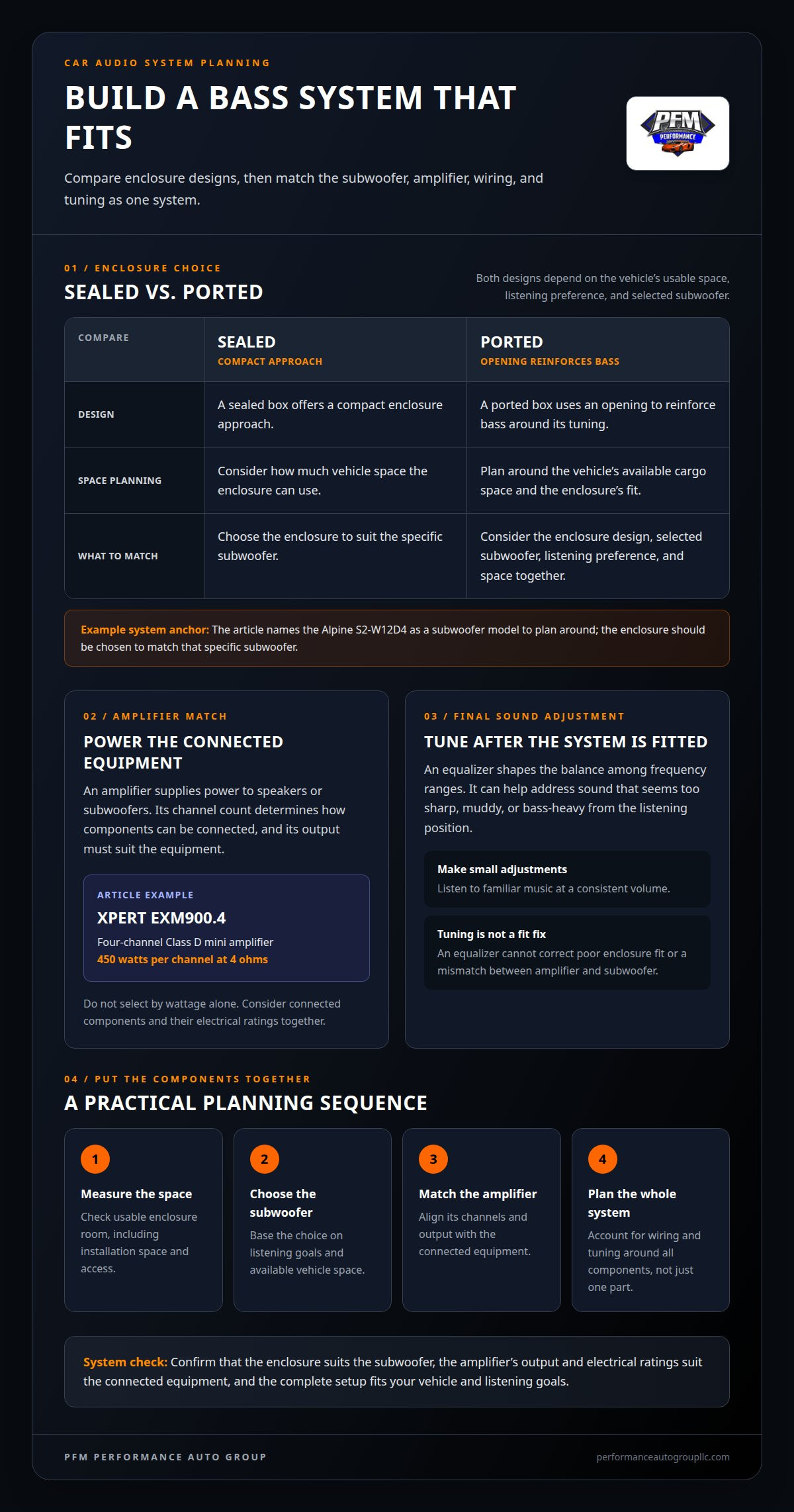
Enclosures are commonly designed as sealed or ported boxes, each with a different sound character. A sealed enclosure offers a compact approach, while a ported design uses an opening to reinforce bass around its tuning. The vehicle’s available space, listening preference, and selected subwoofer all affect the fit. A model such as the Alpine S2-W12D4 can anchor a system plan, but the enclosure should be chosen to match that specific subwoofer.
An amplifier supplies power to speakers or subwoofers, and its channel count determines how components can be connected. The XPERT EXM900.4 is described as a four-channel Class D mini amplifier with 450 watts per channel at 4 ohms. Its listed configuration illustrates why matching amplifier output and speaker requirements matters. Don’t select by wattage alone; consider the connected components and their electrical ratings together.
Equalizers shape the balance among frequency ranges. Use one to address sound that seems too sharp, muddy, or bass-heavy from the listening position. Make small adjustments, then listen to familiar music at a consistent volume. An equalizer can refine the sound, but it can’t correct a poor enclosure fit or a mismatch between amplifier and subwoofer. Treat tuning as the final adjustment after component selection and installation.
A practical planning sequence keeps the system cohesive:
- Measure usable enclosure space, including room for installation and access.
- Choose the subwoofer around listening goals and available vehicle space.
- Match amplifier channels and output to the connected equipment.
- Plan wiring and tuning around the complete system, not one component.
These steps help clarify what a proposed setup is designed to do. If you’re considering a subwoofer and amplifier combination, schedule time to discuss your audio system goals and the components you have in mind.
Keep the enclosure, amplifier, and installation needs in view alongside the subwoofer’s listed price, rather than treating a component as a standalone purchase.
Before settling on a combination, confirm that the enclosure suits the chosen subwoofer and that the amplifier’s output and electrical ratings suit the connected equipment. Assessing the system as a whole helps you see whether the parts support your listening goals and fit your vehicle’s available space.
Car audio services in Tampa and Brandon, Florida
For Tampa and Brandon drivers, compare shops by the audio work they handle, not package labels alone. The shops to consider are those that can plan a stereo, speakers, subwoofer, and amplifier as one installation. Ask what parts and labor the proposed package covers. A clear scope helps you compare options without assuming every package includes identical equipment or work.
Start with your vehicle and your main listening goal. A driver who wants clearer vocals may focus first on speaker replacement. Someone seeking stronger bass may prioritize a subwoofer and enclosure. If you want a broader change, consider how a receiver, speakers, and amplifier work together. These examples turn “better sound” into a practical discussion about components and installation.
Local fit matters, too. A sedan in Tampa may have different enclosure space from an SUV used around Brandon. Bring the year, make, model, and current audio concerns when discussing a system. Note whether you want to preserve cargo space, retain existing controls, or add phone integration. Those details help an installer consider vehicle fit before proposing components.
Which Tampa shops offer car stereo, speaker, subwoofer, and amplifier packages? Compare Tampa-area installers whose audio services cover the components you want, then review each package’s written scope. A shop may offer a single-component installation or a combined system, so check what the quoted work actually includes. A receiver-only plan, for instance, differs from one adding speakers and a subwoofer.
Use the same questions for each option in Tampa or Brandon. Ask which components are included, whether installation labor is listed, and whether wiring or tuning forms part of the plan. Also ask how the installer will evaluate the vehicle’s existing system. These steps make differences between packages easier to understand without relying on names like “premium” or “complete.”
Before choosing, write down the sound you want and the features you use most. A driver who streams music and takes calls may prioritize receiver connectivity. A listener focused on bass may ask about enclosure placement and amplifier matching. Share those priorities with the installer, then review the proposed components and work together. This keeps the decision grounded in your vehicle and routine.
For Tampa and Brandon drivers comparing audio services, the next step is a vehicle-specific plan. Bring your vehicle details, list the components you’re considering, and describe one listening problem you’d like to solve. A focused discussion can clarify whether a stereo, speaker, subwoofer, amplifier, or combined installation best fits your goals. Compare the written scope before committing to the work.
Consider Tampa-area installers that can plan a stereo, speakers, subwoofer, and amplifier together, and confirm the quoted package includes those components and installation labor.
Customer experiences
Customer feedback can reveal how an audio installation feels after daily use. Look for specific details, not praise alone. A useful review might describe clearer vocals during a commute or bass that doesn’t overwhelm conversation. Another may explain whether component choices were discussed before installation. These details help you judge whether the experience matches your priorities. Treat each comment as one person’s account, then look for recurring themes across reviews.
Look for descriptions of the process as well as the result. A customer might mention that the installer explained receiver controls before handing back the vehicle. That detail speaks to communication, not just equipment selection. A review that identifies the vehicle and installed components can also provide useful context. A sedan with a compact enclosure presents different practical concerns from an SUV with more cargo room.
Specific concerns are more useful than general claims. Look for examples involving installation fit, wiring, sound balance, or support after installation. If a review describes rattling after a subwoofer upgrade, note whether it explains how the issue was handled. Don’t assume one comment represents every installation. Instead, look for repeated descriptions and consider whether reviewers discuss work similar to the system you’re planning.
Use customer accounts to prepare focused questions before discussing a system. If several reviews mention choosing between factory controls and a new receiver, for instance, ask how each option affects your vehicle’s setup. If feedback discusses bass adjustment, ask how listening preferences shape final tuning. These questions connect other drivers’ experiences to your needs without treating a review as a guarantee.
- Notice whether a review names the installed equipment and vehicle type.
- Look for details about communication, installation, and the final handoff.
- Compare comments about similar upgrades, such as speakers or subwoofers.
- Use recurring concerns to form questions about your own installation.
Customer experiences can also clarify what matters after installation. A driver who listens to podcasts may value intelligible voices, while someone who plays bass-heavy music may focus on low-frequency balance. These examples show why satisfaction depends on intended use, not simply the number of components installed. Look for feedback that explains the listener’s goals and how the finished system served them.
Finally, separate firsthand detail from broad promotional language. “The receiver connected easily to my phone” gives a clearer example than “best sound ever.” Neither statement proves another vehicle will produce the same result. Use reviews as context, then discuss your vehicle, preferred music, and concerns directly. Customer stories can inform your plan, but a vehicle-specific discussion is essential.
Personalized audio system packages
A useful system starts with your listening priorities, not a preset label. Decide whether you want clearer vocals, stronger bass, or a broader change, then match the components and installation scope to that goal.
Available Package Levels
What car audio upgrade packages are available in Tampa, FL? Options can be planned around a single upgrade, such as new speakers, or a combination of a receiver, speakers, subwoofer, and amplifier. Entry-level, midrange, and premium are useful comparison categories, but the actual components and work define each package. Compare written inclusions, not labels alone.
A focused plan might address one clear need, such as replacing speakers. Another setup could add a receiver or subwoofer, while a broader system could combine several components. These are planning examples, not fixed package specifications. Discuss how each proposed system addresses your goal and what installation work its scope includes.
Vehicle and Stereo Compatibility
Are car-audio upgrades compatible with my vehicle’s make, model, factory stereo, and existing features? Compatibility depends on the vehicle and selected equipment, so share the make, model, and current stereo before choosing components. Identify features you want to retain, such as steering-wheel controls or factory functions. That information helps shape a system around your vehicle rather than assuming every receiver or speaker will fit.
A plan that keeps the factory stereo differs from one that replaces it. List existing features, describe how you use them, and discuss how the proposed components fit those priorities. Speaker placement, available space, and connections between components also influence the design. Review these points together before settling on a system.
Make the comparison specific. Write down your preferred music, the sound you want to change, and any features you rely on during drives. A listener seeking clearer dialogue may prioritize a different combination from someone who wants more bass. This short brief gives the installer practical criteria for planning a system.
Next, compare proposed components by function. A receiver can change controls and audio sources; speakers affect how voices and instruments sound; a subwoofer focuses on low-frequency output. An amplifier can support the system’s power needs. A plan may address one component or combine several, depending on your goal and vehicle layout.
Review the work scope alongside the equipment list. If a package adds a subwoofer, for example, discuss its placement and the related installation work. If it replaces the stereo, identify which factory features the plan aims to retain. Clear comparisons help distinguish a focused upgrade from a broader system.
Finally, rank your priorities before approving a design. Mark each feature as essential, desirable, or unnecessary. A driver who values a simple factory appearance may choose differently from one seeking extensive system changes. A ranked list keeps the discussion focused and prevents unrelated additions from overshadowing the sound improvements you want.
PFM Performance Auto Group: Auto Window Tinting
PFM Performance Auto Group offers auto window tinting as a separate way to personalize your vehicle after planning its sound system. Consider it if you’re also looking to change the cabin’s appearance or privacy. Options include Black Pearl Nano Ceramic Window Tint by Madico, privacy window tinting, and windshield window tinting. The right choice depends on the areas you want tinted and your preferences for the finished look.
Window tinting is separate from audio installation, so consider each project on its own merits. PFM Performance Auto Group also offers commercial and home window tinting for projects beyond your vehicle.
For details, contact PFM Performance Auto Group or visit performanceautogroupllc.com.
Make your next upgrade a considered choice
Let your everyday listening guide the next step. Before choosing car audio upgrade packages in Tampa, decide what you want to improve and how the system should fit your vehicle and routine. A clear priority gives your installation discussion a practical starting point.
PFM Performance Auto Group also offers auto window tinting, commercial window tinting, and home window tinting. If tinting is another project on your list, consider it separately from your audio plans and choose the service that fits the space.
Bring your priorities into the conversation, whether you’re planning an audio system or exploring a tinting project. A thoughtful next step begins with the outcome you want for your vehicle, home, or business.
Your sound system should feel personal, purposeful, and ready for the drives ahead.
Frequently Asked Questions
How much do car audio upgrade packages in Tampa cost?
The cost depends on the components and installation work selected for your vehicle. A receiver-only upgrade differs from a setup with speakers, an amplifier, and a subwoofer enclosure. Vehicle compatibility and installation scope also shape the quote. For a useful comparison, list the components you want and identify any factory features you plan to keep. Request a quote based on your specific project.
How do Tampa car audio shops compare on reviews, warranties, and installation quality?
Compare reviews that describe similar work, then look for specific comments about system performance and installation follow-through. For Hillsborough County drivers, warranty coverage is another useful point: PFM Performance Auto Group offers a warranty on car audio installations, with terms varying by product. Its professional car-audio installations are designed to integrate with the vehicle’s electrical system without straining the battery or alternator. Consider these details alongside the components in your proposed setup.
Which Tampa shops offer car stereo, speaker, subwoofer, and amplifier packages?
Compare Tampa-area installers whose audio services cover the stereo, speakers, subwoofer, and amplifier you want. Review each package’s written scope, since equipment and installation work can vary.
How long does a car audio package installation take in Tampa?
Installation time depends on the vehicle, the number of components, and the work involved. A receiver-only installation differs from a system that adds speakers, an amplifier, and a subwoofer.