
How to Prevent Furniture Fading from Sun: The 2026 Ultimate Guide
Imagine the afternoon you finally notice the damage. You pull back a throw pillow on your designer sofa, only to find a stark, ghostly rectangle where the vibrant fabric has surrendered to a dull, dusty grey. It’s a quiet form of property damage that feels deeply personal; you’ve invested significant time and resources into your home’s aesthetic only to watch the Florida sun bleach it away. To prevent furniture fading from sun, many homeowners resort to keeping heavy curtains drawn all day, which unfortunately turns a beautiful living space into a dark, cave-like environment.
You shouldn’t have to sacrifice your natural light or your stunning views just to protect your investment. We understand the emotional and financial value of your property, and we believe in a more meticulous approach to preservation. This 2026 guide reveals the professional strategies and high-tech solutions needed to stop solar damage at the glass. You’ll learn how to mitigate the three main drivers of fading, which include UV radiation, solar heat, and visible light, while maintaining the interior clarity you love. From advanced nano-ceramic films to strategic interior care, we’ll show you how to preserve your home’s vibrant life for decades to come.
Key Takeaways
- Learn the technical breakdown of the “Fade Factor” to understand how UV rays, solar heat, and visible light collectively degrade your interior investments.
- Discover how professional nano-ceramic film can prevent furniture fading from sun by filtering 99% of harmful radiation while preserving your home’s clarity and views.
- Master strategic interior habits, such as the “Rotation Rule,” to ensure even exposure and longevity for your high-end upholstery and statement pieces.
- Identify the specific vulnerabilities of materials like walnut, cherry, and leather to better guard against the irreversible effects of photo-oxidation and thermal drying.
- Understand why a meticulous, expert assessment of your property’s solar orientation is the foundation of a truly effective, long-term protection strategy.
Understanding the Fade Factor: Why Your Furniture Loses Its Color
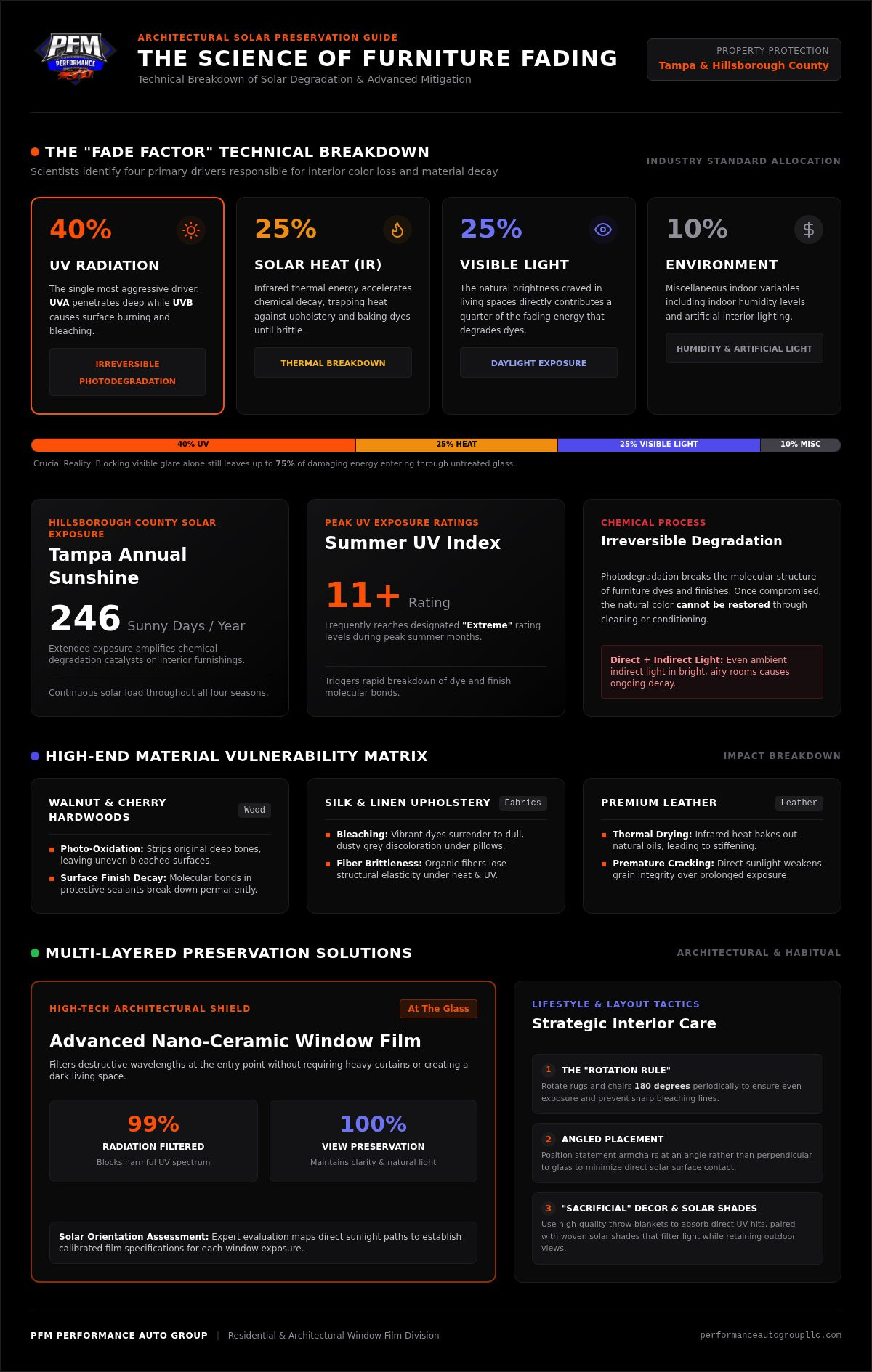
Solar damage is a multi-front war against your interior. It’s a common misconception that simply blocking the glare will save your upholstery. To truly prevent furniture fading from sun, you have to address the “Fade Factor,” a technical breakdown established by industry standards. Scientists attribute 40% of fading to ultraviolet (UV) radiation, 25% to solar heat (Infrared), and 25% to visible light. The remaining 10% comes from miscellaneous environmental variables like indoor humidity and artificial lighting. This means that even if you block the rays you can see, 75% of the damage-causing energy could still be pouring through your glass.
In Hillsborough County, this challenge is amplified. Tampa averages approximately 246 sunny days per year, with summer UV Index levels frequently hitting “Extreme” ratings of 11 or higher. This intense solar energy acts as a catalyst, triggering a chemical reaction that breaks the molecular bonds in fabric dyes and wood finishes. Even indirect light in a bright, airy room contributes to this decay. High-performance architectural window film technologies are designed to filter these specific wavelengths, providing a sophisticated layer of protection that standard glass simply cannot offer.
The Role of Ultraviolet (UV) Radiation
UV radiation is the most aggressive contributor to interior damage. While UVA rays penetrate deep into materials, UVB rays are responsible for surface-level burning and bleaching. These rays act as a relentless bleaching agent on organic materials, stripping the life from silk, linen, and expensive hardwoods. Photodegradation is the chemical process behind sun fading. This process is irreversible, meaning once the molecular structure of your furniture’s finish is compromised, the color cannot be restored through simple cleaning or conditioning.
Infrared Heat and Visible Light: The Hidden Culprits
We often focus on what we can see, but Infrared (IR) heat is a silent destroyer. It accounts for a full quarter of the fading process by accelerating the chemical breakdown of fabrics and finishes. Untreated windows often act like an oven, trapping heat against your upholstery and baking the dyes until they become brittle and pale. There is a cruel irony in the “natural light” we crave in our homes; the very brightness that makes a room feel open and inviting is the same energy that systematically devalues your assets. Rejecting the thermal energy that fuels degradation is essential to prevent furniture fading from sun over the long term.
Strategic Interior Adjustments: Moving Beyond Just Closing the Blinds
Protecting your home’s interior doesn’t always require an immediate overhaul. While professional-grade barriers are the most effective solution, adopting specific lifestyle habits can offer an immediate, albeit manual, first line of defense. The goal is to manage the energy entering your space without living in a dark, shuttered environment. By understanding how light moves through your specific floor plan, you can implement a strategy that respects both your aesthetic and your investment.
Furniture Placement and Room Layout
Every room has “hot zones” where direct sunbeams track across the floor and walls at specific times of the day. To identify these, spend a Saturday observing the light’s path. Once you’ve mapped the exposure, consider the “Rotation Rule.” Periodically rearranging your layout or simply rotating rugs and chairs 180 degrees ensures that exposure is evened out, preventing the stark, uneven bleach marks that occur when a piece sits stationary for years. Angled placement is another sophisticated tactic; by positioning a leather armchair at an angle rather than perpendicular to a window, you reduce the surface area receiving direct solar impact. We also recommend using “sacrificial” decor. High-quality throw pillows and blankets can act as a stylish shield, taking the brunt of the UV hit and protecting the more expensive upholstery underneath.
Window Treatments and Solar Shades
Not all window coverings are created equal. While blackout curtains are effective, they force you to choose between protection and your view. High-quality solar shades offer a middle ground, using a weave that filters light while maintaining visibility. However, traditional blinds have significant limitations. The gaps between slats, even when closed, allow narrow strips of high-intensity light to penetrate, which can lead to “tiger striping” on wood floors. The Library of Congress preservation guidelines on light damage emphasize that photochemical degradation is cumulative. Every hour of unfiltered exposure adds to the structural breakdown of organic fibers. To manage this, many discerning homeowners are turning to motorized treatments that automate closure during peak UV hours, ensuring the home is guarded even when they aren’t there to pull the cord.
Beyond the windows, area rugs play a vital role in your defense strategy. They serve as a protective layer for expensive hardwood or laminate flooring, which is often the most difficult and costly material to repair once sun-damaged. Even indoor plants can serve as a natural light buffer, though their role is limited. A large, sun-loving palm can break up direct beams, but remember that the plant itself might eventually suffer from the same intense Florida heat that threatens your furniture. Implementing these adjustments is a dedicated way to prevent furniture fading from sun on a daily basis. If you find the constant management of curtains and furniture rotation to be a burden, you may want to request a professional assessment to see how a permanent film solution can simplify your home maintenance.
The Superior Shield: Why Ceramic Window Tinting Outperforms Standard Films
While curtains and layout changes offer a degree of protection, they don’t address the root cause of solar damage at the entry point. The technology behind window films has undergone a radical transformation. Gone are the days of dark, metallic, or bubbly dyed films that obscured your view and eventually turned purple. Modern solutions utilize advanced nano-ceramic technology to provide a virtually invisible barrier that is specifically engineered to prevent furniture fading from sun without altering the aesthetic of your home.
We utilize Black Pearl Nano Ceramic by Madico, a film that represents the gold standard in property care. This material is designed to filter out 99% of harmful ultraviolet radiation and reject up to 87% of infrared heat. This “Heat Rejection” advantage is vital for preserving delicate fibers and wood finishes that are sensitive to thermal degradation. By stopping the energy at the glass, you create a stable interior environment that protects your investments 24/7, even when the Florida sun is at its most aggressive.
Nano Ceramic Technology Explained
The secret lies in microscopic ceramic particles embedded within the film. These particles are spectrally selective, meaning they allow visible light to pass through while blocking the invisible wavelengths responsible for heat and damage. Unlike older metallic films, ceramic technology relies on advanced solar control that doesn’t create a mirrored look. It’s also 100% metal-free. This ensures that your home’s Wi-Fi, 5G, and cellular signals remain completely unobstructed, providing security and connectivity alongside aesthetic refinement.
Professional vs. DIY Installation
The market is flooded with DIY kits, but applying these to residential windows carries significant risks. Most modern homes feature double-pane or insulated glass units (IGUs). If an incorrect film is applied, it can trap too much heat between the panes, leading to “thermal shock” and catastrophic glass breakage. Our meticulous approach as master craftsmen ensures that the film’s absorption rate is perfectly matched to your specific glass type. Achieving a factory finish requires edge-to-edge precision that only professional tools and experience can provide. For a deeper look at how these solutions enhance your living space, see our House Window Tinting Near Me: The 2026 Guide to Tampa Home Comfort. Professional installation isn’t just about the look; it’s about protecting your window warranties and ensuring long-term durability.
Material-Specific Protection: Caring for Wood, Leather, and Upholstery
Not every asset in your home reacts to solar energy in the same way. To truly prevent furniture fading from sun, you must understand the specific chemical vulnerabilities of the materials you’ve brought into your living space. A meticulous approach to preservation requires more than a one-size-fits-all solution; it demands a deep understanding of how organic fibers, hides, and wood species interact with the “Fade Factor” we’ve established. By identifying these unique risks, you can better guard the long-term value of your interior.
Preserving Hardwood Floors and Fine Woodwork
Wood is essentially a living material that remains reactive even after it’s been harvested and finished. UV radiation systematically changes the molecular structure of lignin, the natural polymer that acts as the “glue” holding wood fibers together. When lignin breaks down, the visual result varies by species. Light woods, such as maple or pine, often undergo “ambering,” where they develop a yellow or orange tint. Conversely, darker, high-end species like cherry and walnut are most susceptible to severe bleaching, losing their deep, rich tones in a matter of months. While applying UV-inhibiting topcoats can provide a temporary surface defense, these finishes often fail when exposed to the intense Florida heat without a primary barrier at the glass.
Protecting Leather and High-End Fabrics
Leather requires a different defensive strategy because it’s highly sensitive to Infrared (IR) heat. Heat is the silent killer of leather suppleness; it accelerates the evaporation of the natural oils and moisture that keep the hide flexible. Once these oils are gone, the leather becomes brittle, leading to surface cracking and irreversible color loss. High-end fabrics face similar threats. Natural fibers like silk and linen are famously fragile and can actually disintegrate under prolonged UV exposure. While modern “sun-fast” performance fabrics use solution-dyed acrylics to resist fading, they aren’t immune to the structural weakening caused by solar energy.
Sun damage also significantly exacerbates a phenomenon known as “crocking.” Crocking refers to the transfer of dye from a material’s surface to another through friction, a phenomenon that becomes far more prevalent once solar energy has destabilized the original chemical bonds of the fabric or hide. As a master craftsman, I recommend supplementing your solar barriers with high-quality, pH-balanced conditioners for leather and wood. However, you should avoid heavy waxes in areas of high exposure, as these can actually “cook” the surface when trapped behind high-intensity IR heat.
Professional Residential Tinting in Tampa: Protecting Your Investment with PFM
Living in Hillsborough County offers a lifestyle defined by light, yet the very sunshine we celebrate presents a unique challenge for our homes. Tampa averages approximately 246 sunny days every year. During the long summer months, the UV Index regularly climbs to extreme levels of 11 or higher. This relentless solar intensity means your interior is under constant siege. We don’t view window film as a mere commodity; we see it as an essential form of care for the property you’ve worked so hard to curate. To truly prevent furniture fading from sun, you need a partner who understands the local climate and the technical nuances of solar protection.
Our approach at PFM Performance Auto Group is rooted in a tradition of premium reassurance. We recognize that your home is likely your most significant financial and emotional investment. A one-time professional installation of Black Pearl Nano Ceramic film is a sophisticated strategy that pays for itself through enhanced furniture longevity and reduced HVAC load. By rejecting up to 87% of infrared heat, you aren’t just protecting your fabrics; you’re creating a more comfortable, energy-efficient sanctuary. It’s a methodical transition from worrying about damage to enjoying the long-term guardianship of your interior aesthetic.
The PFM Performance Auto Group Consultation Process
We move beyond the immediate, urgent need for protection to provide a logical, long-term solution tailored to your specific floor plan. Every home has a unique solar orientation. Our experts conduct a meticulous assessment of how light interacts with your glass throughout the day, identifying the specific “hot zones” that threaten your most prized possessions. This process is designed for the discerning homeowner who demands clarity and aesthetic refinement. We ensure the film we select matches your glass type perfectly, avoiding the risks of thermal stress while maintaining the natural views you love. You can book your professional home window tinting consultation today to begin this collaborative process.
Earning Your Business Through Craftsmanship
PFM Performance Auto Group has been a staple of the Hillsborough County community since 2004. With over 20 years of experience, we’ve evolved through hard work and a perfectionist streak that defines every project we undertake. We don’t just aim for “good enough.” We strive to surprise our clients with a level of detail and precision that exceeds expectations. As your trusted advisor, we take pride in our history of protecting the community’s investments with a master craftsman’s touch. Our commitment is to treat your property as if it were our own, earning your trust through every meticulous edge-to-edge installation. When you’re ready to secure the vibrant life of your home, schedule your expert residential tinting appointment with our dedicated team.
Preserving the Vibrant Life of Your Home
Your furniture and flooring represent more than just decor; they’re an investment in your lifestyle and comfort. While rotating your layout and using solar shades offer a first line of defense, the Florida sun requires a more meticulous solution to prevent furniture fading from sun. True protection demands a barrier that addresses the technical reality of the “Fade Factor” without turning your living space into a dark enclosure.
With over 20 years of craftsmanship in Tampa, we’ve seen how Black Pearl Nano Ceramic technology transforms home preservation. By providing a 99% UV protection guarantee, this high-performance film ensures that your silk upholstery, rich walnut finishes, and supple leathers remain as vibrant as the day you bought them. You deserve the peace of mind that comes from a master craftsman’s touch and the security of elite level durability.
It’s time to stop living with the curtains drawn and start enjoying your views with complete confidence. We look forward to earning your business and helping you protect the property you love.
Frequently Asked Questions
Does window tint really stop furniture from fading?
Window tinting drastically slows the fading process by addressing the primary causes of solar damage. While no solution can stop fading entirely due to interior artificial light and humidity, professional film blocks 99% of UV rays and a significant portion of solar heat. This intervention preserves the molecular integrity of your fabrics and wood finishes. It effectively extends the vibrant life of your interior investments for years beyond what untreated glass allows.
Will residential window film make my house too dark?
Modern nano-ceramic technology allows you to protect your home without sacrificing natural brightness. Unlike older, dark films, our Black Pearl Nano Ceramic series is spectrally selective. This means it filters out invisible infrared heat and ultraviolet radiation while allowing high levels of visible light to pass through. You’ll maintain the airy, open feel of your living spaces while enjoying a more comfortable, temperature-controlled environment that feels natural and clear.
How long does professional home window tinting last?
Professional residential window film is designed for long-term durability and typically lasts for decades. When meticulously installed by a master craftsman, high-performance films like those from Madico resist bubbling, peeling, and discoloration. We’ve served the Hillsborough County community for over 20 years, and we’ve seen how quality materials stand the test of time. Your investment is protected by both the advanced chemistry of the film and our expert, precision-focused installation process.
Can I still have a view of the outdoors with UV protection film?
Yes, you can enjoy perfectly clear views while ensuring your windows prevent furniture fading from sun. High-quality ceramic films actually enhance your view by reducing the intense glare that often obscures outdoor details during the bright Florida afternoons. Because these films don’t rely on heavy dyes or metals, they remain virtually invisible on the glass. You won’t feel like you’re looking through a tinted lens; instead, you’ll see the landscape with improved clarity.
Is ceramic window tint worth the extra cost for a home?
Ceramic window tint is a superior investment for homeowners who prioritize both performance and aesthetic refinement. While the initial cost is higher than standard dyed films, ceramic technology offers significantly better heat rejection and 99% UV protection without interfering with Wi-Fi or cellular signals. It’s a more durable solution that won’t turn purple or bubble over time. For discerning property owners, the long-term savings in energy costs and furniture replacement far outweigh the upfront premium.
What happens if I apply the wrong film to my double-pane windows?
Applying an incompatible film to double-pane or insulated glass units can lead to catastrophic glass breakage. Incorrect films can trap excessive heat between the panes, causing thermal expansion stress that exceeds the glass’s structural limits. This is why a professional assessment is vital. We meticulously match the film’s absorption and reflection rates to your specific glass type to ensure your window warranties remain intact and your home stays safe from structural failure.
Do I need to tint all windows or just the ones facing the sun?
While southern and western-facing windows are the primary hot zones, we often recommend treating all windows to ensure comprehensive protection. Ultraviolet radiation is persistent and can damage interiors through indirect or reflected light. Tinting the entire home also provides a consistent aesthetic and uniform energy efficiency. During our consultation, we’ll evaluate your home’s specific solar orientation to help you decide which areas require the most urgent attention to effectively prevent furniture fading from sun.
How do I clean windows that have been professionally tinted?
Cleaning tinted windows is a straightforward process, but it requires a gentle approach to preserve the film’s protective coating. You should always use a soft, non-abrasive cloth or microfiber towel along with an ammonia-free cleaning solution. Ammonia can eventually degrade the adhesives and surface of the film, leading to a loss of clarity. By using simple, mild soap and water or a dedicated tint-safe cleaner, you’ll maintain the meticulous finish and longevity of your professional installation.