Window Tint and Night Driving Visibility: A 2026 Safety Guide & Percentage Chart
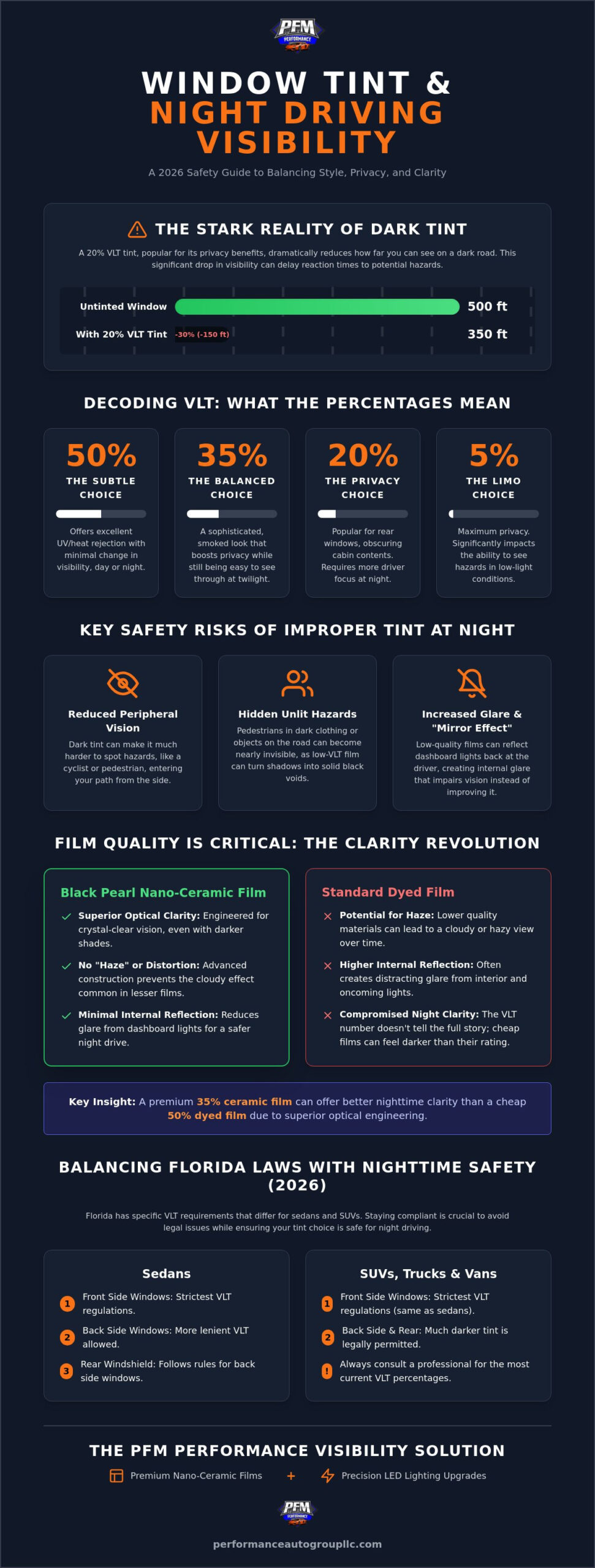
Did you know that windows tinted at a 20% VLT can slash your nighttime sight distance from 500 feet to just 350 feet? When the sun dips below the Florida horizon, the delicate balance between daytime privacy and window tint and night driving visibility becomes a critical safety calculation. You want that sleek, protected look for your vehicle; however, you shouldn’t have to squint through your side windows just to navigate a dark intersection safely.
We understand the anxiety of choosing a shade that feels perfect at noon but turns treacherous at midnight. It’s a common fear among discerning drivers who value both aesthetics and security. This 2026 safety guide is designed to eliminate that confusion by breaking down Florida’s specific VLT requirements and the science of optical performance. You’ll discover how premium nano-ceramic films offer elite heat rejection without the dangerous darkness of traditional dyed tints, giving you the confidence to choose a level that protects your investment and your life.
Key Takeaways
- Decode the meaning of Visible Light Transmission (VLT) to understand exactly how much light enters your cabin during both day and night.
- Learn how to balance window tint and night driving visibility so you can protect your privacy without compromising your ability to spot hazards.
- Compare the superior optical clarity of Black Pearl Nano Ceramic film against standard dyed alternatives that often cloud your peripheral vision.
- Stay compliant with the latest 2026 Florida tint laws for sedans and SUVs to avoid legal complications while maintaining a premium aesthetic.
- Discover how pairing high-quality window film with precision LED lighting upgrades creates a comprehensive visibility solution for safer travel.
Navigating the Tint Percentage Chart: What VLT Means for Your Drive
Understanding the numbers on a tint chart is the first step toward a safer, more comfortable driving experience. Visible Light Transmission represents the percentage of light that passes through the window film into the vehicle interior. It is an inverse relationship that many drivers find confusing at first. Lower percentages indicate darker windows because less light is allowed to enter the cabin. When you look at a professional tint percentage chart, you are seeing a visual roadmap that transitions from the nearly transparent 70% films down to the deep, opaque 5% shades. This choice directly impacts window tint and night driving visibility, making it essential to choose with precision rather than just aesthetics.
Breaking Down Common VLT Levels
- 50% Tint: This is the subtle choice. It offers excellent UV protection and heat rejection with almost no discernible change in visibility. It is perfect for those who want the benefits of window film technology without the dark look.
- 35% Tint: Often called the balanced choice, this level provides a sophisticated, smoked appearance. It offers a significant boost in privacy while remaining relatively easy to see through during twilight hours.
- 20% Tint: This is the privacy choice. It is a popular standard for rear windows, creating a dark aesthetic that obscures the cabin contents from outside view. However, it requires more focus from the driver during nighttime maneuvers.
- 5% Tint: Known as the limo choice, this allows maximum privacy. While it looks sleek, it has a significant impact on your ability to see hazards in low-light conditions.
Why VLT Percentages Aren’t the Whole Story
A number on a box does not always tell the full tale of how your eyes will react on a dark road. The quality of the film construction plays a massive role in nighttime clarity. For instance, a premium 35% ceramic film can often feel clearer than a cheap 50% dyed film because it lacks the “haze” or internal reflection common in lower-tier products. High-quality materials, like the Black Pearl Nano Ceramic Window Tint by Madico, are engineered for superior optical performance. These advanced films maintain high structural integrity and clarity even as the VLT percentage drops.
Your biology also matters. The human eye naturally attempts to adjust to lower light levels, but a film with high internal reflection can create a “mirror effect” against your dashboard lights. This glare is a critical factor for window tint and night driving visibility. When you invest in professional-grade installation at PFM Performance Auto Group, you are choosing films designed to minimize these optical distortions. We believe in earning your trust through meticulous craftsmanship, ensuring that your chosen percentage provides the protection you need without sacrificing the safety you deserve.
How Window Tint Impacts Night Driving Visibility and Safety
The relationship between window tint and night driving visibility is a delicate balance of physics and biology. While a dark aesthetic is often the primary goal for many vehicle owners, the physical reality of light reduction cannot be ignored. When you drop below a certain VLT, your peripheral vision is typically the first to suffer. Detecting hazards like a cyclist on a dark shoulder or a pedestrian in a crosswalk becomes significantly more difficult because the film filters out the very light your eyes need to perceive movement. This is especially true for unlit objects. According to research on tint and traffic safety, reduced light transmission directly correlates with slower reaction times in low-contrast environments. This “Contrast Factor” is why some films make shadows appear as solid black voids, hiding potential dangers until they are dangerously close to your bumper.
- Peripheral Vision: Darker films can obscure your ability to see objects entering your path from the side.
- Unlit Hazards: Pedestrians in dark clothing or cyclists without reflectors become nearly invisible behind low-VLT glass at night.
- Blind Spots: Excessive darkness on front side windows makes checking mirrors a chore, often forcing drivers to roll down their windows in the rain just to see.
The Contrast and Glare Connection
Interestingly, high-quality window film can actually improve your nighttime experience by managing excessive glare. We have all been blinded by the high-intensity headlights of a trailing truck in our rearview mirror. A precision-installed tint acts as a filter, cutting that harsh glare and reducing eye fatigue during long commutes across the Skyway Bridge. This creates what we call “High-Definition” vision. By neutralizing the spikes of light from other vehicles, your eyes don’t have to work as hard to adjust. This reduction in strain allows for a more relaxed and focused drive, provided the film quality is high enough to maintain clarity without adding haze.
Weather and Environment Variables
The environment where you drive dictates your safety requirements. A 20% tint might feel manageable on the well-lit avenues of downtown Tampa, but the situation changes completely on the unlit rural roads of Hillsborough County. Add a classic Florida torrential downpour at 10 PM, and your visibility profile drops even further. This is why we strictly advise higher VLT percentages for windshields. Maintaining maximum clarity through the glass you look through most is non-negotiable. If you’re feeling uncertain about which level provides the best protection for your lifestyle, you can consult with our master installers to find your perfect balance. We believe in providing solutions that respect both your privacy and your safety on the road.
Nano Ceramic vs. Dyed Film: The Clarity Revolution
Many drivers mistakenly believe that achieving high heat rejection requires the darkest possible shade. This misconception often leads to choices that compromise window tint and night driving visibility. Traditional dyed films rely on heavy layers of pigment to absorb solar energy. Over time, these pigments degrade under the intense Florida sun, leading to a subtle clouding or “milky” distortion. When you’re driving at night, this degradation scatters incoming light from streetlamps and headlights, creating a hazy veil that obscures fine details on the road. It’s a frustrating experience that can make a familiar commute feel uncertain.
Nano Ceramic technology represents a fundamental shift in how we protect your vehicle. Instead of using unstable dyes, these films utilize microscopic ceramic particles that are non-reactive and incredibly durable. These particles are engineered to be small enough to allow visible light photons to pass through without interference, while effectively reflecting infrared heat and UV rays. When you choose a premium product like Black Pearl Nano Ceramic by Madico, you’re investing in a film that maintains its structural integrity for years. It eliminates the visual noise common in cheaper alternatives, ensuring your view remains crisp and high-contrast even in low-light environments. For a deeper understanding of how these advanced materials also shield your skin and interior from harmful solar radiation, our comprehensive guide on car window tint UV protection for Florida drivers explains the full science behind nano-ceramic film performance.
The Black Pearl Nano Ceramic Advantage
The primary benefit of this advanced material is its ability to provide elite heat rejection without needing an illegally dark VLT. You can stay within the boundaries of Florida’s official window tint laws while enjoying a cabin that stays significantly cooler. Because these films are made from non-conductive materials, they won’t interfere with your vehicle’s modern safety features, such as GPS signals or night-vision assistance systems. Black Pearl Nano Ceramic provides a ‘factory-glass’ feel with added protection. It’s the ultimate choice for the discerning owner who refuses to trade safety for style.
Why Quality Installation Matters for Clarity
Even the most advanced film can become a liability if it isn’t applied with precision. Poor installation often results in microscopic bubbles, creases, or “fingers” at the edges of the glass. During the day, these might just look like an eyesore; at night, they become dangerous points of light refraction. Every bubble acts as a tiny lens that catches and bends light from oncoming traffic, creating distracting starbursts and glare. This is a critical factor when considering window tint and night driving visibility.
At PFM Performance Auto Group, we take a “Master Craftsman” approach to every project. We understand that our reputation is earned through the meticulous details of a flawless finish. We don’t just stick film to glass; we curate a protective layer that enhances your driving experience. To ensure your vehicle receives this level of care, you can read our full guide on professional car window tinting in Tampa. We treat your property as our own, ensuring your view of the road remains unobstructed and clear, no matter the hour.
Balancing Florida Laws with Nighttime Safety Requirements
Living in the Sunshine State necessitates a higher level of solar protection, but this requirement must be balanced against the legal standards designed to keep our roads safe. Florida’s specific regulations are not arbitrary; they are established to ensure that every driver maintains a sufficient field of vision during the most dangerous hours of the day. When you push beyond these legal boundaries, you aren’t just risking a citation from local law enforcement. You are fundamentally altering the relationship between window tint and night driving visibility, often creating blind spots that can lead to catastrophic errors in judgment on unlit Hillsborough County roads.
Florida Tint Law Breakdown for 2026
To remain compliant and safe, it is vital to adhere to the current 2026 VLT standards. These regulations vary depending on the window’s location and the type of vehicle you drive:
- Front Side Windows: Must allow more than 28% of light transmission. This level is specifically chosen to ensure you can still see pedestrians and side-view mirrors in low-light conditions.
- Back Side and Rear Windows: For sedans, these must allow more than 15% of light. SUVs and vans have more leeway, with a minimum requirement of more than 6% VLT.
- Windshield: Tint is strictly prohibited below the manufacturer’s AS-1 line, unless you possess a valid medical waiver.
The risks of ignoring these limits extend far beyond a “fix-it” ticket. In the event of a nighttime collision, having an illegal tint can shift the burden of liability. Insurance companies and legal teams often use non-compliant window film as evidence of negligence, arguing that the driver knowingly compromised their vision. This makes the choice of film a significant factor in your long-term legal and financial security.
The ‘Master Craftsman’ Recommendation
At PFM Performance Auto Group, we operate as your trusted advisor to find a solution that satisfies your need for privacy without violating the law. We often recommend a “staggered” film application. By using a 35% film on the front side windows and a 15% to 20% film on the rear, we create a cohesive, high-end look that prioritizes your safety. This approach ensures that your window tint and night driving visibility remains within a safe margin while still providing the heat rejection you need. You can consult with a trusted advisor at PFM Performance Auto Group to find the ideal balance for your vehicle. If you are ready to invest in a precision-installed, legal solution, you can book your consultation here.
Optimizing Your Visibility: The PFM Performance Solution
Achieving the perfect balance of window tint and night driving visibility requires looking beyond the glass itself. While choosing the correct VLT and film quality is essential, tinting is only half the equation for total nighttime safety. If your film reduces the ambient light entering the cabin, the most effective way to restore your confidence is to increase the volume and quality of light illuminating the road ahead. At PFM Performance, we view your vehicle as a complete ecosystem where protection and performance must work in harmony. We don’t just apply film; we engineer a comprehensive visibility solution tailored to the unique challenges of Florida driving.
Our approach combines the meticulous installation of premium Black Pearl Nano Ceramic films with precision electronic upgrades. By addressing both how you see out and how your vehicle lights the way, we eliminate the compromises often associated with darker window shades. This dual focus ensures that your car remains a sanctuary of privacy during the day and a beacon of safety after the sun sets over Tampa Bay.
LED and HID Lighting Upgrades
The most effective way to offset the light reduction of window tint is to replace dim, yellowed factory halogen bulbs with high-output LED or HID lighting. Modern LED bulbs provide a crisp, white light that mimics natural daylight, significantly improving your ability to see through even the most sophisticated ceramic films. This increased luminosity helps you detect road markings, signs, and potential hazards much sooner than standard lighting allows. If you are looking to enhance your vehicle’s nocturnal capabilities, you can explore our car audio and electronics services for professional lighting upgrades. Visibility is a two-way street; better headlights ensure you see the road while helping other drivers see you.
The Final Checklist for Nighttime Safety
Maintaining peak visibility is an ongoing commitment that extends beyond the initial installation. We recommend a simple but effective routine to keep your view unobstructed. First, keep your windows meticulously clean inside and out. Even a thin layer of dust or interior “off-gassing” film can catch the light from oncoming traffic, creating dangerous, glare-inducing streaks. Second, we encourage every client to test their visibility in a familiar, controlled environment immediately after a new tint installation. This allows your eyes to adjust to the new contrast levels before you tackle a long nighttime commute.
Trusting your vehicle to a local shop with over 20 years of experience in Hillsborough County means you are choosing a partner invested in your long-term safety. We take pride in our history of serving this community with a “Master Craftsman” mindset. We aren’t just here for a single transaction; we are here to earn your business through every detail of our work. Whether we are installing a precision-cut windshield tint or upgrading your entire lighting array, our goal is a safer, more stylish driving experience that exceeds your highest expectations.
Mastering Your View: Safety and Style for the Florida Road
Choosing the right film is about more than just a dark aesthetic; it’s a commitment to your safety behind the wheel. We have explored how understanding VLT percentages and choosing premium materials like Black Pearl Nano Ceramic can drastically improve window tint and night driving visibility. By balancing Florida’s legal requirements with high-performance lighting upgrades, you can enjoy a cabin that’s both private and perfectly clear in low-light conditions. It’s a total system designed for the discerning driver who refuses to compromise on quality.
At PFM Performance, we have been serving the Tampa community since 2004 with a focus on meticulous craftsmanship and premium reassurance. We understand that your vehicle is a significant investment. We take our role as your trusted advisor seriously. Don’t settle for a “good enough” installation that compromises your vision when the sun goes down. As specialists in Black Pearl Nano Ceramic technology, our master craftsmen are ready to provide the precision your property deserves.
We look forward to helping you achieve the elite look you want with the uncompromising safety you deserve. Drive with confidence, knowing your view is protected by professionals who care about your property as much as you do.
Frequently Asked Questions
Does 20% tint make it hard to drive at night?
A 20% VLT tint significantly reduces the light entering your cabin, which can make nighttime navigation challenging. Because it allows only 20% of visible light through, your ability to spot pedestrians or unlit obstacles is often compromised. It’s darker than the Florida legal limit of 28% for front side windows. We typically recommend a higher VLT for the front to ensure you don’t struggle with blind spots when turning or merging.
Is it legal to tint my windshield in Florida?
In Florida, you cannot legally tint the entire windshield unless you have a documented medical necessity. State law permits non-reflective tint only above the manufacturer’s AS-1 line, which usually covers the top 5 to 6 inches of the glass. While some shops might offer full windshield tinting, it remains a safety risk and a legal liability that can lead to significant citations during a routine traffic stop.
It is also important to ensure your glass is structurally sound before any modifications. If your windshield has chips or cracks that could hinder your view, Pinnacle Auto Glass provides expert repair and replacement services across Florida to help you maintain peak visibility.
Can I see my side mirrors through a 15% tint at night?
Seeing your side mirrors through a 15% tint at night is difficult, particularly in rural areas or during a heavy Florida downpour. This level of darkness is designed for rear-seat privacy rather than front-window clarity. Many drivers with 15% front tints find themselves rolling down their windows just to back into a driveway or change lanes safely. We advise staying at or above 28% for the front to maintain essential mirror visibility.
What is the best tint percentage for night driving safety?
The safest range for window tint and night driving visibility on front side windows is between 35% and 50% VLT. These percentages provide excellent UV protection and glare reduction while still allowing enough light for your eyes to detect movement in the shadows. Pairing this with a high-quality nano-ceramic film ensures that your view remains sharp and high-contrast, even when street lighting is sparse or non-existent.
Does ceramic tint provide better night visibility than carbon tint?
Nano-ceramic films offer a distinct advantage in clarity over carbon or dyed alternatives. Because ceramic particles are microscopic and non-reactive, they don’t create the internal haze or graininess that can plague cheaper films. This structural precision means you get a high-definition view of the road. It is the difference between looking through a clean lens and one with a slight film of dust, especially under bright headlights.
For those interested in high-performance ceramic applications, you can explore Window Tinting at D3 Auto Care LLC to see how they achieve superior optical clarity.
Will window tint reduce the glare from headlights behind me?
Yes, one of the primary benefits of professional window tint is its ability to neutralize headlight glare from trailing vehicles. By filtering out the intense spikes of light, the film prevents your pupils from constantly constricting and dilating. This creates a much more comfortable driving environment. It reduces the eye strain and night blindness that often occur after being flashed by high-intensity discharge or LED headlights.
What happens if I get a ticket for tint that is too dark in Tampa?
If you are cited for illegal tint in Tampa or Hillsborough County, you will generally face a non-moving traffic violation. This usually results in a fine and a requirement to bring the vehicle into compliance. You’ll need to have the illegal film removed by a professional and may have to show the corrected windows to a law enforcement officer or the court. It is a costly process that is easily avoided by following legal standards. To understand how the right film choice also safeguards your health and interior from solar damage, our guide on car window tint UV protection for Florida drivers outlines how staying compliant and choosing premium materials go hand in hand.